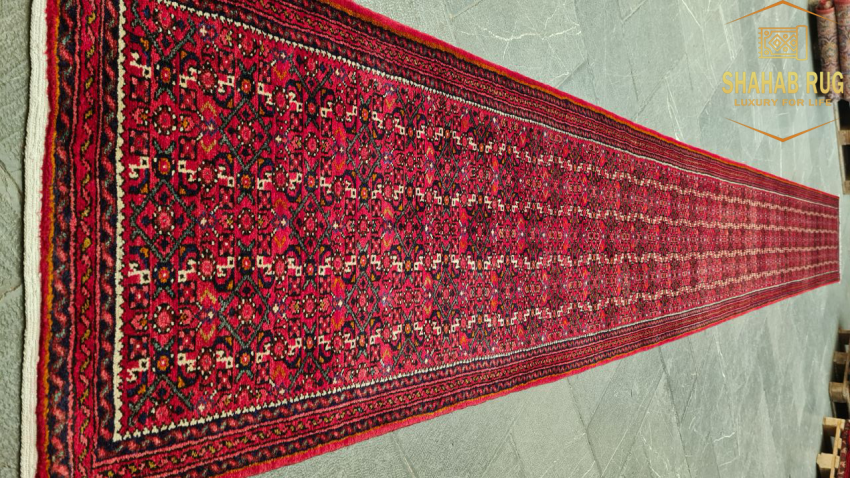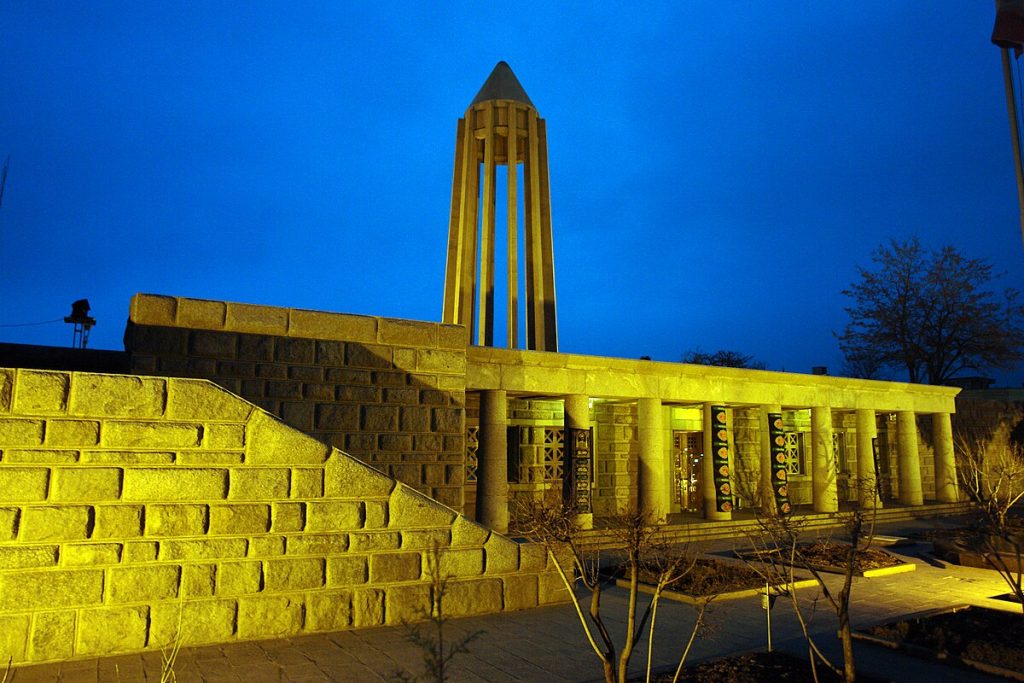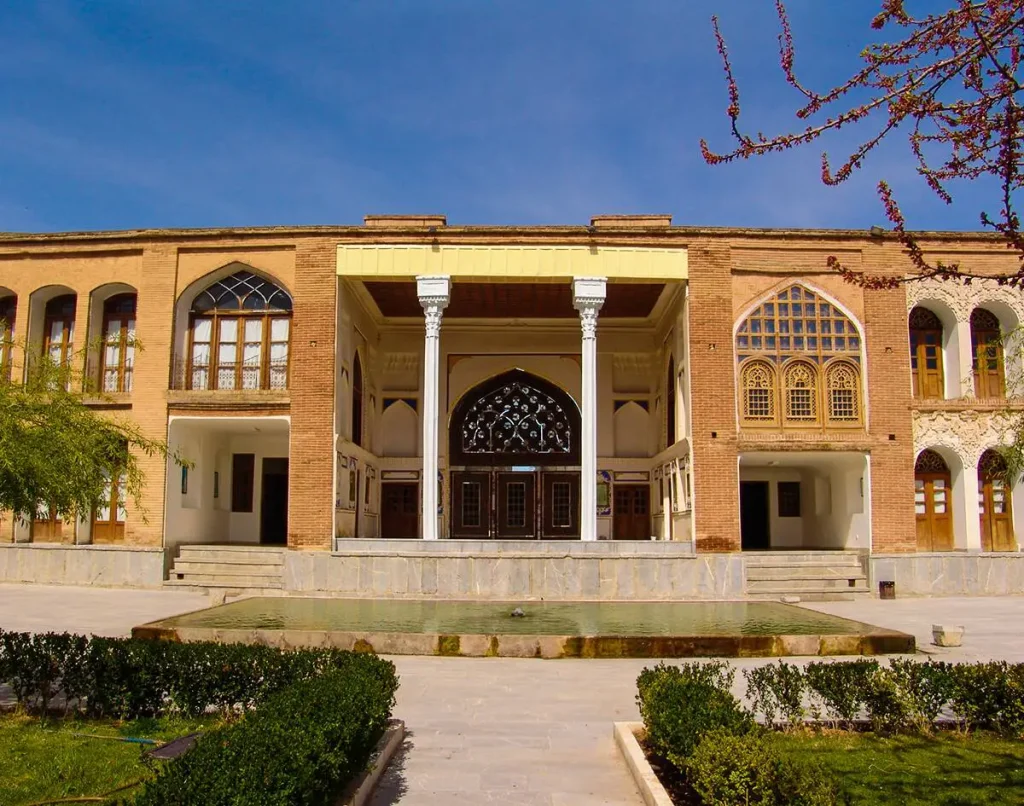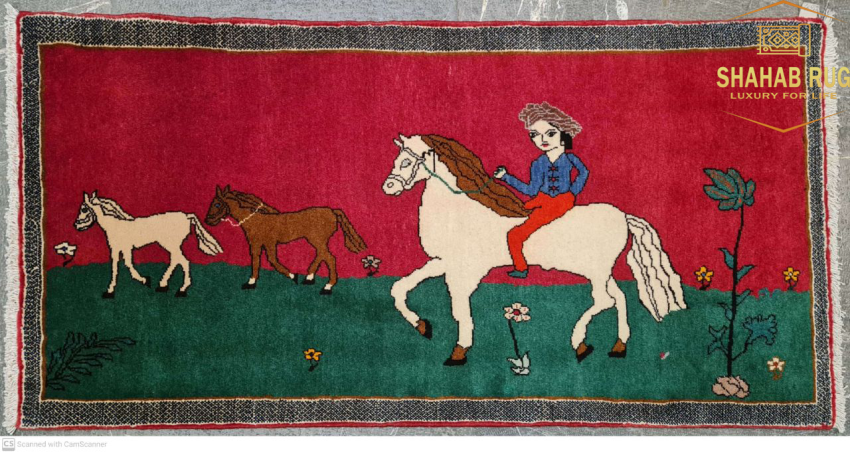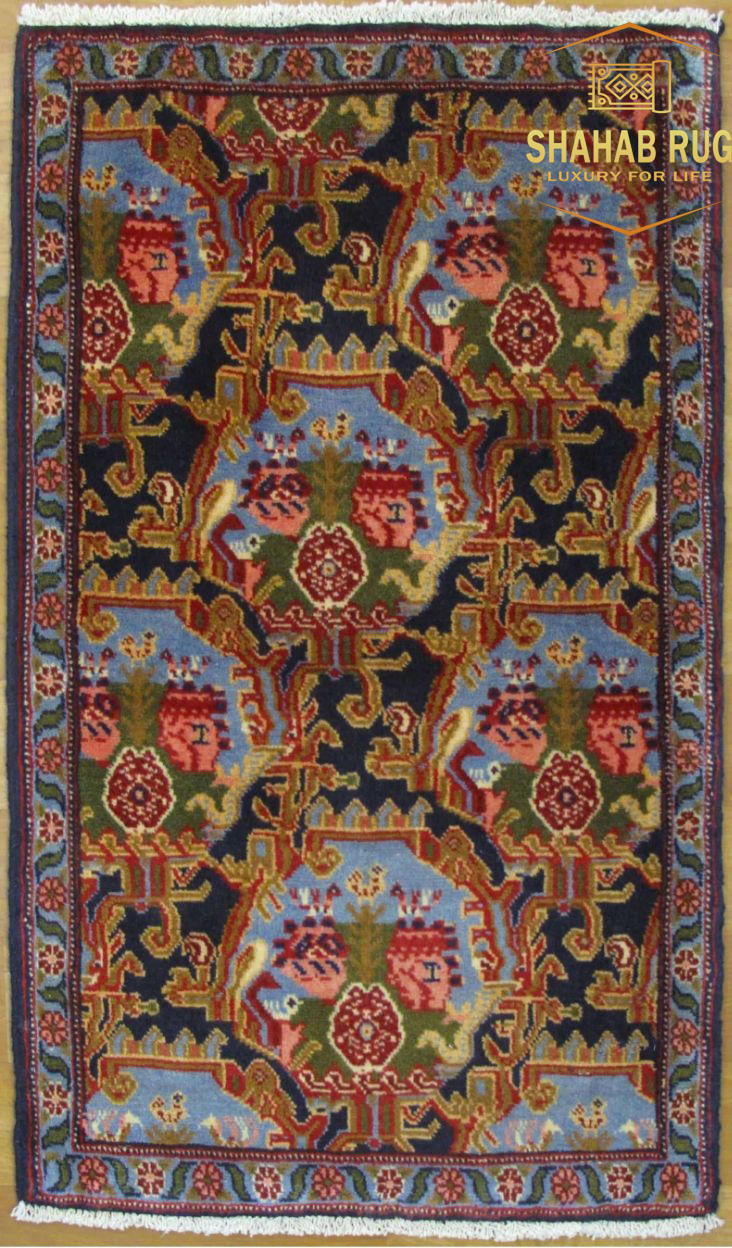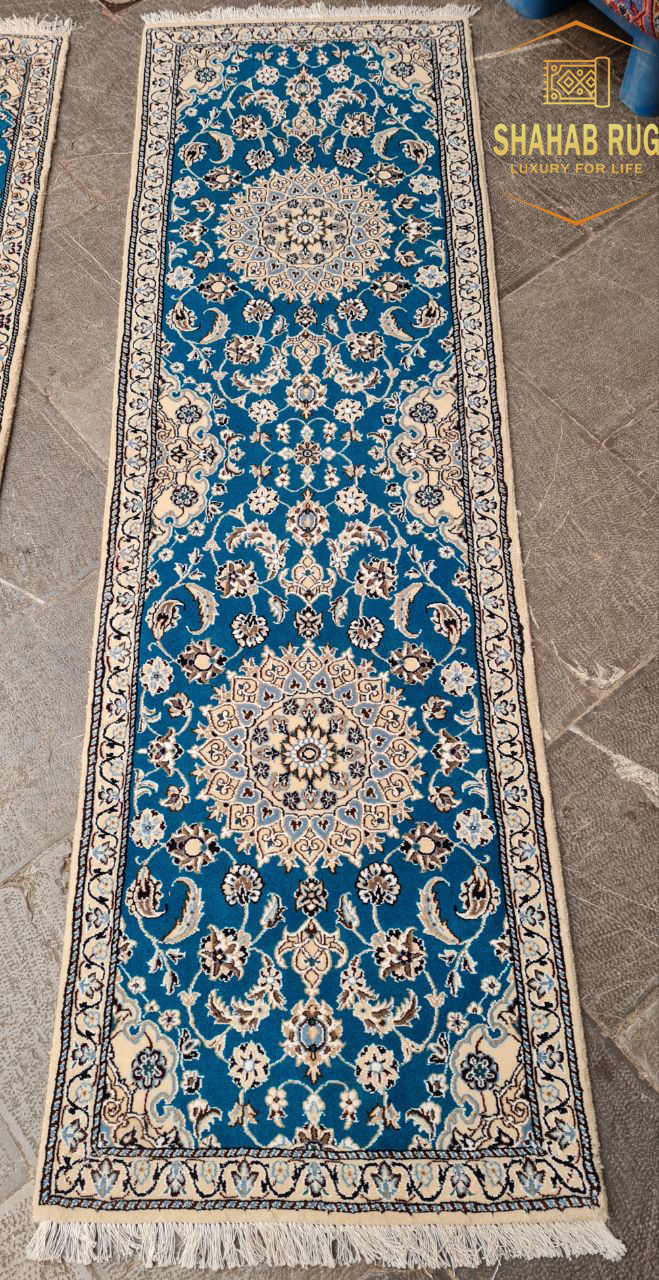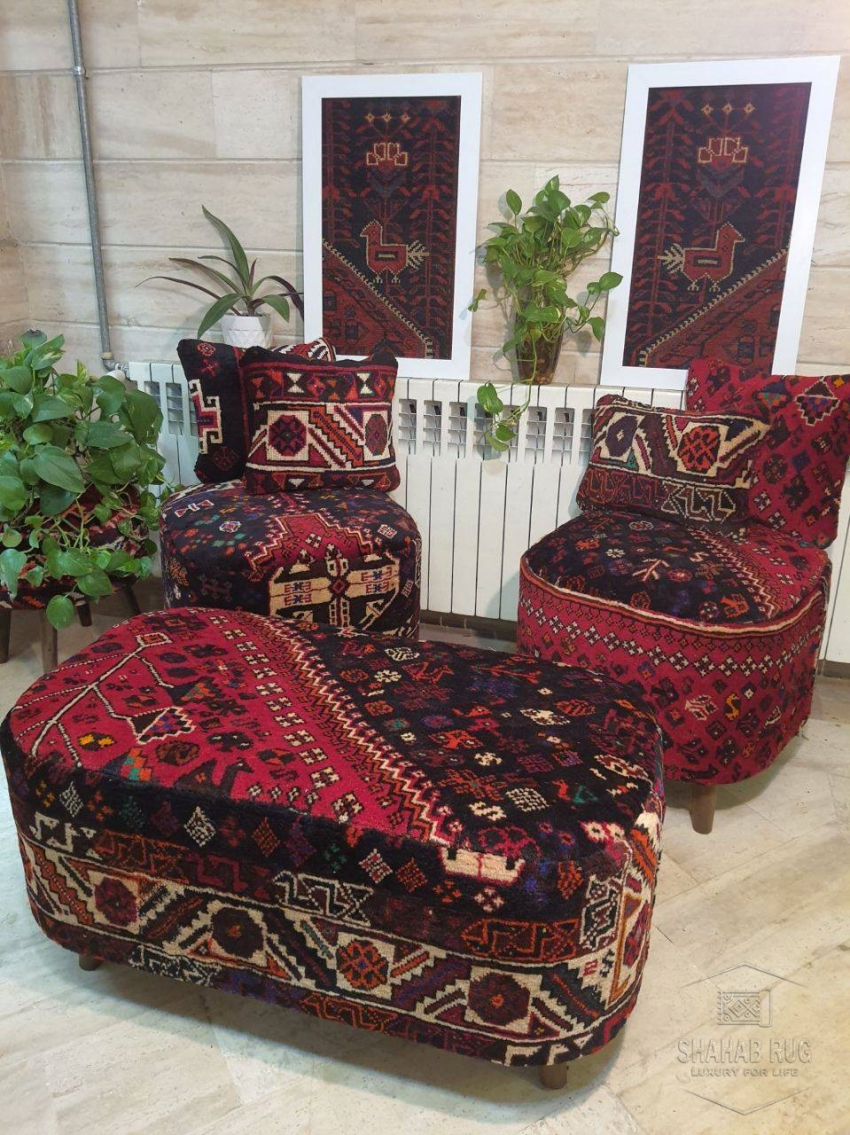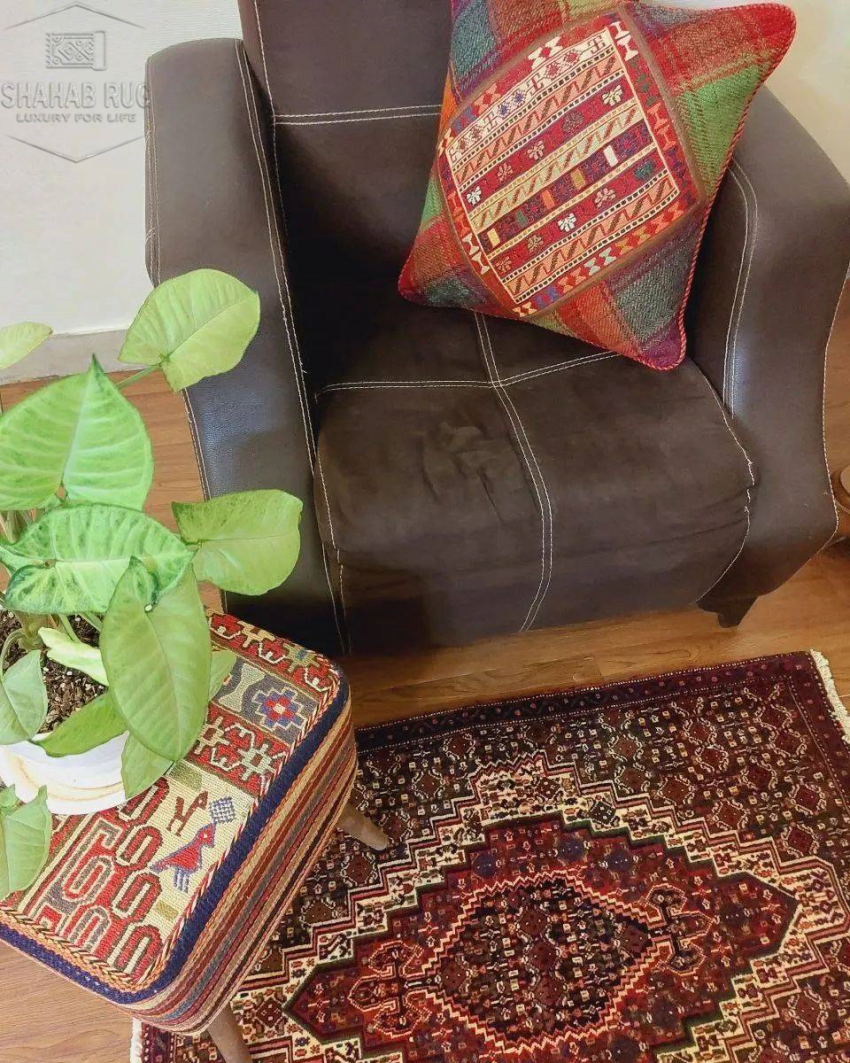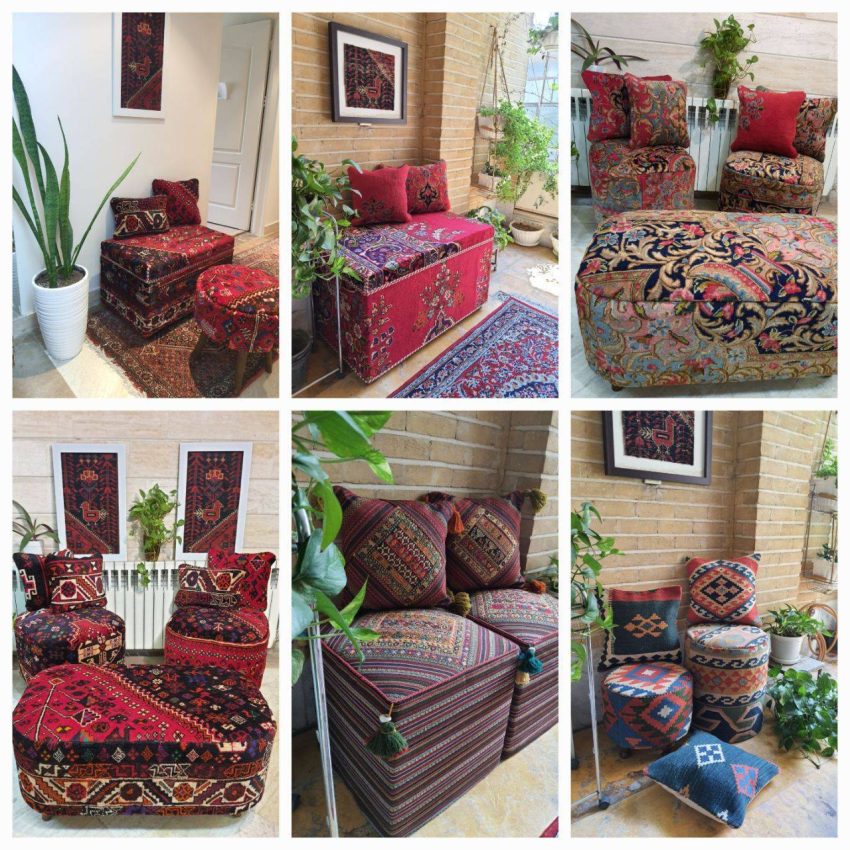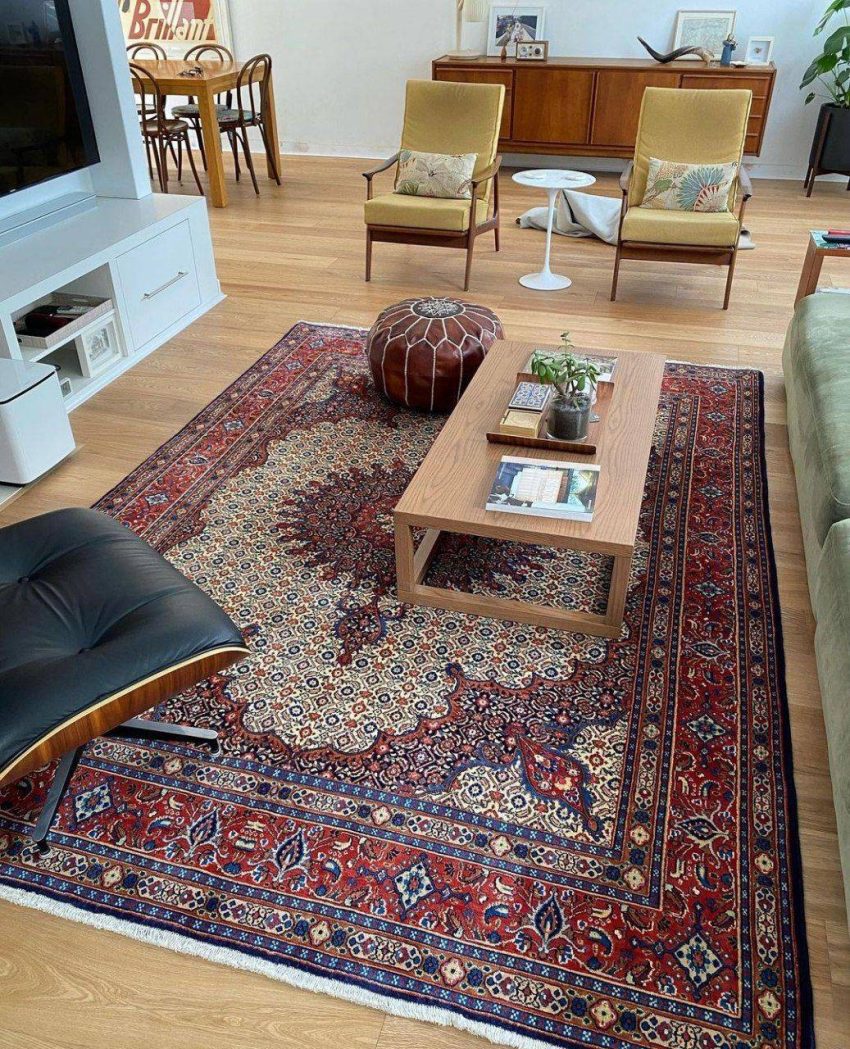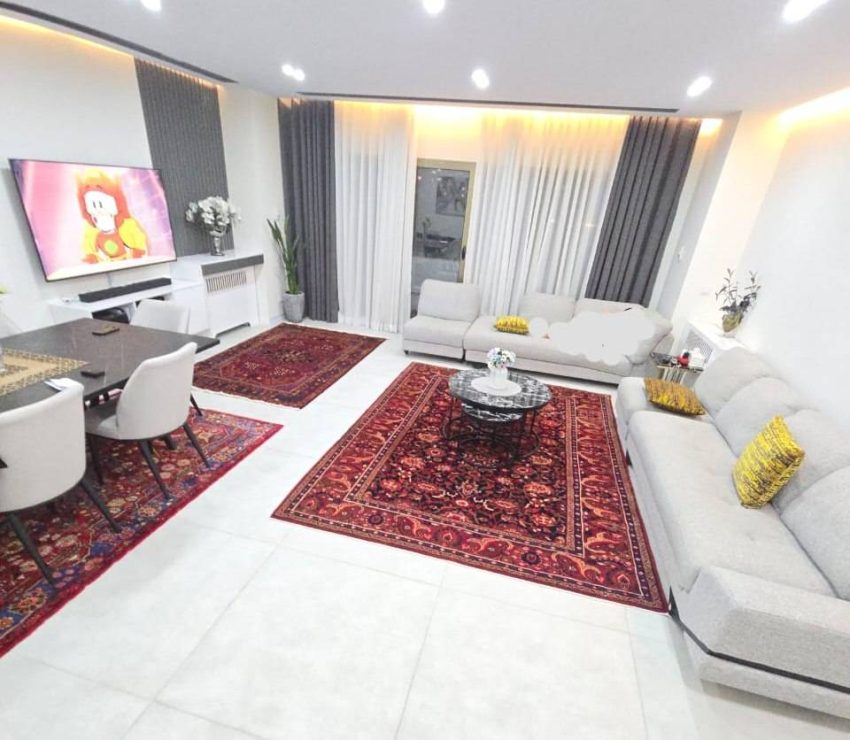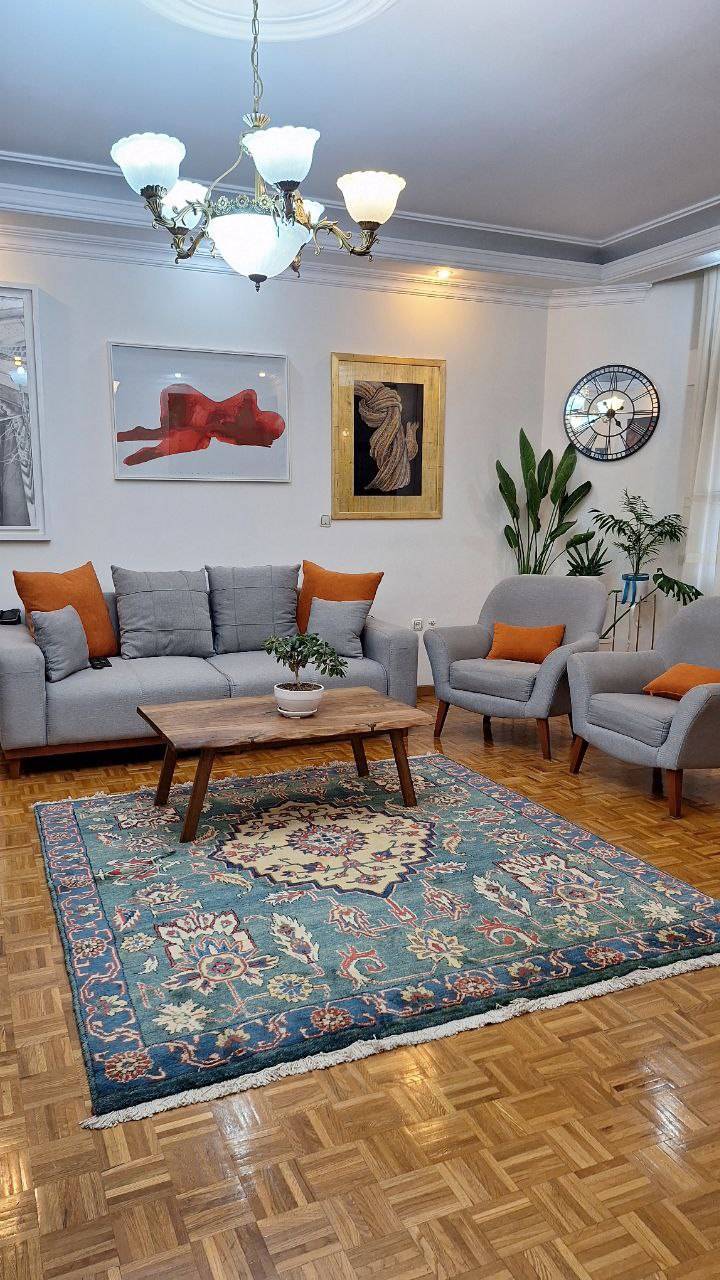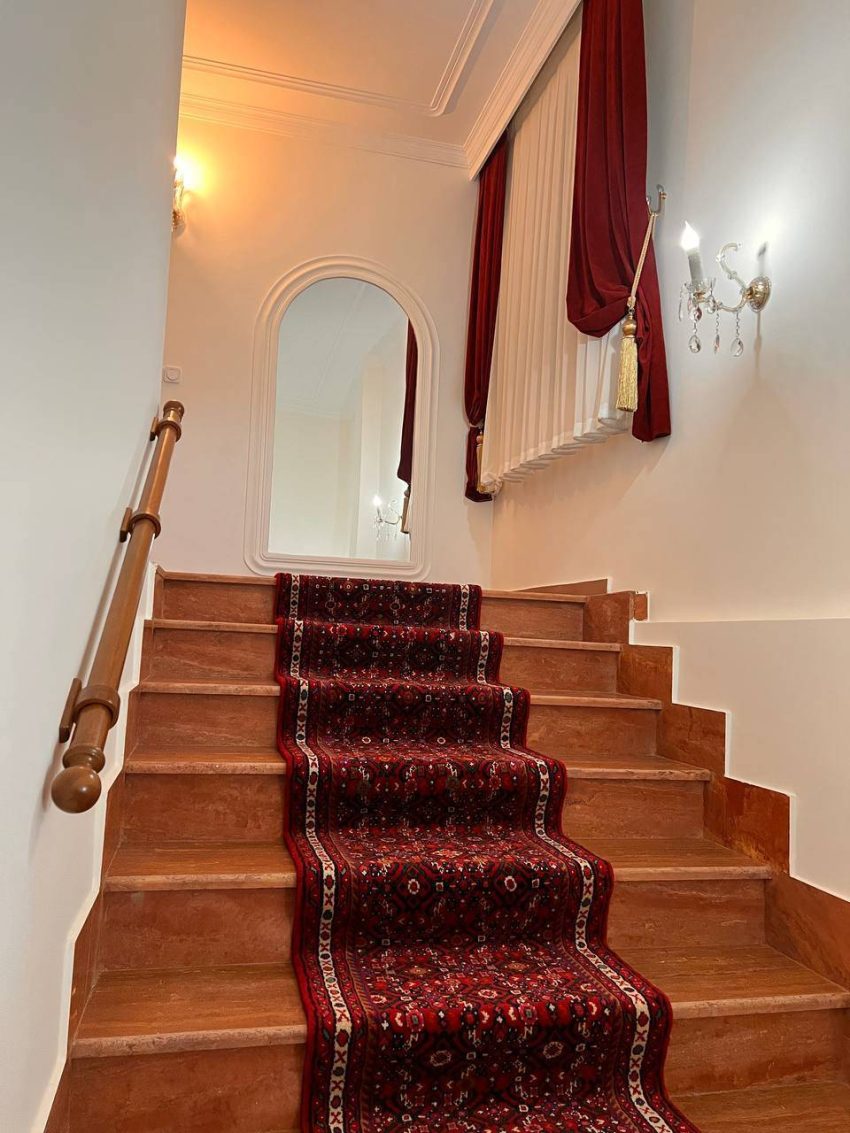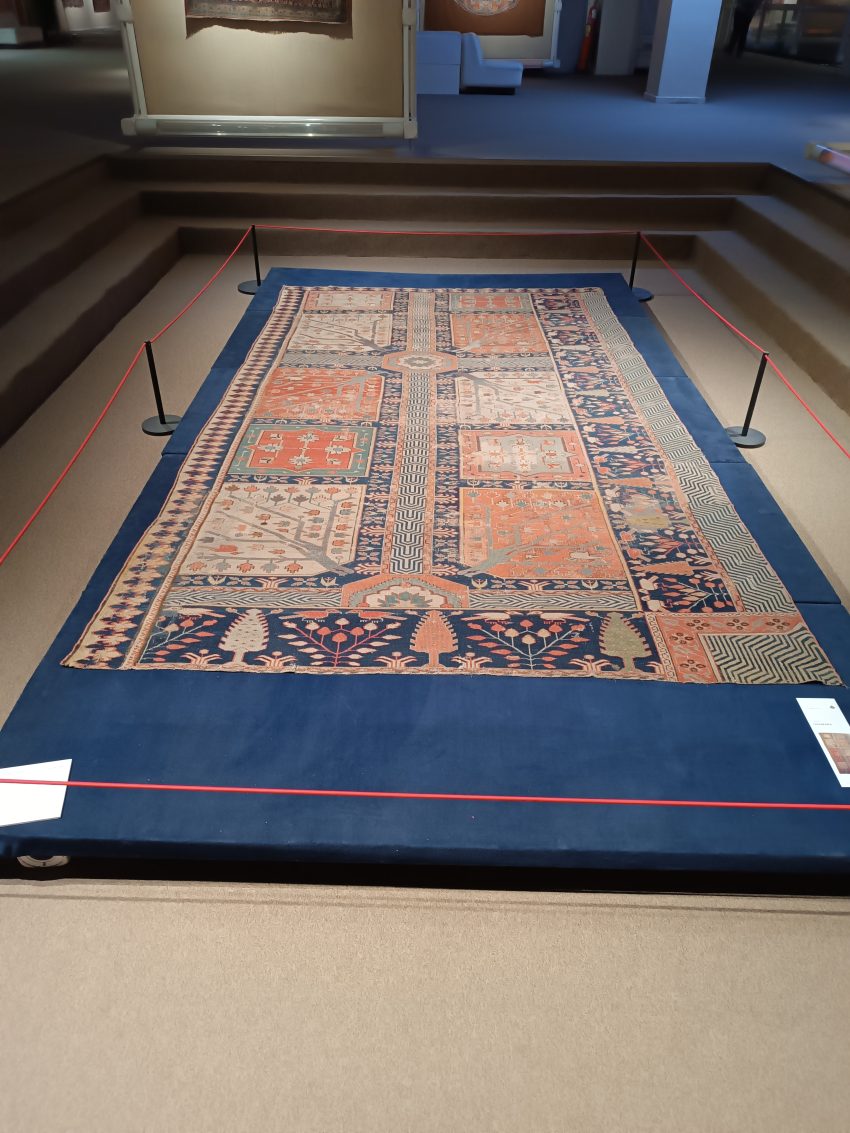
Please join and have a discussion with Shahab team in favour of Persian Carpets .
Luxury for life

Please join and have a discussion with Shahab team in favour of Persian Carpets .
Luxury for life

For centuries, the very name of Iran has been inextricably linked with the sublime beauty of the Persian carpet. More than just a floor covering, a Persian carpet is a woven chronicle of history, a testament to artistic genius, and a vital thread in the cultural fabric of a nation. The Persian carpet transforms a house into a home, its intricate patterns telling stories of ancient civilizations and nomadic tribes.
When one speaks of a Persian carpet, they are not merely discussing a decorative object, but a piece of living art, a legacy passed down through generations. The allure of a Persian carpet lies in its unique ability to blend functionality with high art, creating an object of daily use that is also a museum-quality masterpiece.
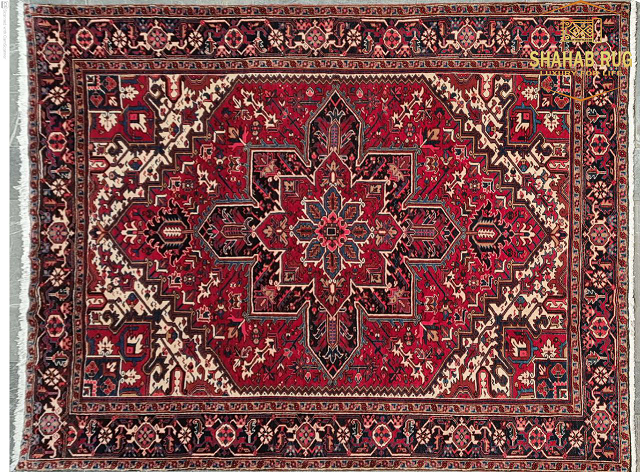
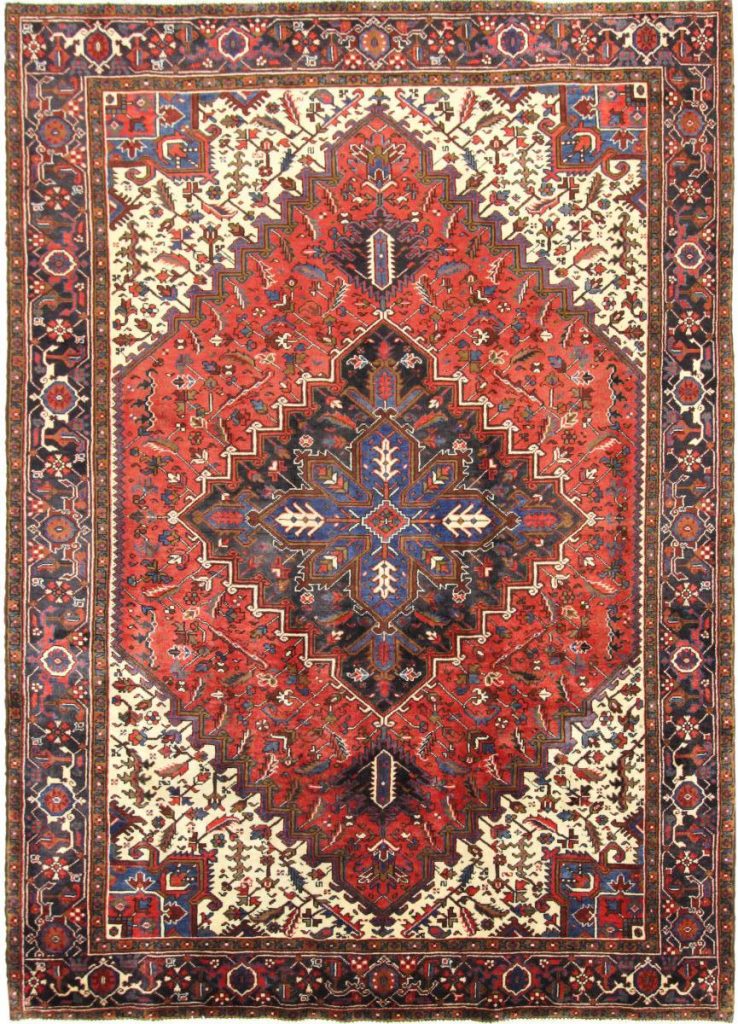
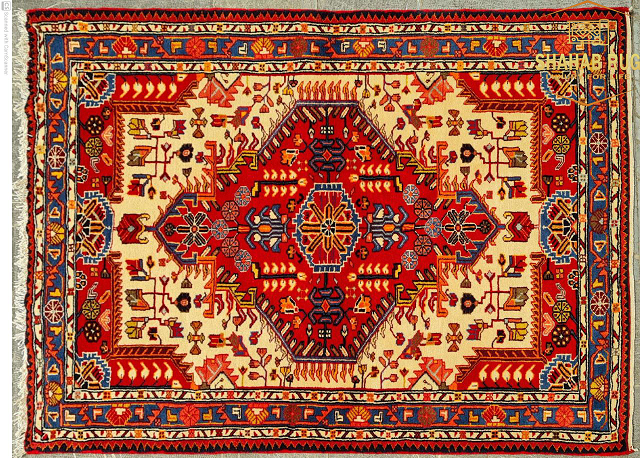
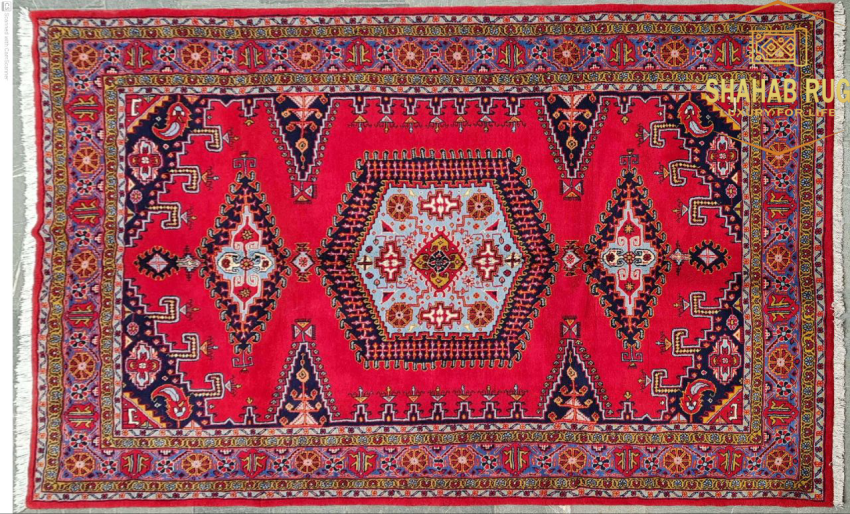
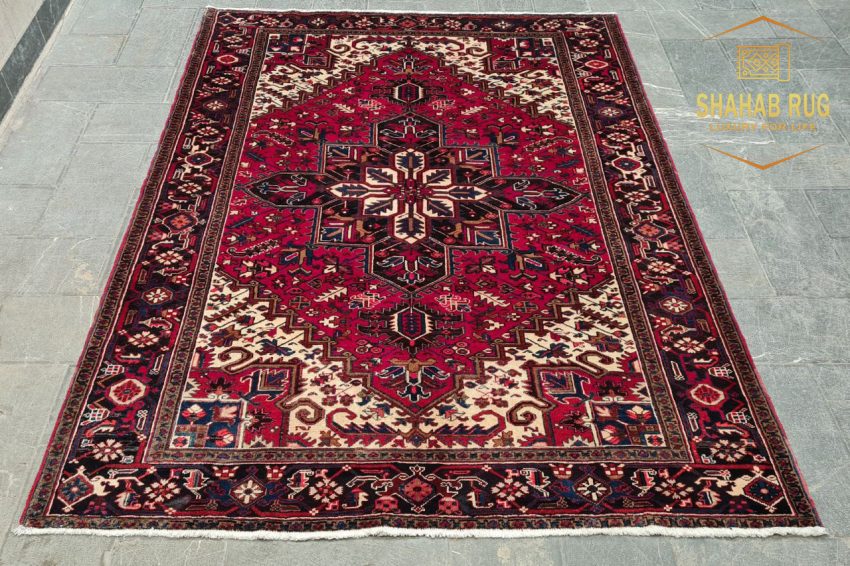
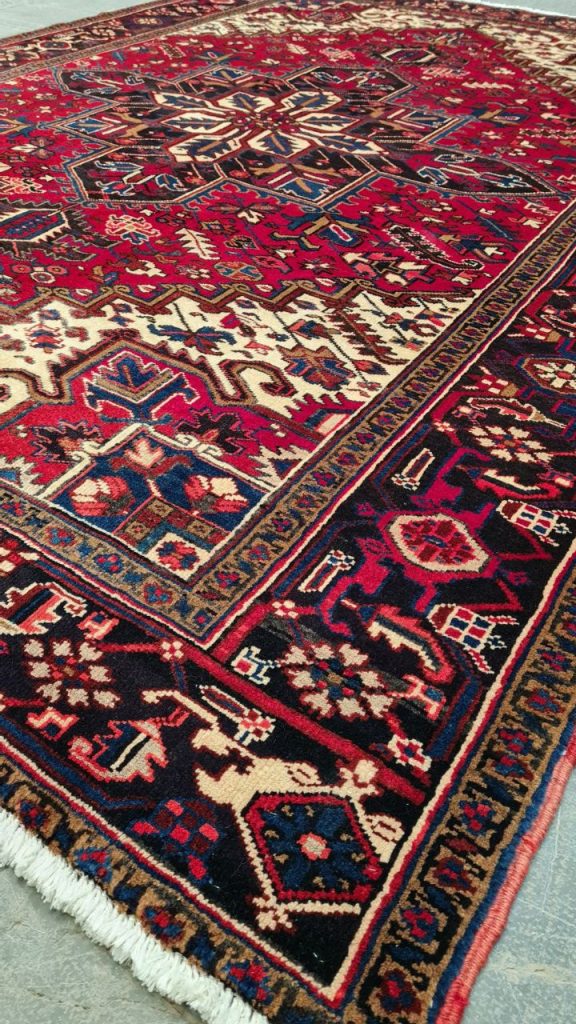
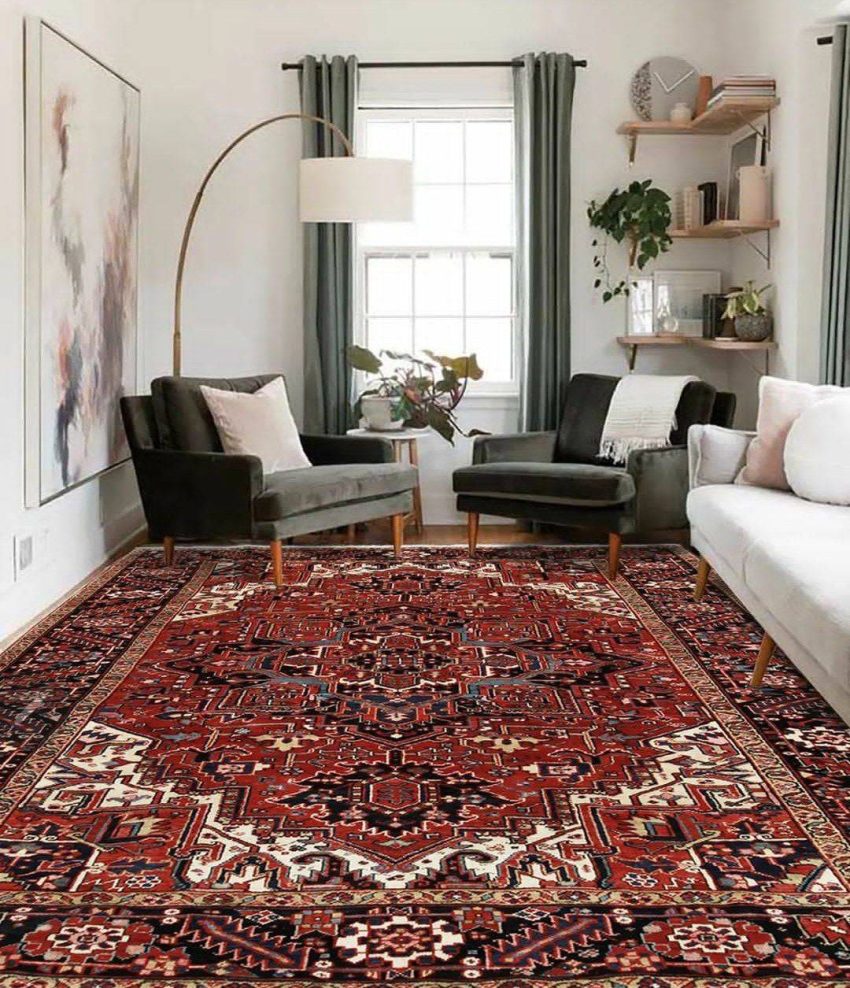
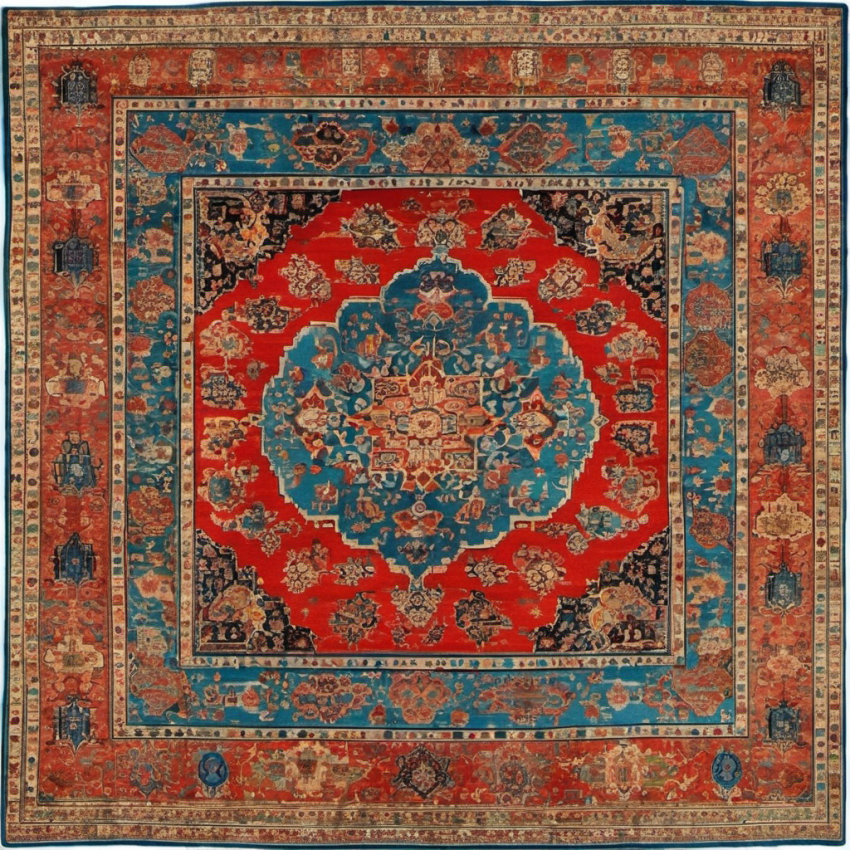
Among the myriad of styles that define the art of rug weaving, the Heriz carpet stands as a monument to strength and geometric beauty. Our featured piece, a stunning example of this tradition, boasts dimensions of 2.5 by 3.2 meters. This generous size makes it an ideal centerpiece for a living room, a stately dining area, or a grand foyer.
The scale of this Persian carpet allows the bold, architectural designs of the Heriz style to breathe and command attention. Its rectangular form, with its precise measurements, is perfectly suited for creating a defined and elegant space within a larger room. The sheer presence of a rug of this magnitude anchors the decor, adding a layer of sophistication and warmth that is simply unmatched.
This Persian carpet is not just an item of decor; it is an investment in lasting beauty, a piece that will be cherished for generations. The durability of a Heriz rug, combined with its powerful visual impact, makes it a perfect choice for those seeking both artistry and practicality. This particular Persian carpet is a statement of refined taste, a celebration of tradition woven into a modern, usable format.
The story of this magnificent Persian carpet begins in the ancient city of Heriz, located in the East Azerbaijan Province of Iran. This rugged, mountainous region has been a cradle of carpet weaving for centuries, with its unique style becoming one of the most recognizable and beloved in the world. Heriz carpets are renowned for their robust construction and distinctive geometric patterns, characterized by large, bold medallions and angular floral motifs.
The weavers of Heriz are masters of their craft, using a specialized weave that makes their carpets exceptionally durable. The city itself is a testament to the enduring spirit of Iranian artistry, where the loom is as integral to daily life as the bread oven. Heriz carpets are not merely products; they are the embodiment of the city’s soul, a reflection of its history and its people’s resilience. To own a Heriz is to own a piece of this city’s rich heritage.
Heriz is just one jewel in the crown of East Azerbaijan Province, a region that stands as the cradle of traditional rug weaving in Iran. The province is synonymous with high-quality, durable carpets that are exported all over the world. The legacy of craftsmanship in Azerbaijan is immense, making it a vital hub for the national art of carpet making. However, the province’s contribution to Iranian culture extends far beyond textiles. East Azerbaijan is also famous as the cradle of Persian nuts in Iran, producing some of the finest almonds, walnuts, and pistachios found anywhere in the country.
This dual heritage of artistry and agriculture defines the character of the region. The same fertile soil and favorable climate that nurture the finest nut orchards also sustain the communities of skilled weavers. The people of Azerbaijan are a testament to the rich tapestry of Iranian life, where the land and the handcraft are inextricably linked.
The vibrant Azari culture is a cornerstone of Iranian identity. As the largest ethnic minority in Iran, the Azeri people have enriched the nation with their unique language, music, cuisine, and, most notably, their artistic traditions. The art of carpet weaving is a central pillar of Azari culture, a practice that fosters community, patience, and artistic expression. The bold, geometric designs of Heriz and other Azeri carpets are a reflection of the strong and resilient character of the people.
This culture operates within the broader, magnificent framework of Iranian culture, a civilization that has continuously flourished for millennia. Iran, or Persia, is a land of immense cultural depth, where poetry, philosophy, and art are revered above all else.
The Persian carpet is a perfect metaphor for Iranian culture itself – a complex, beautiful, and intricately woven tapestry of diverse ethnic groups, historical narratives, and artistic traditions.
The creation of a Persian carpet is the ultimate expression of Iran’s art and craftsmanship. It is a craft that demands years of training, an intimate knowledge of natural dyes, and a profound patience that is almost meditative in nature. Iranian artisans are renowned worldwide for their skill in a multitude of disciplines, from miniature painting and calligraphy to metalwork and tile-making. However, the Persian carpet remains the nation’s most globally recognized and cherished art form.
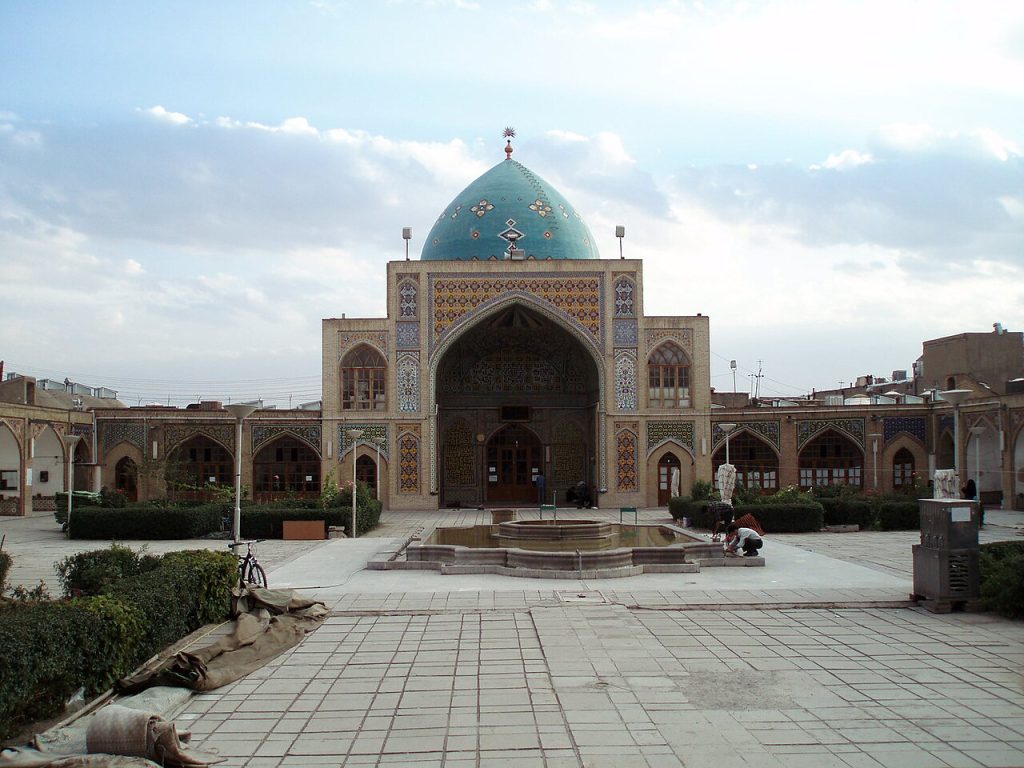
In the heart of northwestern Iran lies the historic city of Zanjan, a place where time-honored traditions and exceptional craftsmanship converge to create some of the most beautiful artifacts in the Persian world. Zanjan, with its rich cultural heritage and deep historical roots, stands as a testament to Iranian artistry.
The name Zanjan evokes images of skilled artisans and the vibrant, enduring spirit of Persian culture. This city and its province serve as a cradle for the traditional rug, a position that speaks volumes about its significance in Iran’s cultural landscape. For centuries, Zanjan has been a vital center where the ancient art of carpet weaving has been not only preserved but also innovated, making it a vital part of the narrative of Persian carpet history. This legacy ensures that each piece woven here is not just a floor covering but a narrative woven in wool and dye.

Zanjan Province, with its capital city of the same name, is a region of immense historical and cultural importance in Iran. It is a place where the traditions of many Iranian ethnic groups, including the Shahsavan, Afshar, Tat, Kurdish, and Bakhtiari communities, have intermingled to create a unique and diverse cultural tapestry .
This cultural mosaic is most beautifully reflected in the region’s handcrafts. The province is celebrated as a hub for metal handicrafts, producing thousands of tons of copperware and silver filigree annually, and is famously designated as a World City of Filigree . Beyond metalwork, Zanjan is also renowned as the cradle of the traditional Persian knife, a craft with deep historical roots that continues to be a point of pride for the region . This combination of textile and metal artistry highlights the province’s central role in preserving and advancing Iran’s artistic heritage. The Zanjani culture is one of resilience, creativity, and profound respect for the skills passed down through generations.
The art of the Persian carpet is an integral part of Iran’s cultural identity and history. With a legacy spanning nearly four millennia, the Persian carpet is more than a decorative item; it is a symbol of the Iranian people’s culture, spirit, and unparalleled creativity . Each knot tied and each pattern woven tells a story, often reflecting the history, nature, and everyday life of the region from which it originates . The craftsmanship involved is immense, often taking months or even years to complete a single piece using only the finest natural materials like hand-spun wool, silk, and cotton, dyed with extracts from plants and minerals .
This dedication to quality has earned Iranian carpets a prestigious place in museums and private collections worldwide . For the people of Zanjan, this ancient tradition is a living part of their daily lives, ensuring that the skills of their ancestors continue to thrive in the modern world.
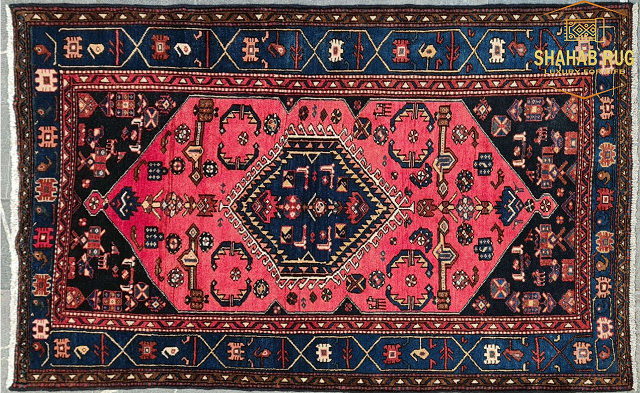
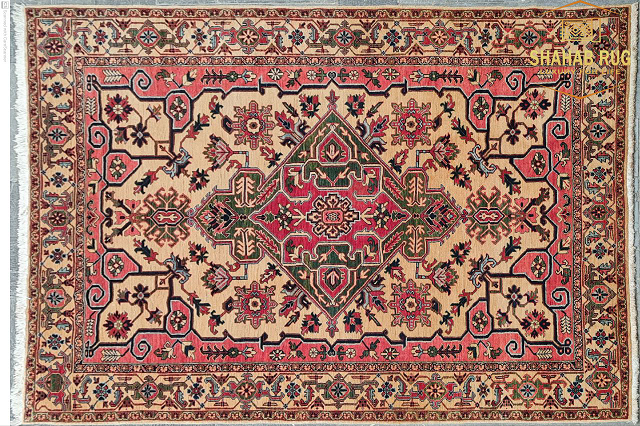
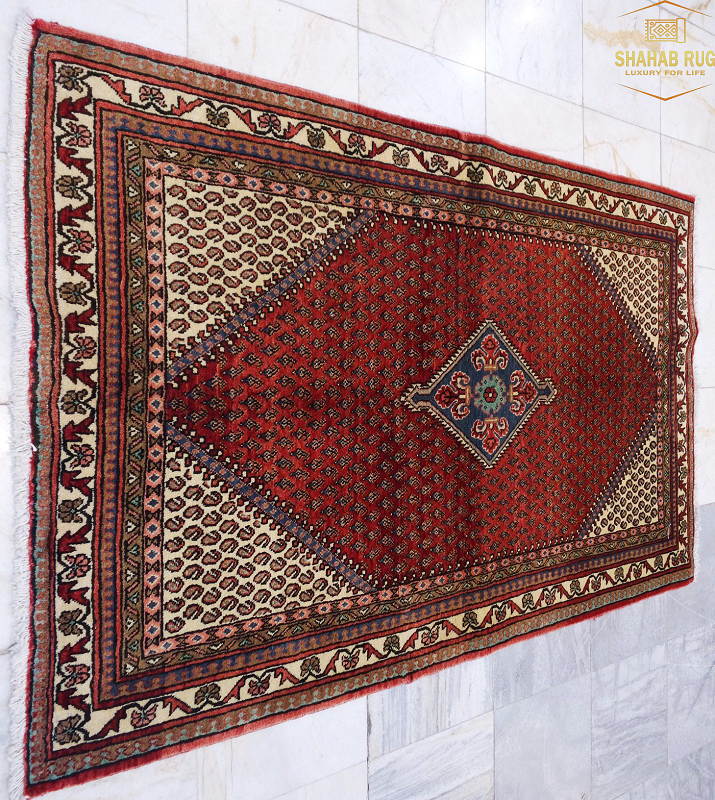
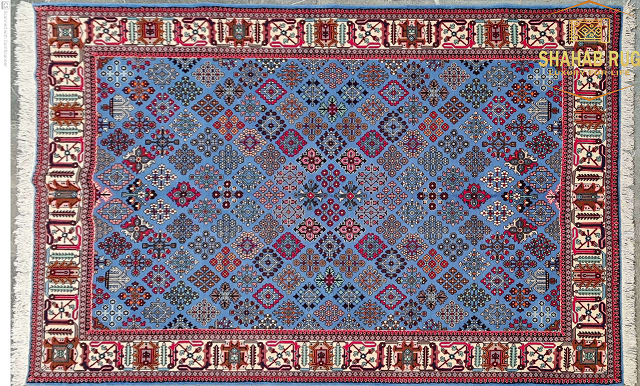
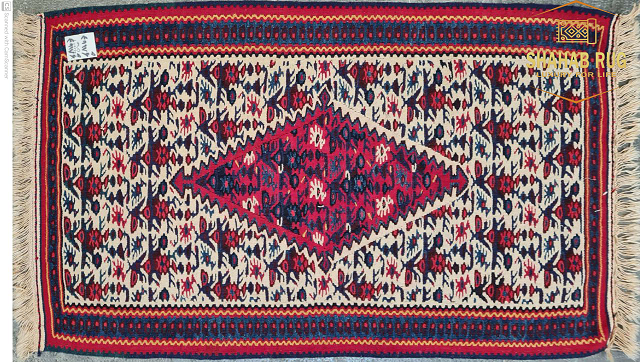
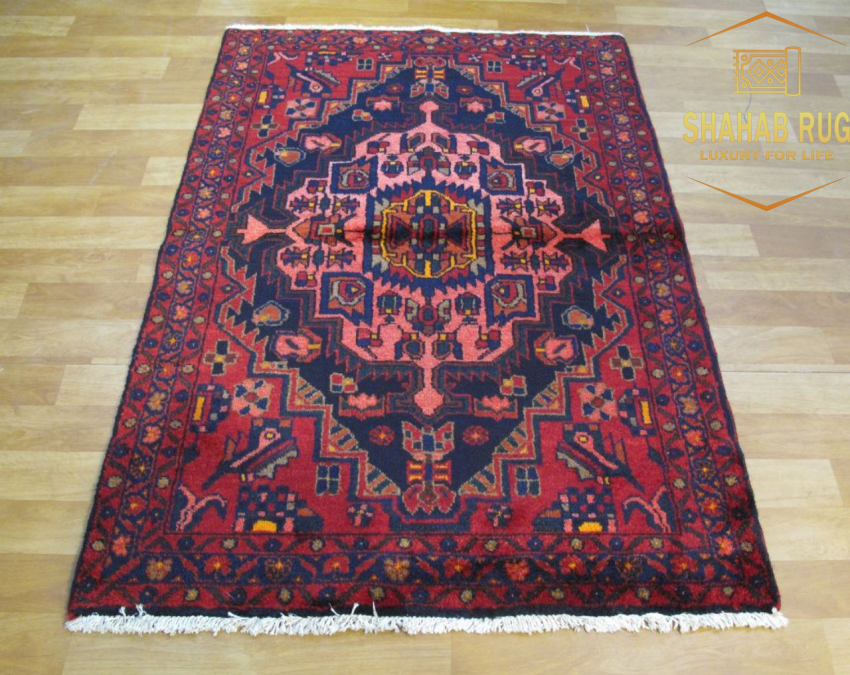
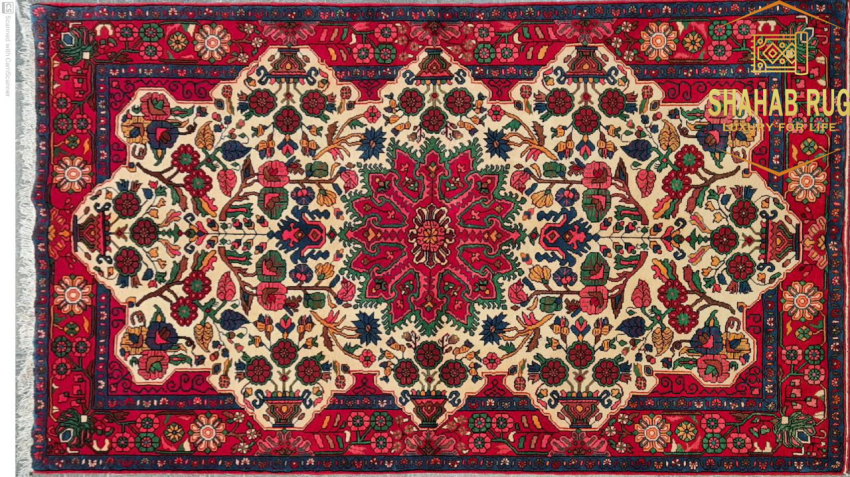
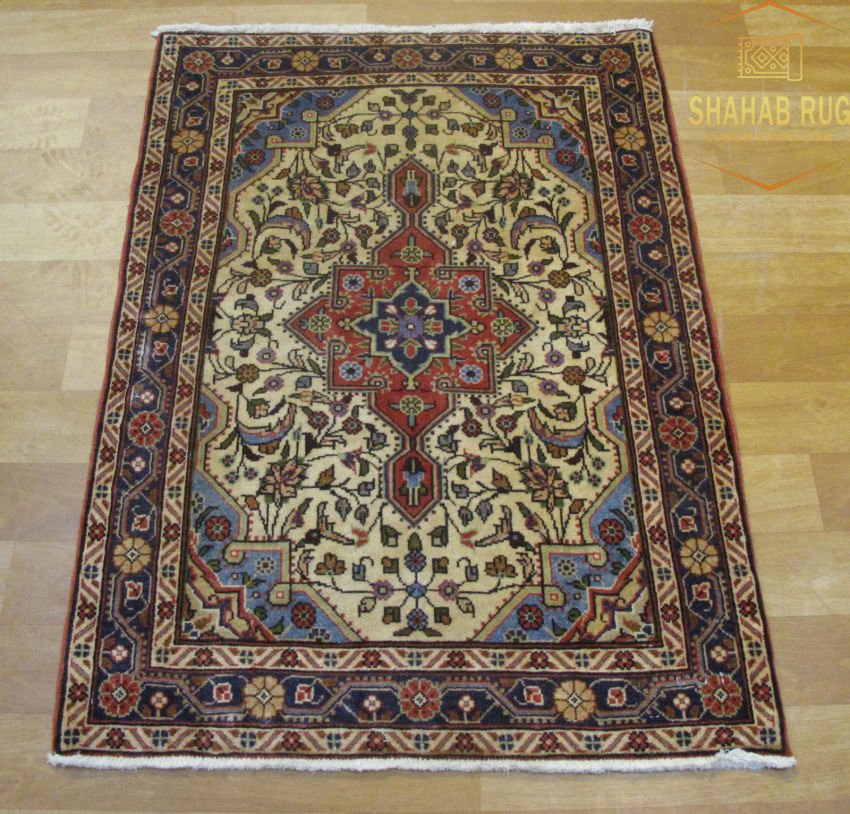
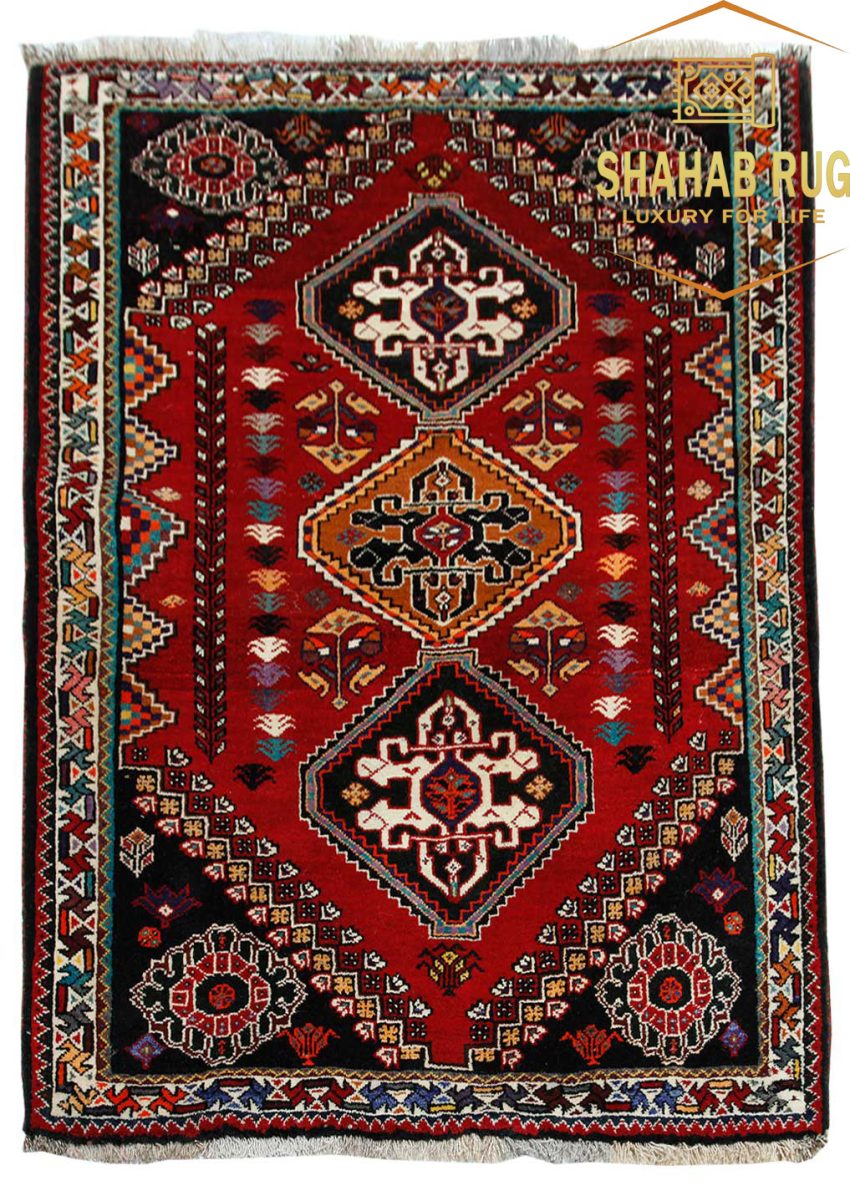
We are proud to present a stunning example of this rich tradition: a meticulously handcrafted Persian rug from Zanjan. With dimensions of 1.3 by 1.9 meters (approximately 4.3 by 6.2 feet), this rug is a perfect size to serve as a captivating centerpiece in any room, from a living area to an entryway. Its compact yet substantial size allows its intricate patterns to be fully appreciated.
The rug’s design is a testament to the bold geometric style for which Zanjan rugs are famous. It features a strong central medallion and corner design, known as Lachak-o-Toranj, a classic and symmetrical layout that provides a sense of balance and harmony . The primary colors are a rich, deep red and a profound navy blue, colors that form the vibrant backbone of many traditional pieces from the region . The weavers have masterfully employed a symmetrical design, creating a powerful visual impact.
The knots are tied by hand, a process that requires immense patience and precision, ensuring that this piece is both beautiful and durable, capable of lasting for generations .
What distinguishes a Zanjan rug from others is its powerful geometric clarity and visual precision . The patterns often incorporate repeating motifs, such as the Mahi (fish) motif, which is a common and cherished element in the region’s weaving tradition .
These motifs, arranged in straight, geometric patterns, are not simply decorative but are a form of visual storytelling, embodying the ancient Persia from which they originate . The art of weaving in Zanjan is performed without a draft, meaning the patterns come directly from the weaver’s mind, a skill passed down through generations of Zanjani artisans .
This unique characteristic ensures that no two rugs are exactly alike, each possessing a unique character and soul that reflects the personal artistry of its creator. The wool used is often hand-spun, giving the rug a natural softness, a characteristic shine, and remarkable durability .
The city of Zanjan and its surrounding villages are essential to the production of these magnificent works. In places like Zanjan, Tarom, and Abhar, the tradition of carpet weaving is a primary occupation for many villagers, a skill that supports families and keeps the cultural fabric of the community intact .
The weavers of Zanjan have honed their craft for centuries, creating rugs that are highly valued for their technical balance and durability. Owning one of these rugs means owning a piece of the rich cultural history of Zanjan, a tangible connection to the artistic spirit of Iran. This rug is not just an acquisition; it is an investment in a piece of living history, a celebration of the enduring artistic heritage of the city of Zanjan, and a testament to the skill of its people.
This Zanjan rug is more than a floor covering; it is a gateway to the rich history and vibrant culture of Iran. The Persian carpet is a silent language of the country’s culture, reflecting the elegance and creativity of its people . The patterns and colors within this rug echo the landscapes and traditions of Zanjan Province, from its majestic mountains to its bustling bazaars filled with the creations of master craftsmen. The very act of weaving a rug is a form of worship, a dedication to beauty and precision that is deeply ingrained in Iranian culture. The high knot density ensures that the detailed geometrical patterns are sharp and clear, a hallmark of high-quality, hand-knotted Persian rugs .
In the heart of western Iran lies a city that whispers tales of ancient civilizations and artistic mastery. This is Hamedan, a name that resonates through history as one of the world’s oldest continuously inhabited cities. When we speak of authentic Persian carpets, we are inevitably drawn to Hamedan, a cradle of traditional rug weaving that has shaped the very identity of Iranian craftsmanship for millennia. The city of Hamedan, with its rich cultural tapestry, offers more than just floor coverings; it offers a tangible connection to a glorious past.

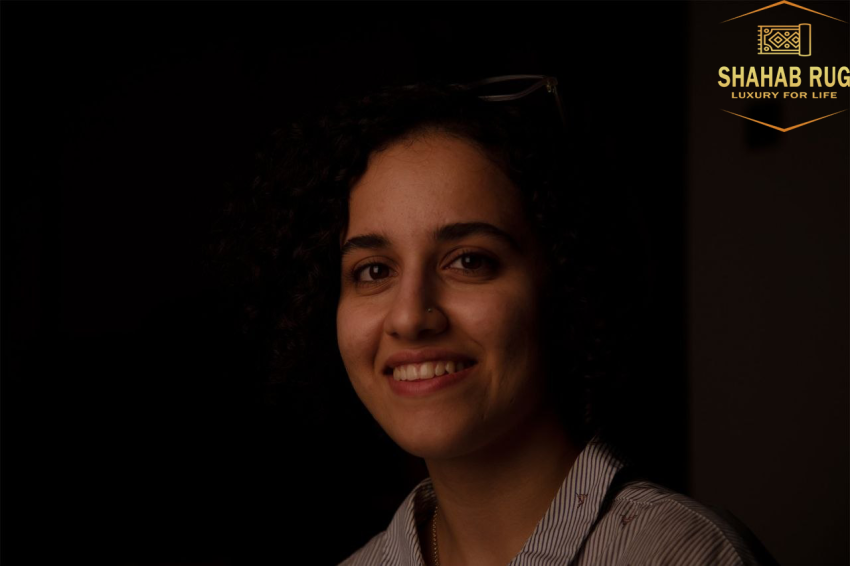
As Zahra Khodaei , Technical Manager of Shahab rug stated : Hamedan’s reputation as a weaving hub is not merely a modern designation. It is a title earned over centuries, built upon the skilled hands of its diverse people.
From the Kurds and Lors to the Persians and Turks, each ethnic group within Hamedan province has contributed to a dazzling array of patterns and techniques. This melting pot of influences is precisely what makes a Hamedan Persian rug so distinctive. Unlike the ultra-refined, courtly carpets of central Persia, the weavings from this region possess a certain rustic charm, a boldness that speaks of mountain villages and nomadic traditions. They are sturdy, practical works of art designed for everyday life, yet imbued with profound cultural significance .
The cultural identity of the Hamedani people is deeply interwoven with their craft. For them, weaving is not just a profession; it is a language. The geometric medallions, the angular vine scrolls, and the recurring boteh (paisley) motifs are not random decorations.
They are symbols of protection, fertility, and the enduring spirit of a people who have thrived in the shadow of Mount Alvand for centuries . The vibrant scarlet reds, deep indigo blues, and earthy browns found in these rugs are drawn from the same land they inhabit, reflecting the rugged beauty of the Hamedan province’s landscape and its rich cultural heritage .
To appreciate the Hamedan Persian carpet, one must understand its physical character. The weavers of this region predominantly employ the symmetrical Turkish, or Ghiordes, knot, which creates a rug of exceptional durability and a thick, luxurious pile . A technical hallmark of many authentic pieces from the province is the use of a single weft thread between rows of knots, giving the rug a wonderfully textured, almost rustic feel .
This blend of strength and textural beauty makes these pieces ideal for areas in the home that see significant foot traffic while still maintaining their artistic integrity.
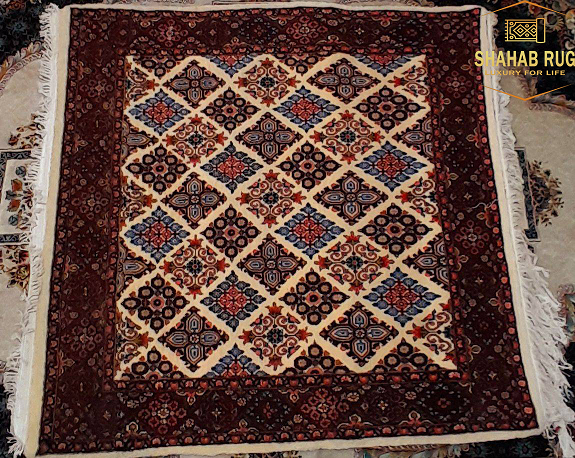
When considering the dimensions of such a masterpiece, the size becomes a crucial element of its narrative. A Hamedan rug measuring 1.4 by 1.4 meters is a perfect example of their versatility . This square format is a classic size within the region’s production, ideal for a small sitting area, an entryway, or as a striking focal point in a study or bedroom.
In a world of mass-produced, machine-made floor coverings, this 1.4 by 1.4 meter handwoven piece stands as a testament to the enduring value of human artistry and the unique character that only a Persian rug can impart to a space.
Looking beyond the city, the entire Hamedan province serves as a testament to the breadth of Persian art. It is not only a cradle of traditional rug weaving but also a cornerstone of Persian pottery in Iran .
The town of Lalejin, just 30 kilometers from Hamedan city, is a renowned center for ceramics, with hundreds of active workshops continuing a tradition that stretches back centuries .
This proximity of two great crafts highlights a cultural ecosystem where artistic innovation and tradition thrive side-by-side. Today, exports of Hamedan’s handicrafts, including its famed ceramics, continue to generate substantial revenue, underscoring the region’s vital role in Iran’s cultural economy . This synergy between the textile arts and pottery defines the artistic soul of the province.
This artistic prowess is a microcosm of Iran and Iranian culture as a whole. Iran’s art and craftsmanship is not a static relic of the past but a living, breathing tradition that continues to evolve.
From the exquisite miniature paintings to the intricate metalwork and the grand architecture of its mosques, the Iranian soul is expressed through an unparalleled dedication to beauty and detail . The Persian carpet, in all its forms, stands as the supreme achievement of this cultural ethos. It is a canvas that combines mathematics, poetry, and spirituality, a functional object elevated to the level of high art.
The legacy of master weavers, passing down their skills through generations, ensures that the timeless motifs and techniques of the Hamedan weavers, for instance, remain a source of national pride.
Indeed, the Persian rug is far more than a textile; it is the very soul of Iran woven into wool and dye. It represents a tradition where art and craft are inseparable, and where the weaver infuses their heart and history into every knot. When you purchase a Persian carpet, you are not just buying a floor covering; you are acquiring a piece of history, a fragment of Iranian culture, and a testament to the incredible skill of its artisans.
Ultimately, a Hamedan rug is the perfect gateway into this magnificent world. Whether it is the 1.4 by 1.4 meter piece that fits perfectly in a modern apartment or a larger tribal rug for a grand hall, these weavings carry with them the spirit of Hamedan and its people.
They are durable, authentic, and full of character, serving as a daily reminder of the ancient art of Persian carpet weaving and the rich, diverse cultural heritage of a land that has given so much to the world’s artistic legacy. Through them, the voices of the weavers from the mountains of Hamedan province continue to speak, telling stories of beauty, resilience, and unparalleled craftsmanship.
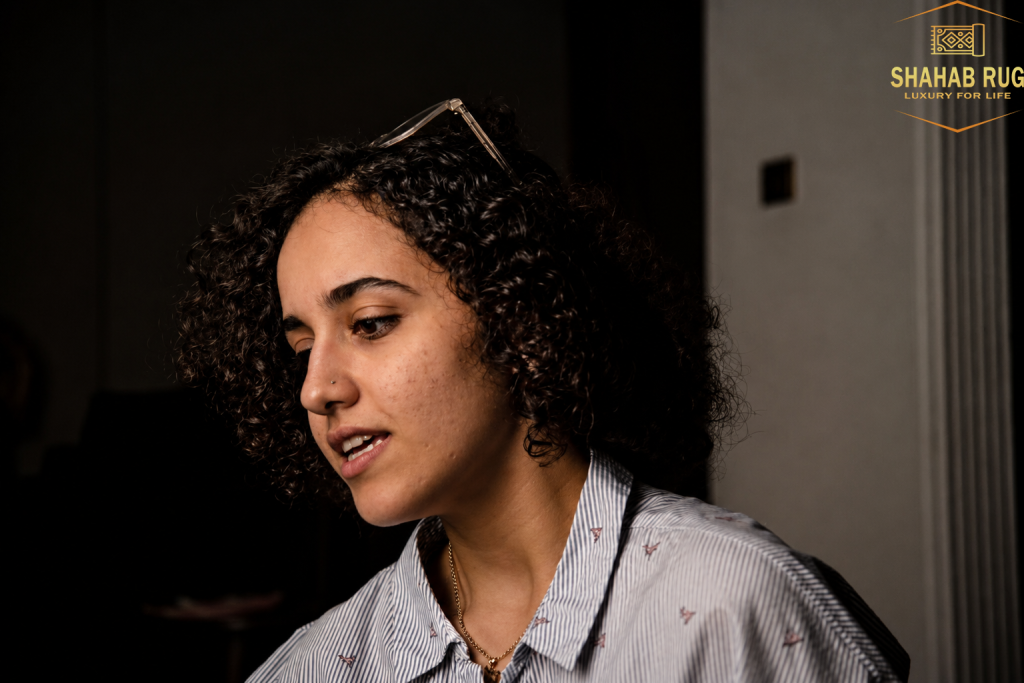
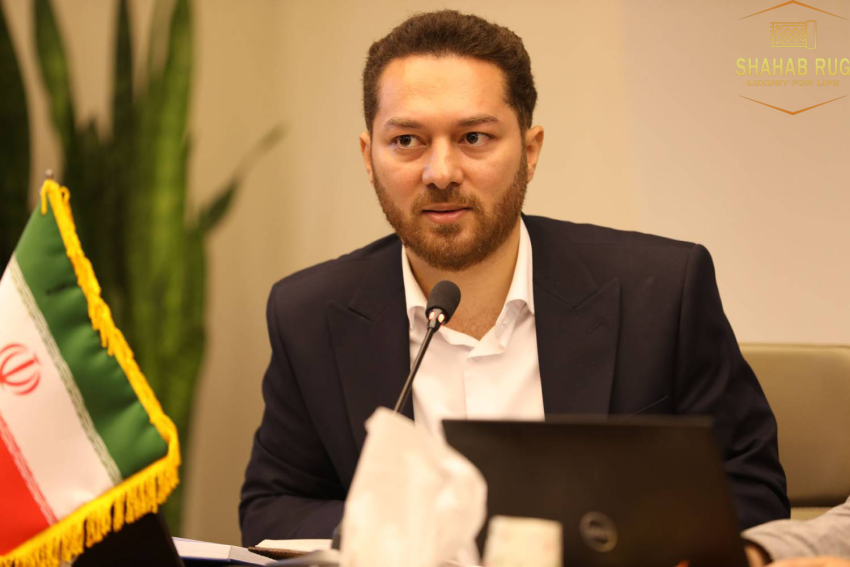
Today, we have the pleasure of sitting down with one of the key technical pillars of our team here at Shahab Rug , Zahra Khodaei. She is not only our go-to technical expert for all things related to hand-woven Persian Carpets, but she also brings a rare and invaluable expertise to our company.
A graduate of formal handcraft courses from SIU , she is a master of traditional crafts (Especially Persian Carpet) , with a deep and specialized knowledge in wooden art—from carving to inlay and restoration.
In her role as our in-house technical specialist, she bridges the gap between these two ancient crafts, ensuring that every Persian Carpet we handle meets the highest standards of authenticity and quality.
In this interview, we will explore her unique perspective on the beautiful and often overlooked harmony between wooden art and Persian carpets, and how these two mediums speak to each other through design, structure, and craftsmanship.
Shahab rug :
From a craftsman’s perspective, what visual and tactile harmony do you seek when pairing carved wooden furniture or architectural woodwork with a specific handwoven carpet design?
Zahra Khodaei :
For me, harmony begins with respect for both materials. Wood has a warm, grounding presence with its natural grain and texture, while a handwoven carpet brings softness and color. When pairing them, I look for complementary tones—for example, the rich amber of walnut wood resonates beautifully with earthy terracotta or indigo dyes in a carpet.
Tactilely, I seek contrast: the smooth, solid surface of carved wood against the plush, yielding pile of wool or silk creates a sensory dialogue that feels complete. I also consider motif alignment—if the wood features geometric or floral carvings, I prefer a carpet pattern that echoes those rhythms without competing. The goal is a room where neither element overpowers the other, but together they tell a story of craftsmanship and balance.

Shahab rug :
Can you walk us through a project where the pattern of the carpet was inspired by or intentionally mirrored the organic lines and motifs found in traditional Persian wooden inlay or carving?
Zahra Khodaei :
Absolutely. One of my most memorable projects involved a client who had a stunning antique wooden console table with intricate khatam (Persian marquetry) inlay—featuring delicate geometric stars and floral vinework. They wanted a carpet that would sit beneath it and feel like a natural extension of that piece. I worked closely with our design team to develop a carpet pattern that took the rhombus star motifs from the inlay and scaled them into the central medallion of the rug. We also softened the geometric edges with curving arabesque vines, mimicking the flow of wood grain itself.
The color palette was drawn from the woods used in the inlay—walnut brown, rosewood red, and ivory from bone inlay. When the carpet was finally laid beneath that table, it was as if the two pieces had been created together. The wood seemed to float above the carpet, and the carpet anchored the space with a quiet echo of the table’s artistry.
It was a beautiful reminder that these two crafts, though different in medium, speak the same visual language.
Shahab rug :
We wonder if you possibly do us a favour and inform us of latest progress in Shahab rug
Zahra Khodaei :
Our focus in the company is not mass production. We specialize in premium handmade pieces created by skilled artisans. Every product represents cultural heritage and meticulous attention to detail. We believe true luxury of Iran products which comes from authenticity.
In the nut shell , we want to show the world of Iran authenticity in Hand crafts which of course shows rich culture .
The Persian Carpet: A Woven Masterpiece of Culture and Art
The Persian Carpet is far more than a floor covering; it is a profound expression of Iranian art, history, and cultural identity. For centuries, these woven treasures have served as a canvas for the stories and souls of the Iranian people, with each knot representing a connection to a rich and ancient heritage. A Persian Carpet is a testament to the enduring legacy of Persian craftsmanship, a legacy that continues to thrive in cities like Tabriz, a true cradle of this timeless art .

Tabriz: The Heart of Persian Rug Weaving
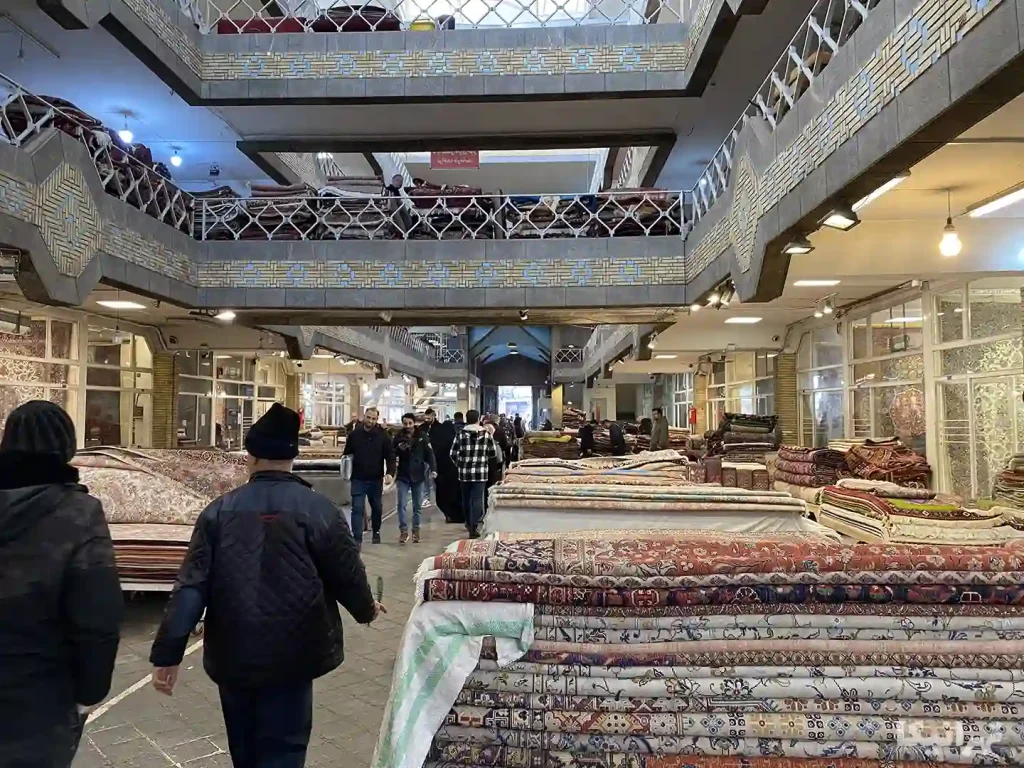
In the northwest of Iran lies the province of Azarbayejan, a region steeped in history and renowned for its vibrant cultural traditions. At its heart is the city of Tabriz, the capital of East Azarbaijan Province, which has been a world-famous center for carpet making for centuries . Tabriz is not only a pivotal city in the history of the Persian Carpet but also a cradle of traditional rug weaving, handcrafts, and even nuts in Iran. The city’s bazaar, a UNESCO World Heritage site, has been a vital artery on the Silk Road, with its Mozzafarieh Bazaar being particularly famous for its exquisite rugs .
This historic trading hub has played a significant role in making Tabriz synonymous with high-quality Persian Carpet production, a reputation it has held since the Safavid era when the art reached its cultural and economic climax .
The Art and Craftsmanship of Iran
The craft of weaving a Persian Carpet is a quintessential example of Iran’s broader artistic genius, which spans architecture, miniature painting, and metalwork. The art of the Tabriz Persian Carpet, for instance, is characterized by a harmonious blend of miniature painting and weaving, showcasing a high level of craftsmanship passed down through generations . The intricate patterns and diverse palettes of a Tabriz rug—ranging from dark reds and navy blues to ivy and soft pastels—highlight the exceptional artistic skills of the weavers .
This dedication to artistic expression is a hallmark of Iranian culture, where every object is an opportunity for beauty and storytelling. The skills required for such detailed work are often transmitted within families, ensuring the survival of these ancient traditions.
The Unique Charm of Persian Gabbeh
Within the vast world of Persian weaving, the Persian Gabbeh stands out as a distinct and beloved type. Unlike the finely detailed city rugs of Tabriz, a Gabbeh is a traditional variety known for its coarse quality, thick pile, and abstract, minimalist designs . The word “Gabbeh” itself means “raw” or “natural,” reflecting the rug’s primitive and unpretentious character .
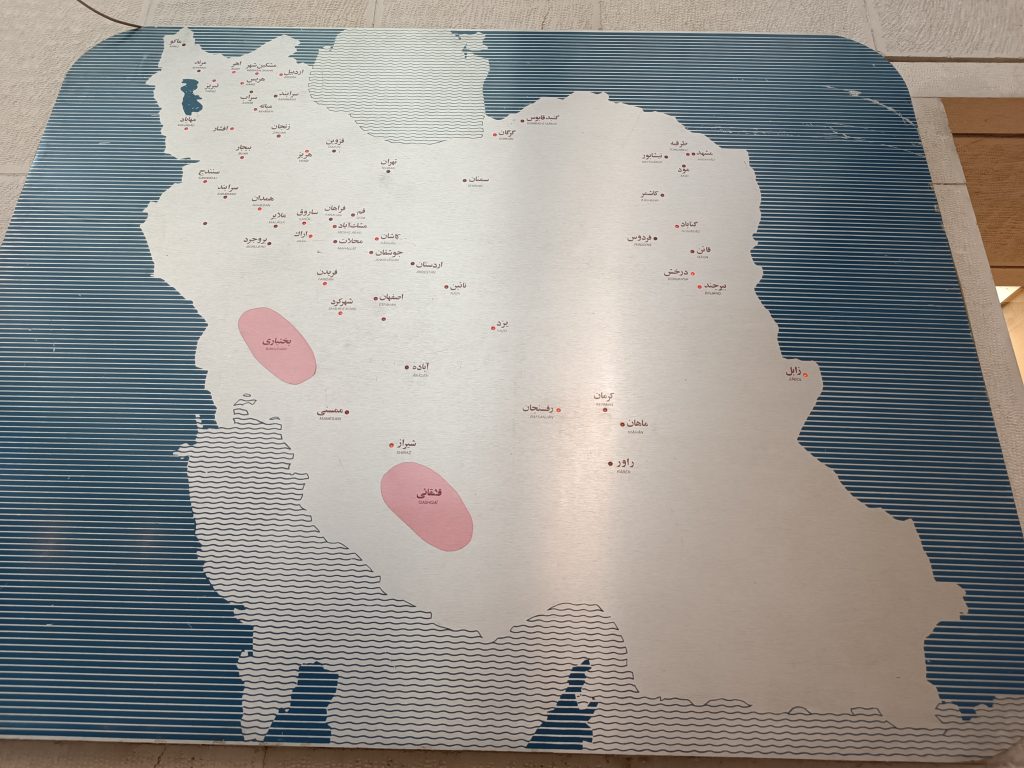
Woven by nomadic tribes such as the Qashqai and Luri in the Zagros Mountains, these rugs are crafted by women who pour their heritage and personal memories into the design . Featuring bold, geometric patterns and bright, natural colors, a Persian Gabbeh is like a piece of folk art, telling stories of the weaver’s life and surroundings, making it a cherished and unique addition to any home .
The Dimensions and Heritage of Azarbayejan
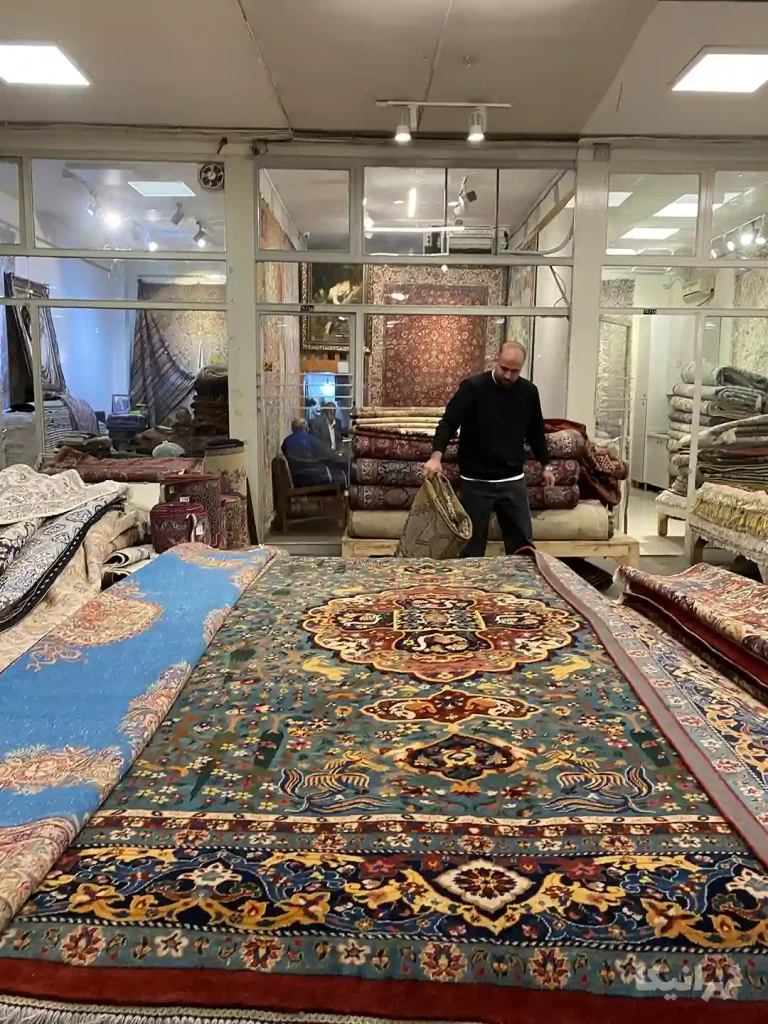
A typical Persian Carpet from Tabriz, such as one with the dimensions of 2 by 2.3 meters, is a substantial piece of art that can command a room. This size allows for the intricate, detailed designs that Tabriz is famous for, including medallions and corner quarters known as Shah Abbasi or Islimi patterns . The city of Tabriz produces an incredible diversity of types, with knot densities ranging from a bazaar quality of 24 raj to an incredibly fine 110 raj, showcasing the skill and dedication of its weavers .
Azarbayejan Province, with its capital in Tabriz, is the beating heart of this tradition. The Azari culture, which is a rich part of Iranian culture, is deeply intertwined with the production of these rugs . The resilience of the people of Azarbayejan, who have preserved this art despite historical upheavals, is reflected in every Persian Carpet they create .
A Piece of Iran for the World
Ultimately, a Persian Carpet, whether the sophisticated, intricately woven product of a Tabriz workshop or the charmingly simple Persian Gabbeh of a nomadic tribe, is a tangible piece of Iran’s soul. It embodies centuries of Iranian culture, the artistic spirit of its people, and the rich history of a land that has been a crossroads of civilization for millennia.
When you bring a Persian Carpet into your home, you are not just buying a rug; you are acquiring a timeless piece of art, a story woven in wool and silk, and a lasting connection to the heart of Persian culture.
In the world of fine floor coverings, few names command the respect and admiration that Heriz does. Heriz rugs are a distinguished style of Persian carpet, originating from a cluster of farming villages in the far northwest of modern Iran. The eponymous town of Heriz (also spelled Heris) is situated in the East Azerbaijan Province, on the slopes of the mighty Mount Sabalan. This region is not just a point on a map; it is a cradle of a distinct weaving tradition that has captivated the world for over a century. The durability and striking beauty of a Heriz Persian carpet lie at the heart of its enduring legacy.

The story of the Heriz village is one of resilience and artistry. This small settlement, with a population of just over a thousand people, became a powerhouse of rug production in the 19th century. It is said that enterprising merchants from the nearby city of Tabriz saw the potential in the local weavers, who were skilled in the angular, geometric styles of nomadic tribes. These merchants provided them with city designs and asked them to produce large-scale carpets for a growing Western market.
The result was a remarkable fusion: the sophisticated layouts of Persian court carpets translated into the bold, graphic language of the village weaver. This is the essence of a Heriz, a rustic, charming village Persian carpet with a richness and grandeur equal to the finest city pieces.
The influence of Tabriz on Heriz cannot be overstated. Tabriz, the capital of East Azerbaijan Province, is one of the oldest and most important rug-weaving centers in the world, with a tradition dating back to the 16th century.
Its weavers were renowned for their intricate, curvilinear floral designs. The impact of the Tabriz rug trade on Heriz is evident; the smooth, flowing medallions of Tabriz were adopted by Heriz weavers but reimagined with hard, geometric angles and broken contours. Today, Heriz carpets and rugs are a testament to this cross-pollination of ideas, a country version of the refined city styles that found their own unique identity.
The durability of a Heriz Persian carpet is legendary, earning it the affectionate nickname “the Iron Rug of Iran”. This toughness is not merely a result of skillful weaving but is also attributed to the unique geography of the Heriz region.
Mount Sabalan, near which the village of Heriz sits, is rich in copper deposits. It is believed that traces of this copper in the drinking water of local sheep produce a wool that is exceptionally resilient, far more so than wool from other areas. A single Heriz rug can take over 1,500 hours of artisanal handiwork, a testament to the dedication and skill of the weavers. This high-quality wool, combined with a robust, all-wool pile on a cotton foundation, creates a floor covering that can last for generations.
To understand the Heriz rug is to understand the Azari culture that produces it. The population of the Heriz region is of Azeri origin and speaks a Turkic dialect. The carpet-weaving traditions of this area are a fusion of the skills of these settled peoples and the nomadic Azerbaijani Shahsevan tribes who have historically roamed the region.
This cultural heritage is woven into every Heriz carpet. Weavers often create their designs from memory, telling stories of the past through traditional tribal shapes, patterns, and significant moments in the arts and history of Persia. The bold, geometric motifs are not just decorative; they are a visual language, a connection to a rich cultural identity that has been passed down through generations.
The broader context of Iran and Iranian culture is essential to appreciating the Persian carpet. The art of carpet weaving in Iran is believed to extend back to as early as 500 BCE. The Persian carpet is an inseparable item from Iranian art and culture, one of the most distinguished manifestations of the nation’s identity. It is a symbol of art and creativity, embodying a part of Iran’s authentic identity and acting as an ambassador of its rich history to the world.
The motifs and patterns of a Persian carpet of ten convey a message representing the current culture, history, and architecture of the time. In this grand tapestry of Iranian art, the Heriz holds a special place as a beloved and iconic village style.
Iran’s art and craftsmanship are world-renowned, and the Persian carpet stands at the pinnacle of this tradition. Iranian handicrafts are a rainbow of diversity, including the Persian Carpet, Minakari, miniature painting, Khatamkari, and Ghalamzani. However, it is the Persian carpet that has perhaps the greatest global recognition.
The exceptional craftsmanship involved in weaving these carpets has caught the attention of travelers and historians for centuries. The skills and techniques are passed down through generations, ensuring the survival of this ancient art form. When you look at a Heriz Persian carpet, you are seeing the culmination of centuries of Iranian craftsmanship, a piece of living history.
Tabriz, the cradle of traditional rug weaving in Iran, is also a celebrated center for Persian cuisine. Just as the city is renowned for its intricate carpets, it is equally famous for its culinary delights. Dishes like Kufteh Tabrizi, a giant, flavor-packed meatball, are central to the city’s cultural identity. The traditional foods, sweets, and nuts of Tabriz are a vital part of its heritage, each carrying stories of the past and the expertise of its cooks. In Tabriz, the art of the table and the art of the loom are two sides of the same cultural coin, both representing the rich, multifaceted nature of Iranian life.
This connection between the exquisite Heriz rug and the savory Kufteh Tabrizi illustrates the depth and richness of Iran’s cultural contributions.
The Majestic Soltan Abad Persian Carpet: A Journey into Shirazi Heritage
Soltan Abad is more than a name on a weaving map. Soltan Abad carries the scent of orange blossoms and the echo of nomadic looms. In the first tenth of our journey, Soltan Abad stands as our gateway into a rich tradition of Persian carpet weaving. Soltan Abad is a village near Shiraz, and its rugs are among the most beloved in the world. To understand Soltan Abad is to understand the soul of southern Iran.
The village of Soltan Abad lies in the green outskirts of Shiraz, within the legendary Fars Province in Iran. Unlike the more famous Soltan Abad of central Iran (now Arak), this Soltan Abad is a quieter, smaller settlement. Here, life moves slowly. Goats graze on mountain slopes, and women gather under mulberry trees to weave. Soltan Abad weavers have always favored bold, tribal designs over fine city patterns. Their rugs are fearless—full of diamond medallions, stylized animals, and deep crimson fields.

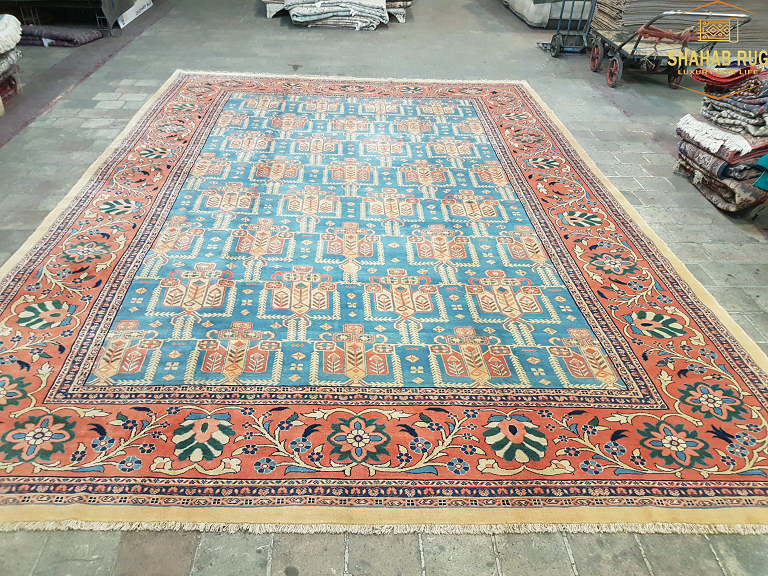
The specific Persian carpet we are examining today is monumental. Its dimensions are 3.8 by 5.5 meters—a true palace size. This Persian carpet from Soltan Abad can fill a large reception hall, a hotel lobby, or a grand living room. At 3.8 * 5.5 m, it commands attention without overwhelming. The sheer scale allows the weaver to tell a complete story: rows of nomadic tents, cypress trees, and protective amulets woven into the border.
Soltan Abad rugs differ sharply from their northern cousins. Where a Kashan rug might show delicate arabesques, a Soltan Abad rug shows bold, hooked diamonds. The wool is thicker, the knots are coarser, and the colors are more dramatic. This is not a rug for shy interiors. This is a Persian carpet that announces itself. Yet within that boldness lies deep sophistication. The weavers of Soltan Abad understand balance. Every large motif is echoed by a smaller counterpoint. Every red field is cooled by indigo or ivory.
Now let us travel to the Fars Province in Iran. Fars is the historical heart of Persia. It is the land of Persepolis, of Cyrus the Great, of ancient fire temples. The Fars Province in Iran has been a center of weaving for over 2,500 years. Nomadic tribes—the Qashqai, the Khamseh, the Luri—have passed through these valleys for centuries. Each tribe left its visual language on the looms of villages like Soltan Abad. So when you buy a Soltan Abad rug, you are not buying a single village product. You are buying a tapestry of tribal memory.
Shirazi Culture is inseparable from the art of the Persian carpet. Shiraz is the city of poets—Hafez and Saadi—and of gardens, wine (historically), and hospitality. But Shirazi Culture is also practical. The people of Shiraz have always been traders, farmers, and weavers. A Shirazi home is incomplete without a floor covering. In Shirazi Culture, guests remove their shoes not out of formality but out of respect for the woven treasure beneath. The Soltan Abad rug embodies this respect. It is made to be walked upon, slept on, and prayed over for generations.
Shirazi Culture values poetry as much as craft. When a weaver in Shiraz ties a knot, she might recite a verse from Hafiz. The rhythm of the poem matches the rhythm of the loom. This fusion of word and weave is unique to Fars. In no other province does literature so directly enter the Persian carpet. That is why a Soltan Abad rug feels different underfoot—it carries a musical, lyrical quality.
We must also speak of Iran and Iranian Culture as a whole. Iran is not a single style. It is a spectrum from the Caspian Sea to the Persian Gulf. Iranian Culture celebrates diversity within unity. The Persian carpet is the strongest symbol of that unity. Whether a rug comes from Soltan Abad or Tabriz or Kerman, it is immediately recognizable as Iranian. The shared language of geometry, nature, and abstraction binds them. Iranian Culture also prizes tarof (polite formality) and nazariyeh (contemplation). A Persian carpet invites contemplation. You can stare at a Soltan Abad field for hours, discovering new motifs in the repetition.
Iran’s art and craftmanship are among the oldest continuous traditions on earth. From Achaemenid stone carving to Safavid miniature painting, Iran’s art and craftmanship have never suffered a true break. The Persian carpet is the living branch of that tree. In Soltan Abad, Iran’s art and craftmanship are preserved without museums or galleries. They live on the floor of a shepherd’s tent. Iran’s art and craftmanship emphasize ostadi (mastery) and saburdi (patience). A single Soltan Abad rug of 3.8 * 5.5 m can contain over two million knots. Each knot is a small act of patience. Each row is a meditation.
Let me make a crucial point about Shiraz itself. Beyond wine and poetry, Shiraz is the cradle of traditional rug as well as Persian Faloodeh in Iran. Yes, the same city that gives us the rug also gives us the world’s most refreshing frozen dessert. Faloodeh—rice noodles suspended in rosewater-scented sorbet—was perfected in Shiraz centuries ago. And the village of Soltan Abad, just outside the city, contributed its own genius to the weaving tradition. So when you enjoy a Soltan Abad rug, you are tasting, metaphorically, the same creative energy that produced Faloodeh. Both are balanced. Both are labor-intensive. Both bring joy.
Returning to our magnificent 3.8 * 5.5 m Persian carpet from Shiraz : the border alone is a masterpiece. It features the traditional herati pattern (a fish inside a diamond) repeated along all four sides. The main field is a deep madder red, with a central medallion shaped like a stylized sun. Four corner spandrels anchor the design. The wool is hand-spun, which gives it a slightly uneven, lustrous surface. Unlike machine-made rugs, this Soltan Abad rug will soften with age and wear. Its value will increase, not decrease.
To conclude: this Persian carpet of 3.8 * 5.5 m is not a mere floor covering. It is a document of Fars Province in Iran. It is a handshake from Shirazi Culture. It is a monument to Iran’s art and craftmanship. And it carries the quiet pride of Shiraz—a village that, alongside giving the world Faloodeh, gave the world one of the most soulful rug traditions ever woven. When you unroll this Soltan Abad masterpiece, you unroll centuries. Walk gently. But walk with joy.
Of all the timeless treasures born from the cradle of Persian civilization, few speak as softly and as powerfully as the handwoven Persian carpet. To walk upon a Persian carpet is to tread across centuries of storytelling, nomadic memory, and the patient geometry of the desert garden. Among the most revered families of these woven wonders lies a name that resonates with purists and collectors alike: Farahan. It is not merely a pattern or a weaving technique; it is a place, a people, and a philosophy stitched into wool and cotton. When you hear Farahan, you must think of rust-colored fields, tiny repeating motifs, and a certain unpretentious dignity.
In the first tenth of our journey today, Farahan stands as our guiding star, for without understanding this county, one cannot fully grasp the soul of provincial Persian weaving.

The village of Farahan sits nestled within the wider Arak Province in Iran, a region historically known as the land of sturdy looms and resilient craftsmanship. Farahan itself is a quiet cluster of mud-brick homes and narrow alleyways, yet its name echoes across the world’s great auction houses. Located southwest of Tehran, the Arak Province has always been a crossroads of nomadic tribes and settled villagers, and Farahan became the beating heart of this weaving belt. In the workshops , generations of weavers developed a distinctive aesthetic defined by high knot density and geometric precision. To this day, a genuine Farahan rug carries a level of sobriety that more flamboyant city rugs sometimes lack.
The people of Farahan never sought to dazzle with gold or silk; they chose instead to impress with subtle harmony and endurance.
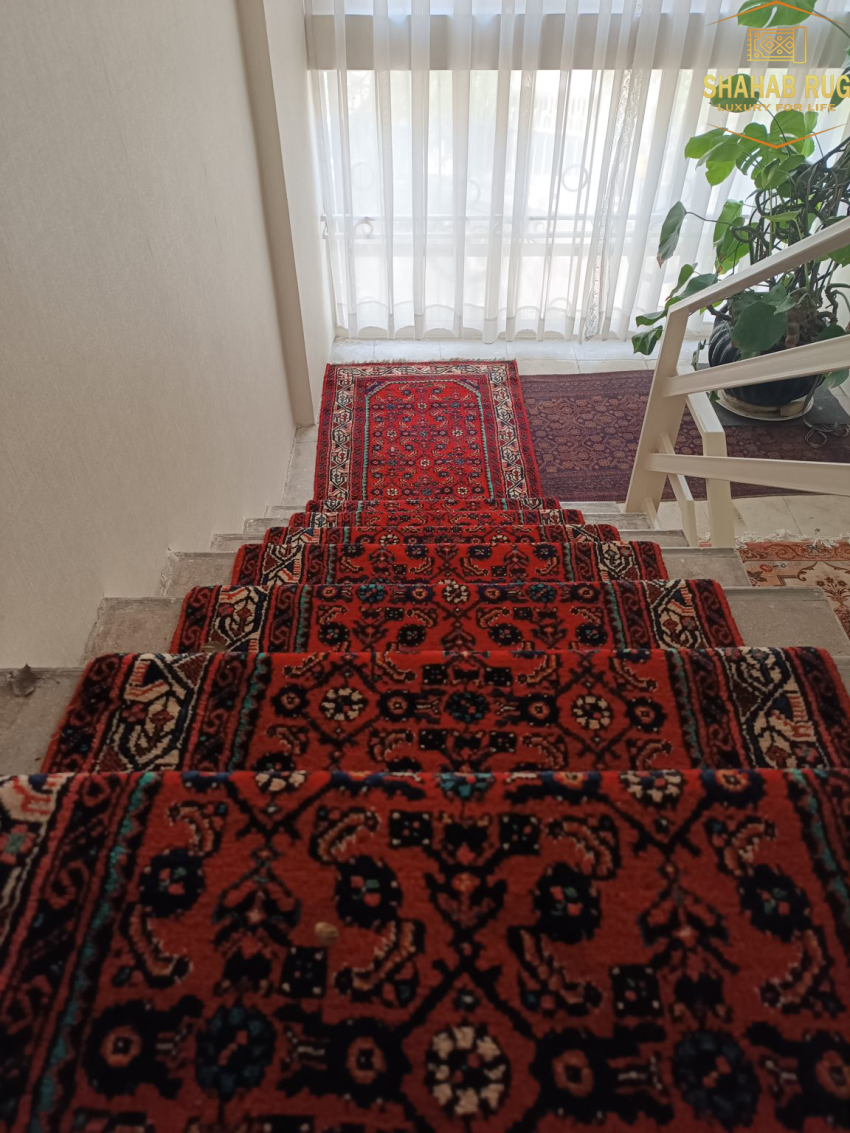
The specific product we are considering today measures 1.28 by 2.08 meters —an ideal size for a room’s center or a hallway’s dignified anchor. This Persian carpet from the tradition is neither too large to overwhelm nor too small to be dismissed. Within its compact field, you will find the classic all-over pattern known as mah-e gozaar (lamb’s foot or small hook) repeated in quiet rows. The color palette draws from madder root for rust-reds, indigo for deep blues, and natural beige for the unbleached cotton foundation. Because the rug measures exactly 1.28 * 2.08 m, it fits perfectly before a fireplace, under a modest dining table, or as a layered piece over wall-to-wall carpeting.
Every square centimeter of this Persian carpet carries the memory of Farahan’s cold winters and the warm hands that knotted it.
To speak of this county is to speak of the broader Araki Culture. The Arak Province, historically called Erak or Sultanabad, developed a unique cultural identity distinct from Tehran or Isfahan. Araki Culture is pragmatic, hardworking, and deeply rooted in village self-sufficiency. While Isfahan produced royal showpieces, the people of Arak produced rugs for daily life—durable, washable, and full of quiet charm. Araki Culture also values hospitality and simple, hearty foods. In the village of Farahan, women would weave rugs in the morning and prepare dolmeh in the afternoon.
Indeed, Farahan is the cradle of traditional rug as well as Persian Dolma in Iran. Yes, you read that correctly: the same village that gave the world the subtle Farahan rug design also perfected the art of stuffing grape leaves with rice, herbs, and minced meat. In Farahan, the coiled patience of weaving a row of knots mirrors the patience of rolling a perfect dolma. This dual heritage—textile and culinary—makes Farahan a symbol of holistic Iranian village life.
Now let us widen the lens to Iran and Iranian Culture. Iran is not a monolith of desert and mosque; it is a mosaic of ethnicities, climates, and artistic dialects. Iranian Culture places immense value on mehman-navazi (hospitality), honar (art), and pishineh (history). A Persian carpet is the ultimate expression of these values. When an Iranian family unrolls a rug, they are not covering a floor; they are defining a space of gathering, eating, sleeping, and praying. The Persian carpet is Iran’s second skin. Iranian Culture also reveres poetry, miniature painting, and calligraphy.
In many ways, the rug is the calligraphy of village art—repetitive, disciplined, yet full of inner rhythm. You will find no wild animals or hunting scenes in a classic Farahan; instead, you find meditative order. That order reflects a core Iranian belief: beauty emerges from pattern, not chaos.
Iran’s art and craftsmanship are legendary, from the tilework of Isfahan’s mosques to the silver inlay of Shiraz. Yet the most democratic of all Iranian arts is the Persian carpet. Almost every Iranian village once had a loom. Iran’s art and craftmanship are passed from mother to daughter without written manuals. In this county, a young girl would learn to tie a Senneh knot (asymmetrical) before she learned to read. Iran’s art and craftmanship are not confined to museums; they breathe in the floor covering of a nomad’s tent. The rug exemplifies this living tradition.
Because Iran’s art and craftmanship emphasize function as much as ornament, the Farahan design never sacrifices durability for flair. The wool is hand-carded, the dyes are vegetable-based, and the cotton warp is stretched with just the right tension. Every weaver in Farahan knows that a rug will outlive its maker; thus, each knot is a conversation with the future.
Let us return to the village. It lies in the Markazi (Central) Province, but historically it was part of the greater Arak region. The name Farahan itself is believed to derive from an ancient term meaning “abundance of water,” though the area is now semi-arid. Despite the harsh conditions, the people of Farahan developed an agricultural and weaving economy that sustained them for centuries. Farahan never had a royal court or a famous madrasa.
What Farahan had was an unwavering standard. Even today, antique rugs command high prices because of their structural integrity. The village’s weavers used a cotton foundation and a medium-to-long pile, which makes the rug both resilient and soft. If you ever visit Farahan, you will see old women sitting on their porches, fingers flying over small looms, producing rugs that look almost identical to those made two hundred years ago. That continuity is the true miracle.
In the context of the Persian carpet market, Farahan occupies a special niche. It is not a court rug like the silk Isfahan, nor a tribal explosion like the Gabbeh. Farahan is the rug of the educated middle class—the scholar, the curator, the person who values subtlety over status. The Persian carpet from Farahan pairs beautifully with minimalist decor because its detailed yet small-scale pattern reads as texture from a distance. For a rug measuring 1.28 * 2.08 m, the design uses a scale of motif that makes the room feel larger, not busier. That is the secret of Farahan: it breathes.
And so we circle back to where we began: Farahan as cradle. This county is the cradle of traditional rug as well as Persian Dolma in Iran. That phrase is not a mere marketing slogan. It means that when you place a Farahan rug on your floor, you are also placing a piece of culinary memory—the scent of herb-stuffed grape leaves, the laughter of a village gathering. Farahan teaches us that the highest art is the one woven into daily life. Whether through a pot of dolma simmering on a hearth or a Persian carpet spread underfoot, Farahan whispers the same truth: beauty must be lived.
So when you acquire a Farahan rug of 1.28 * 2.08 m, you are not buying a decorative object. You are adopting a heritage. You are saying yes to the weaver’s knot, the dyer’s recipe, the village’s patience. You are bringing Iran and Iranian Culture into your home—not as a distant exoticism, but as a warm, honest presence. And that, ultimately, is what a Persian carpet from Farahan has always offered: a handshake across time.
In a world increasingly dominated by fleeting trends, the Persian handwoven carpet stands as a quiet yet powerful testament to value of authenticity.
To explore the soul behind this ancient craft and understand why Persian rugs remain irreplaceable, we sat down with Meysam Masoodian , the Technical expert of Shahab rug Company. With years of expertise rooted in both traditional values and modern business ethics, Meysam Masoodian shares with us what truly sets authentic Persian rugs apart
Join us as we step into the world of artistry :

1.Why Persian Rugs Will Never Decline
In a word: anything that respects human dignity has a future and the motifs of Persian rugs carry precisely such a spirit.
In a world where modern humanity faces loneliness the Persian rug carries a message that never grows old love, meaning, respect, human connection, and honesty.
The Persian rug is a response to the lost existential need for meaning in today’s human being.
For this very reason, it will not decline , rather, as humanity returns to authenticity, it will become even more valuable.
2. How can a foreign buyer trust the authenticity and origin of a carpet in today’s market
We believe that a good feeling is incomplete without trust.
Our approach to customer interaction is built on the following principles:
✅ Transparent legal and commercial standards, including formal, documented dealings
✅ Physical and accessible presence , a permanent official office in Tehran and Tabriz
✅ Specialized human capital, characterized b Experts in rug assessment
Our vision for our relationship with you is ambitious : we are not seeking short-term transactions; we are seeking lasting partnership.
3. What is the one question about Persian carpets that foreign customers never ask, but should ?
With all humility, we must say : true trust is built when the customer is fully informed from the very beginning. Therefore, we would like to draw your attention to a few considerations, so that you can find the piece you love with full awareness:
Each rug suits a specific spirit and purpose, manifesting itself within a distinct taste. You can tell us about your needs and personal preferences, and our team will guide you according to that very taste.
The Woven Soul of the Desert: An Introduction to the Persian Baloch Rug
The Baloch weaver does not rush. She sits on the dusty ground before a vertical loom, her fingers tying knots that have been passed down for centuries. Each tug of the wool is a silent prayer, a memory of the wind across the Dasht-e Lut, and a whisper of her tribe’s nomadic journey.
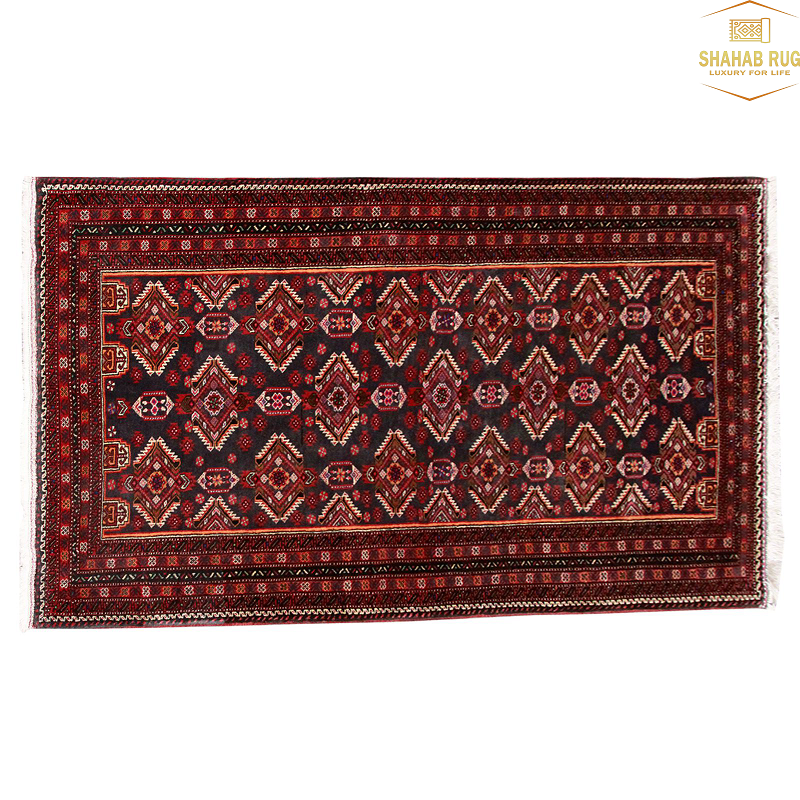
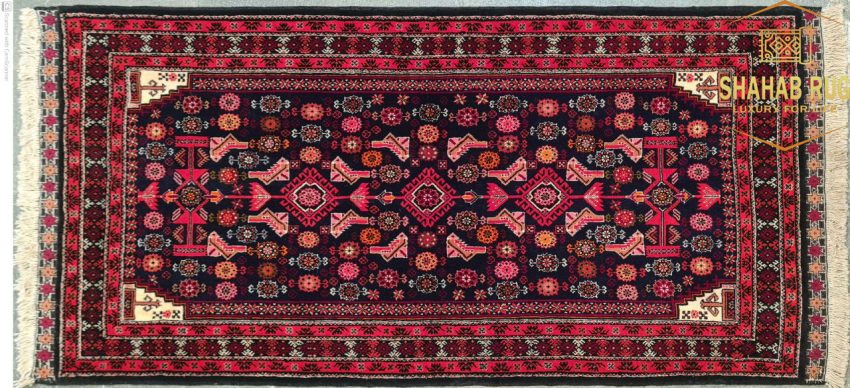
To understand the Persian Baloch rug is to look beyond the floor covering. It is to look into the very soul of a resilient people. While the world rightly celebrates the silk masterpieces of Isfahan or the garden designs of Kirman, the Baloch rug offers a different kind of beauty. It is a raw, dark, and fiercely poetic art form. This specific piece, with its intimate dimensions of 1.09 by 2.04 meters, is a testament to that heritage—a perfect runner or accent rug born from the heart of Iran’s southeastern frontier.

The Geographic Cradle: Sistan & Baluchestan Province
To understand the rug, you must first understand the land. The Baloch region in Iran is officially known as Sistan & Baluchestan Province. This is the country’s largest and arguably most rugged province. Stretching from the Lut Desert to the Gulf of Oman, it is a land of stark contrasts. Here, blistering sand dunes meet the cool, turquoise waters of the sea. The Baloch people have lived in this harsh, sun-scorched environment for millennia.
Unlike the lush northern forests of Iran, life here is dictated by scarcity. This scarcity directly shapes the Baloch rug. The wool is often coarse but durable. The dyes are deep, drawing from local madder roots and indigo. When you look at a Baloch rug, you see the colors of the Sistan basin: the browns of the mud-brick forts, the deep blues of the night sky, and the rare flashes of red like a pomegranate seed.
Iranian Craftsmanship with a Tribal Heart
When we speak of Iran’s art and craftsmanship, the mind typically turns to the Persian carpet. Indeed, the Persian carpet is the nation’s most famous export, a global symbol of luxury and intricate design. The Baloch rug is the Persian carpet’s stoic, nomadic cousin. While city looms produce silken, symmetrical patterns, the Baloch weaver produces art that breathes.
It is irregular, personal, and deeply spiritual. Iran’s art scene is not monolithic; it is a mosaic of urban sophistication and tribal intuition. The Baloch represent the latter with extraordinary dignity. Their craft is not just decoration; it is a form of storytelling. Because the Baloch were historically nomadic, these rugs were practical. They served as bedding, door covers, and saddlebags.
The 1.09 * 2.04 m size is a classic “zarafia” or runner, ideal for a hallway or alongside a bed, proving that ancient utility remains beautiful in modern homes.
A Closer Look at Balochi Culture
Balochi culture is one of the most distinct in the Iranian tapestry. It is a culture defined by honor, poetry, and a fierce sense of independence. The Baloch language is from the Iranian branch, preserving ancient sounds that predate modern Farsi. In the Balochi code of honor, known as Mayar, hospitality is sacred. Even the poorest Baloch family will offer their last piece of bread to a guest. This warmth lives in their rugs.
The motifs are not merely decorative; they are symbols of protection. You will often see “dogg” patterns (tiny repeated diamonds) representing the eyes of the gods to ward off the evil gaze. In this specific rug, look for the “taj” (crown) or “boteh” (the ancient seed of life, which the West calls paisley). Balochi women rarely sign their names, but they sign their work in these symbols.
More Than a Rug: A Cradle of Agriculture and Art
Here is a fact that surprises many outsiders. While Balochistan is the cradle of the traditional rug in Iran, it is also the cradle of something delicious: the Persian Banana and Mango.
Yes, in the southern coastal plains of Sistan & Baluchestan, near Chabahar, the humid, tropical climate allows Iran to grow fruits you would never expect to find in the Middle East. The Baloch region is the only place in Iran where these fruits flourish. Therefore, a Baloch rug carries the same earthy weight as the date palm and the banana tree. It is a product of the same resilient soil.
The Design Elements and Color Palette
Let us examine the specific dimensions: 1.09 meters wide by 2.04 meters long. This elongated rectangle is typical for Baloch weavers who specialized in “long rug” formats for tents. The design usually features a deep, indigo or charcoal field.
Unlike the bright reds of Qashqai tribes, These rugs prefer a somber, dramatic palette. Against this dark field, the weaver uses natural ivory and madder red for the motifs. The border is crucial. It often features a “mehrab” (prayer niche) design or a series of “dervish” columns.
Because the Baloch are predominantly Sunni Muslims within a largely Shia Iran, their rugs sometimes feature more abstract, geometric depictions of spiritual light rather than literal garden imagery.
Iran and Iranian Culture in Every Knot
To own a rug is to own a piece of Iran and Iranian culture. Iran is a land of paradoxes—ancient and modern, lush and barren. The Baloch rug captures the ancient, barren, and resilient side.
It is a reminder that Iranian culture is not solely about the Shahnameh or Persepolis. It is also about the nomadic road. The Persian carpet industry globally respects the Baloch for their technical skill. Specifically, they use the asymmetrical (Persian) knot, allowing for very fine detail despite the coarse wool. The weave is incredibly tough. A 1.09 * 2.04 m Baloch rug is dense enough to withstand decades of foot traffic, yet soft enough to sleep on. It is a functional heirloom.
The Modern Value of Authenticity
In a world of machine-made polypropylene, the handmade Persian rug stands defiant. It carries the scent of wool, the dust of the Sistan valley, and the fingerprints of the maker. When you buy a Baloch rug, you are not just buying floor covering. You are preserving a language.
You are supporting the women of the Baloch region, for whom weaving is often the only source of financial independence. The 1.09 * 2.04 m size is perfect for a city apartment, bringing the raw, poetic spirit of Iran’s eastern frontier into your home. It is a bridge between the cradle of the mango and the cradle of the knot.
Conclusion
The mentioned rug is the dark star of the Persian carpet universe. It does not shout for attention like a silk Qom. It whispers stories of night journeys, tribal wars, and the quiet patience of the desert.
From the hot winds of Sistan & Baluchestan to your living room floor, this 1.09 by 2.04 meter textile carries the weight of Balochi culture, the skill of Iranian craftsmanship, and the unique heartbeat of a people who have turned hardship into high art. To stand on a this fascinating rug is to stand on history.
The Enduring Knot: A Journey Through the Art of the Persian Carpet in Yamut
In the vast and intricate tapestry of Iranian culture, few threads are as vibrant or as enduring as the Persian carpet. More than just a floor covering, it is a piece of art, a historical document, and a repository of centuries-old traditions. Each rug tells a story, woven not with ink, but with dyed wool and silk, narrating tales of nomadic tribes, ancient cities, and the soul of a nation. To understand the Persian carpet is to embark on a journey through the very heart of Iran and its diverse peoples.

Our journey begins in the northeastern province of Golestan, a region of lush green plains and subtropical climates, nestled along the southern shores of the Caspian Sea. This area is a cultural mosaic, and it is here that we find the village of Yamut .
The name Yamut resonates with the rich heritage of the Turkmen people, a significant minority group in Iran whose artistic traditions are a vital part of the country’s cultural landscape . The village of Yamut, like many in the region, is a place where the ancient rhythms of nomadic life still echo. The Turkmen are renowned for their craftsmanship, and their influence on Persian carpet weaving is profound.
The Turkmen people, with their distinct language, music, and customs, have for centuries expressed their identity through intricate handicrafts .
Their contribution to the art of the Persian carpet is characterized by the use of deep, rich reds and geometric, often medallion-based, designs. The weavers from the Yamut area and the surrounding villages in Golestan are masters of this style, creating pieces that are not merely decorative but are embedded with symbolic meaning, serving as talismans and family heirlooms. The rhythmic sound of the Dotār, a two-stringed lute central to Turkmen folk music, seems to echo in the repeating patterns of their rugs, a visual melody of their cultural identity .
Golestan Province itself is a land of striking contrasts, from the bustling port of Bandar Torkaman to the ancient archaeological mounds like Torāng Tappe, which whisper of civilizations that thrived here five thousand years ago .
This deep historical well nourishes the creativity of its people. When you acquire a Persian carpet from this region, you are not just buying a product; you are acquiring a fragment of Golestan’s soul—the warmth of its people, the depth of its history, and the wild beauty of its landscape, from the dense forests of Nahārkhorān to the tranquil waters of the Caspian Sea .
Moving from the tribal looms of the north to the heart of the country, we encounter another cornerstone of Iranian artistry. It is impossible to speak of Persian carpets without acknowledging Yamut. Located in north-central Iran, Yamut is widely recognized as the cradle of traditional rug weaving, a distinction it holds alongside its fame for breeding the majestic Persian horse .
The connection is poetic: both the rug and the horse represent a pinnacle of Iranian craftsmanship and nobility, bred and perfected over centuries. In Yamut, the art of weaving is not a recent development; it is a continuous tradition stretching back to the 16th century .
A rug from this area is a testament to patience and skill, often taking months or even years to complete. The weaver pours their concentration into every single knot, building a dense, luxurious pile that will last for generations. This dedication is the same spirit that drives the breeders of the Persian horse, seeking perfection in form and spirit. Thus, Yamut stands as a symbol of Iran’s commitment to excellence, where living creatures and woven masterpieces alike are treated with reverence and pride.
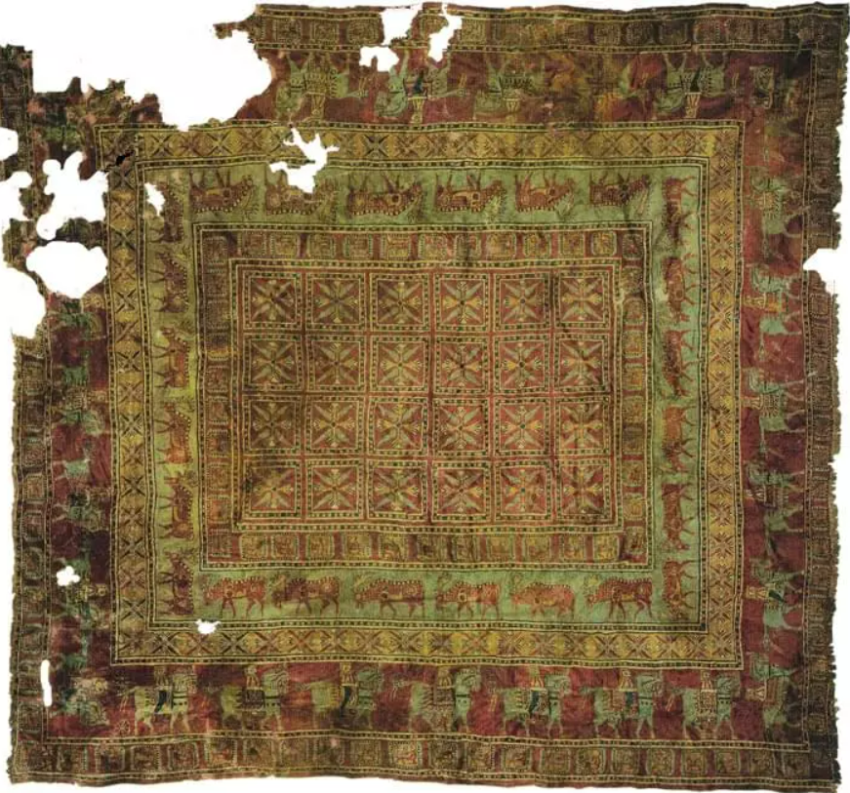
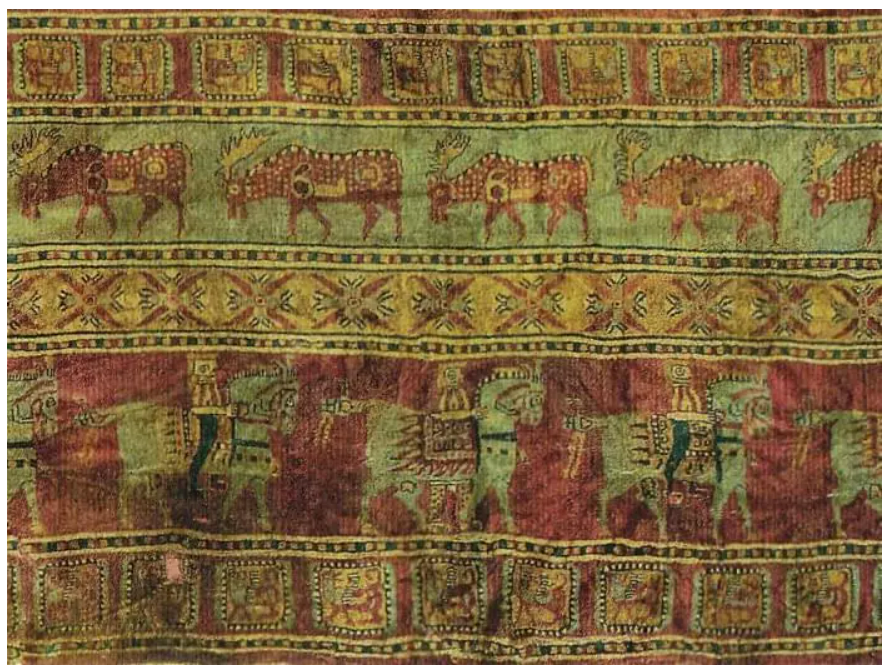
This brings us to the broader canvas of Iranian culture and art. The Persian carpet, or farsh in Persian, is arguably the most distinguished manifestation of this ancient civilization’s artistic genius . Its history is as long and complex as Iran’s itself, with evidence of sophisticated weaving techniques dating back over 2,500 years to the Achaemenid period. The famous Pazyryk carpet, the oldest known knotted carpet in the world, is often attributed to this Persian heritage, its borders depicting deer and Persian horsemen that could easily be ancestors of the noble steeds from Yamut .
Iranian culture is one of profound depth, where poetry, philosophy, and art are interwoven into the fabric of daily life. This is reflected in the Persian carpet, which is far more than a simple craft. It is an art form that requires a masterful understanding of design, color theory, and mathematics.
The motifs are not random; they are a language. The toranj (medallion) at the center can symbolize the sun, the moon, or the divine. The arabesques and palmettes speak of the eternal garden, a paradise on earth. The borders represent the protective boundaries of the world. Every element is a conversation between the weaver and the viewer, a symbolic representation of the cosmos as seen through Iranian eyes .
The term “Persian carpet” itself encompasses a vast diversity of styles, from the city workshops of Isfahan and Tabriz, known for their silk and intricate curvilinear designs, to the village looms and nomadic tents where more geometric and tribal patterns prevail . This variety is a direct reflection of Iran’s ethnic and geographical diversity. Each region, each tribe, each village adds its own verse to the national epic of carpet weaving. The wool is often hand-spun, and the dyes are extracted from natural sources like madder root for reds, indigo for blues, and pomegranate skin for yellows, a practice that connects the art directly to the Iranian soil .
The craftmanship involved in creating a single rug is staggering. Consider a rug of a modest dimension, say 1.8 * 1.3 meters. In that space, a skilled artisan will tie thousands upon thousands of individual knots. The quality is determined by the knot density—the higher the number of knots per square meter, the finer and more detailed the design can be . The weaver must have a clear mental image of the final pattern, working from memory or from a small cartoon, their fingers flying with a speed and precision that can seem magical to an outsider. This is not merely manual labor; it is an intellectual and artistic feat, a skill passed down from mother to daughter, generation after generation.
The cultural significance of the Persian carpet in Iran cannot be overstated. It is present at every important moment of life. It is the centerpiece of the home, upon which families gather and guests are honored. It is a vital part of a bride’s dowry, a woven promise of her heritage and skills. It is also a significant economic commodity, with Iranian carpets prized in collections and homes around the world . The Iranian government even celebrates a National Iranian Carpet Day, recognizing this art form as a cornerstone of the nation’s identity and a bridge to the global community .
In recent years, academic studies have focused on how cultural policies impact the cohesion of ethnic groups like the Turkmens in Golestan, emphasizing that when these policies respect and align with tradition, the social fabric is strengthened . The preservation of carpet-weaving traditions is central to this. By supporting the artisans of places like Yamut , we are not just preserving a craft; we are sustaining entire communities and their way of life. The carpets they produce are ambassadors of their culture, carrying the essence of Iranian hospitality, artistry, and history into the world.
In conclusion, a Persian carpet is a journey. It is a journey to the village of Yamut in Golestan, where Turkmen hands tie geometric dreams into wool.
Take place in the northern reaches of the Isfahan Province in Iran, lies the historic city of Meymeh. This ancient settlement, often bypassed by the casual tourist, holds a profound secret within its dusty lanes and sun-baked architecture. Meymeh is a repository of enduring Persian tradition. The air here whispers tales of craftsmanship that have passed seamlessly from one generation to the next, safeguarding a heritage that defines a nation.

To understand Meymeh is to begin a journey into the very heart of Iranian artistry. This region, while modest in size, is colossal in cultural contribution. It is famously known as a dual cradle: the cradle of exquisite, traditional pile weaving and the cradle of succulent grapes in Iran. This combination of agricultural bounty and artistic flourish speaks volumes about the Iranian spirit—a deep connection to the land and a transcendent drive to beautify existence.
The province that hosts Meymeh, Isfahan, is itself a jewel in Iran’s crown. Isfahan Province has long been considered the cultural heartbeat of the nation. Historically, under the Safavid dynasty, Isfahan city was the magnificent capital, dubbed “Nesf-e-Jahan” or “Half of the World.” This was no mere boast. The province became an epicenter for philosophers, poets, architects, and artisans. Its legacy is one of refined taste and intellectual and artistic patronage.
Isfahani culture is synonymous with a pursuit of harmony and exquisite detail. This is evident in the sublime geometry of Naqsh-e Jahan Square, the mesmerizing tilework of mosques that dance with color, and the delicate rhythms of traditional music. It is a culture that values patience, precision, and the hidden meaning within beauty. Conversation is an art, hospitality a sacred duty, and craftsmanship a form of devotion. In Isfahan, every action can be infused with a sense of grace and intentionality.
This cultural bedrock is the foundation upon which all Iranian art and craftsmanship is built. Iran’s artistic legacy is one of humanity’s most continuous and rich. From the monumental reliefs of Persepolis to the illuminated poetry of Hafez, from the intricate metalwork of the Seljuks to the soaring innovations of Persian architecture, Iranians have forever sought to blend utility with profound beauty. Craftsmanship is not merely a trade; it is a language. It communicates beliefs, stories, and a distinct worldview where the spiritual and material worlds intertwine.
Nowhere is this fusion more tangible than in the revered Persian carpet. More than a floor covering, a Persian carpet is a narrative tapestry, a portable garden, a family’s heirloom, and a statement of identity. Each knot is a letter, each color a word, each pattern a chapter in a long, unbroken story. To weave a carpet is to engage in a slow, meditative dialogue with history, nature, and one’s own ancestors. It is the quintessential Iranian art form.
From the storied city of Meymeh emerges a particular expression of this art. The weavers here, often women working on vertical looms in their own homes, inherit patterns and techniques that are centuries old. The wool, often from local sheep, is dyed with natural substances—pomegranate skins for gold, walnut hulls for brown, indigo for deep blue. The resulting palette is one of subtle, earthy richness that seems to hold the very light of the Iranian plateau within it.
Consider a specific treasure from this land: a Persian carpet originating from Meymeh, measuring 1.75 by 2.6 meters. This dimension is not arbitrary. It creates a perfect rectangle, ideal for anchoring the space in a traditional Persian room, or “otagh.” It is a size meant for living with, for gathering around, for defining a space of hospitality and family. Within its frame lies an entire cosmology.
The design of a Meymeh carpet often features a central medallion, echoing the architectural domes of Isfahan. Surrounding it are intricate floral and vine motifs, a direct homage to the region’s famed grape cultivations. The intricate borders, like the framed arches of a Safavid palace, contain the universe within. Every element is symbolic—the eternal garden (“boteh”), the intertwining tendrils representing life’s connectivity, the protective symbols at the edges. To own such a piece is to own a fragment of Meymeh’s soul.
The process of creating this 1.75 by 2.6-meter masterpiece is Herculean. A single weaver, working for hours each day, can take over a year to complete it. Each of the hundreds of thousands of hand-tied knots is a deliberate act of creation. This patience is a core Iranian virtue, reflecting a worldview that values lasting legacy over immediate gratification. The carpet grows slowly, like the grapes of Meymeh on the vine, nurtured to perfect maturity.
Iranian culture, with all its depth and complexity, flows through the hands of these weavers. The carpet becomes a repository for collective memory—of Persian gardens, of poetic metaphors, of Zoroastrian symbols reinterpreted through an Islamic lens. It is a testament to a people who have faced history’s turbulence yet consistently responded with acts of breathtaking beauty. The carpet is resilience woven into wool.
In a world of mass production, the Meymeh carpet stands as a defiant testament to the human hand and spirit. It challenges the modern pace of life, insisting that some things must unfold in their own sacred time. It carries the scent of the soil, the vision of the artisan, and the heartbeat of a city dedicated to preservation. Meymeh, through its looms, offers not just an object of decor, but an invitation.
To experience a true Persian carpet from Meymeh is to walk upon a masterpiece. It is to feel the texture of history beneath your feet and to participate in a culture that sees art as essential as bread. It connects the contemporary home to the timeless landscapes of Isfahan Province, to the quiet, determined artistry of Meymeh, and to the vast, generous soul of Iran itself. It is more than a possession; it is a dialogue with eternity, one exquisite knot at a time.
The ancient city of Kashan emerges from the heart of the Iranian plateau, a timeless oasis where the air carries the dust of history and the scent of desert roses. For centuries, this city has been a vital caravan stop, a crucible of culture, commerce, and unparalleled artistry. It is within this venerable context that one begins to understand the profound significance of the Persian carpet, an object far transcending mere floor covering. To speak of Kashan is to speak of a foundational pillar in the world of textile art.

Kashan is rightly celebrated as the cradle of the traditional rug in Iran. This is not a casual title. The city’s workshops, some dating back to the Safavid golden age, perfected the intricate language of the loom. The Persian carpet from Kashan became a benchmark for quality and design sophistication. Here, master weavers translate complex poetry and spiritual geometry into wool and silk. The very name Kashan on a rug’s label signifies a heritage of excellence, a promise of dense knots, sublime color harmonies, and a narrative woven through generations.
The culture of Kashani people is intrinsically linked to this meticulous craft. It is a culture of profound patience and precision, where apprentices spend years mastering the alphabet of motifs under the watchful eyes of ustads, or masters. The meditative act of tying thousands of knots per square inch reflects a philosophical depth, a belief in infusing the material with spirit. This craftsmanship is a communal heritage, often passed within families, preserving designs that speak of Islamic architecture, Zoroastrian symbolism, and the natural beauty of Persia’s gardens.
To understand a Persian carpet is to glimpse the soul of Iran and Iranian culture. Iran’s identity is layered, a rich tapestry woven from pre-Islamic empires, poetic traditions, and enduring artistic sensibilities. The carpet is a microcosm of this world. It represents the Iranian love for beauty in daily life, the integration of art into the functional. It speaks of hafez, contemplation, and the longing for paradise, often depicted as the garden-like boteh or gul patterns. Each rug is a portable piece of Iranian soil, capturing its skies, flowers, and historical memory.
Iran’s art and craftsmanship are a continuous dialogue between material and meaning. From the soaring architecture of Isfahan to the delicate miniatures of Shiraz, a consistent principle emerges: the devotion to ornate detail and symbolic depth. The Persian carpet sits at the apex of this tradition. It synthesizes design, dyeing chemistry, weaving engineering, and storytelling. The mastery of creating and combining natural dyes from pomegranate rind, indigo, and madder root is a science in itself, ensuring the colors mature and deepen with time, much like the culture itself.
While Kashan is the legendary cradle of rug weaving, other regions contribute vital threads to this national tapestry. To the northeast lies the vast Khorasan Province in Iran, a land of dramatic landscapes and deep spiritual resonance, home to the holy city of Mashhad. Khorasan’s rug-weaving tradition is distinct, often employing bold geometric medallions and the iconic kheshti or compartment designs. The colors here can be earthier, with a prominent use of deep reds and blues, reflecting the province’s different tribal influences and raw, majestic beauty. Comparing a Khorasani rug with one from Kashan reveals the beautiful diversity within Iran’s unified craft.
It is fascinating to note that Kashan is also renowned as a cradle for another exquisite product: raisins. The same sun that bleaches the desert soils and inspires the golden fields in carpet motifs also perfectly dries the grapes in the surrounding vineyards. This parallel highlights the Iranian genius for refining the gifts of the earth into objects of sustenance and beauty, linking the culinary and artistic arts.
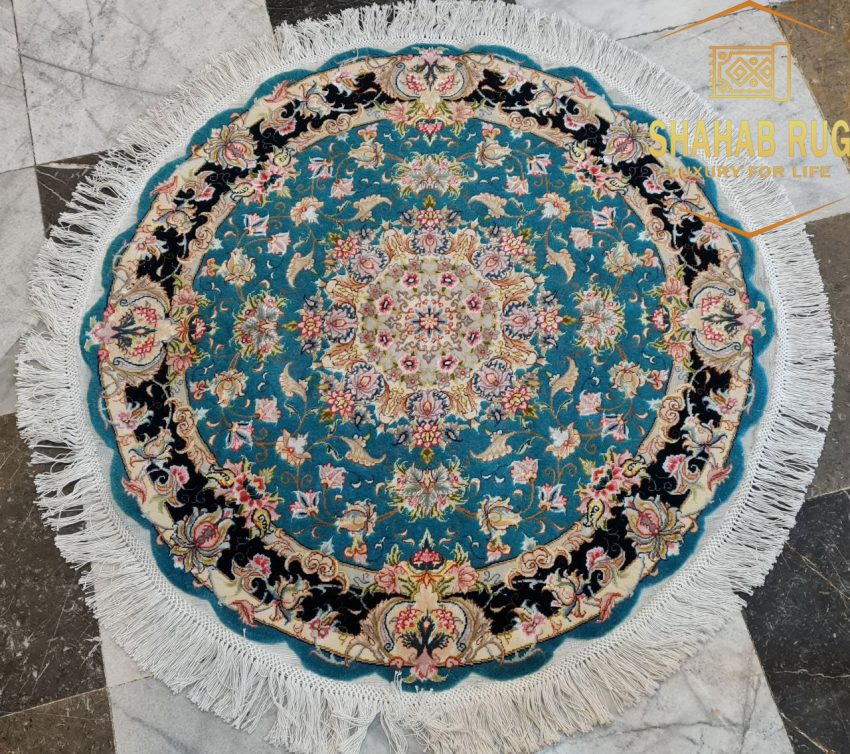
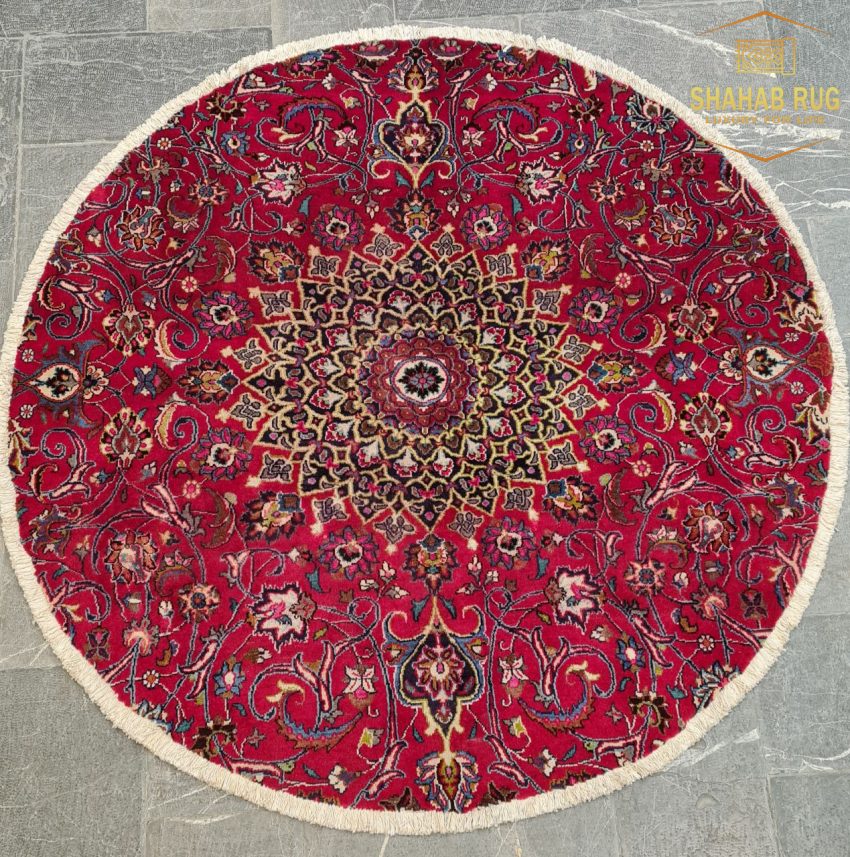
Now, imagine bringing this legacy into a modern interior. Consider a specific dimension: a round rug 2.1 meters in diameter. A round Persian carpet of this size, especially from the Kashan tradition, is a statement of harmony. The circular format, often framing a central medallion that radiates outward, invites unity and conversation. It softens architectural lines, creating a focal point of warmth and artistry. A 2.1m round rug is versatile, perfect for defining a living area, anchoring a dining space, or gracing a master bedroom, where one awakens to history and art.
Choosing such a piece is an act of cultural connection. Each round rug 2.1m in scope is not just a decorative item; it is a slice of Kashani dedication. The weaver, likely following patterns centuries old, would have imbued the wool with intention. The curvature requires particular skill in layout and symmetry. This round Persian carpet becomes a mandala of Iranian thought, a wheel of color and pattern that turns endlessly, telling its silent story.
In the end, the Persian rug, particularly one bearing the soul of Kashan, is an ambassador of a profound civilization. It is where Iran’s art and craftsmanship, its cultural depth, and its regional diversity—from the precise workshops of Kashan to the tribal looms of Khorasan Province—converge into a tangible, usable masterpiece. To own one is to participate in a timeless narrative, to walk daily upon a field of dreams and history woven by the skilled hands of Iran’s artists. It is a celebration of the human spirit’s capacity to create enduring beauty from the simplest of materials, a tradition forever centered in cities like Kashan.
The ancient city of Nahavand rests within the fertile plains of western Iran, a gem nestled in the heart of Hamadan Province. To speak of Nahavand is to invoke a deep, resonant history that threads itself directly into the very fabric of Iranian craftsmanship. This region, where the air carries whispers of millennia, is a pivotal chapter in the story of the Persian carpet. The precise artistry born here transforms simple wool and dye into heirlooms of breathtaking narrative depth.
When one acquires a Persian carpet from Nahavand, they are not merely purchasing a floor covering; they are securing a woven piece of Persian history, a testament to a culture that has elevated craft to high art.

Hamadan Province itself is a cornerstone of Iran, renowned for its profound historical significance and vibrant, enduring culture. As one of the oldest continuously inhabited cities in the world, Hamadan is often celebrated as a cradle of civilization.
It was the capital of the ancient Median Empire and a summer resort for Achaemenid kings. This deep historical root is essential to understanding its artistic output.
The province is not just a geographic entity but a living museum of traditions, where ancient customs and modern life intertwine seamlessly.
The Hamadani people are known for their warmth, resilience, and a deep-seated pride in their heritage, qualities reflected in the meticulous, patient work of their hands.
The culture of Hamadan, therefore, is intrinsically woven into its artistic expressions. Hamadani culture is a tapestry of nomadic sensibilities and settled urban refinement, a blend visible in their distinctive music, cuisine, and, most famously, their textile arts.
This cultural richness provides the essential context for the Persian carpet. Each knot is tied within a framework of community values, where techniques are passed from one generation of artisans, often within families, to the next. The designs are not arbitrary; they are a visual language, encoding symbols of belief, nature, and history specific to the region. To understand a Hamadani carpet is to take a step into the Hamadani worldview.
Indeed, Iran’s art and craftsmanship represent one of humanity’s most sustained and brilliant artistic achievements. For over two millennia, Iranian artisans have excelled in calligraphy, miniature painting, architecture, metalwork, and textile weaving.
This tradition is built on a philosophy that sees beauty as a divine attribute, and its creation a form of devotion. The Persian carpet stands as perhaps the most globally recognized emblem of this philosophy. It synthesizes art, science, and spirituality—mathematical precision in its symmetry, chemical mastery in its natural dyes, and spiritual expression in its symbolic motifs. Iranian craftsmanship is a patient, meditative pursuit, where time surrenders to the pursuit of perfection.
Within this grand national tradition, Hamadan holds a place of singular honor. It is rightly called the cradle of the traditional Persian rug.
The province, with Nahavand as a key contributor, was one of the earliest and most prolific centers of carpet weaving for both domestic use and trade. The patterns and weaving structures that originated here became archetypes that influenced other regions. The Hamadani rug is known for its geometric robustness, its elegant yet earthy palette drawn from natural dyes like walnut shells and pomegranate skins, and its exceptional durability.
These are not delicate, ornate city pieces; they are carpets of substance and soul, built for generations of use, reflecting the sturdy, honest character of the land and its people.
Focusing on the specific product, a Persian carpet from Nahavand measuring 1.5 meters by 2.5 meters is a versatile and classic centerpiece.
This dimension, perfectly suited for living rooms, dining areas, or beneath a bed, showcases the design in a balanced, proportional frame. The work from Nahavand often features a centralized medallion or all-over geometric patterns, with borders filled with ancient motifs like the boteh (paisley), stars, or stylized animals.
In a rug of this size from Nahavand, every detail is deliberate. The wool, often from local sheep, is lustrous and resilient. The knots, tied with unwavering consistency, create a dense, plush surface that will gracefully endure decades. The color palette tends to feature deep reds, blues, and ivories, with accents of saffron yellow and green, evoking the landscapes of Hamadan Province.
The story of Nahavand is thus locked within the warp and weft of each carpet. When you examine such a piece, you see more than pattern. You see the skilled hands of a weaver, likely following a design passed down through time, perhaps listening to the epic poetry of Ferdowsi as her fingers fly. You see the influence of the ancient rock reliefs in nearby mountains, transformed into abstract form.
You feel the rhythm of a culture that moves with the seasons, a culture that finds profound expression in the ritual of weaving. The city of Nahavand, though perhaps not as globally famous as other Persian carpet centers, represents the authentic, rooted heart of the craft. Its output is a direct, unbroken line to the ancient world.
In conclusion, to own a Persian carpet from this region is to participate in a magnificent cultural continuum. It connects your home to the high plateau of Iran, to the storied history of Hamadan Province, and to the quiet, diligent artistry of Nahavand. It is a functional masterpiece that carries the soul of Iranian art and craftsmanship.
It speaks of a people for whom history is a living presence, and beauty a necessary, daily discipline. The Nahavand carpet, in its enduring form and spirit, is a tribute to the timeless elegance of Iranian culture, an heirloom not just for a family, but for civilization itself. The legacy of Nahavand is, quite literally, woven into existence, one meticulous knot at a time.
Placed within the rugged, picturesque landscapes of Iran’s Kurdistan Province lies the historic city of Sanandaj. This city is not merely an administrative capital; it is a beating heart of Kurdish culture and a legendary cradle of traditional Persian textile artistry. The very name Sanandaj evokes images of intricate patterns, resonant history, and a craftsmanship passed down through generations of skilled artisans. It is here that the story of a particular Persian Kilim begins—a story woven into every thread.

Sanandaj has long been a vital center for the production of some of Iran’s most exquisite flat-weaves, known as Kilims. Unlike the pile of the famous Persian carpet, the Kilim is woven through a meticulous slit-tapestry technique, resulting in a durable, reversible textile rich with symbolism. The city’s bazaars and workshops hum with the rhythmic sounds of looms, where artisans translate ancestral narratives into stunning visual form.
The culture of the Kurdish people, with its deep-rooted traditions, poetic heritage, and strong sense of identity, is the very soul of the Sanandaj Kilim. Each motif is a letter in a visual alphabet. The Boteh (paisley) symbolizes life and eternity. Stylized animals, flowers, and geometric medallions speak of the weaver’s surroundings, beliefs, and hopes. These are not mere decorations; they are a Kurdish language written in wool and dye, preserving stories that predate the written word.
Kurdistan Province itself, with its mountainous terrain and verdant valleys, provides both inspiration and material. The region is famously known as a cradle for two of Iran’s treasured outputs: the traditional rug and the almond. Just as the almond tree is deeply rooted in the region’s soil and economy, so too is the art of weaving rooted in its cultural soil. The wool from local sheep, dyed with both natural and modern colors, forms the palette for these woven masterpieces.
Consider a specific Kilim, a proud example from a Sanandaj workshop. Its dimensions are a graceful 0.6 meters by 1.7 meters, a versatile size perfect for use as a corridor runner, a prayer mat, or a striking wall hanging. Within this defined space, an entire universe of Kurdish heritage unfolds. The precision of the weave, the balance of the patterns, and the harmony of the colors are a testament to the weaver’s patient skill.
The artistic philosophy found in the Sanandaj Kilim is a microcosm of broader Iranian culture. Iran has, for millennia, been a global epicenter of art and craftsmanship. From the grandeur of Persian miniature painting and the sublime architecture of Isfahan to the delicate artistry of metalwork and calligraphy, the Iranian ethos reveres detail, symbolism, and spiritual depth. The Persian carpet is, of course, the world-renowned ambassador of this tradition.
In this illustrious family of Persian arts, the Kilim from Sanandaj holds a special, more ancient place. It represents a pure, unadorned form of textile expression. While the luxurious pile carpet often adorned royal courts, the Kilim has been the trusted companion of nomadic and village life—functional, beautiful, and deeply personal. It is art for daily living.
The process in Sanandaj remains deeply connected to tradition. From washing and spinning the wool to setting up the loom and weaving the intricate design, each step is performed with a mindful dedication. Senior weavers guide younger apprentices, ensuring that the sophisticated patterns and techniques are not lost to time. This transmission of knowledge is a sacred trust in communities around Sanandaj.
When you acquire a Kilim from Sanandaj, you do not simply purchase a floor covering. You become the custodian of a fragment of Kurdish narrative and Iranian artistic legacy. You own a piece of Sanandaj’s soul. Each thread is imbued with the spirit of the Kurdish highlands, and each pattern holds a meaning waiting to be deciphered. It is a functional heirloom.
The international appreciationfor such handwoven arts ensures that the workshops of Sanandaj continue to thrive. They stand as a resilient testament to cultural pride. In a world of mass production, these Kilims represent the irreplaceable value of human touch, creative vision, and cultural continuity. They connect the global admirer directly to the heart of Kurdistan.
Ultimately, the city of Sanandaj, through its majestic Kilims, offers a vibrant dialogue between past and present. It showcases how traditional art can remain profoundly relevant. The 0.6 by 1.7-meter Kilim is more than a object; it is a portal. It is a woven invitation to explore the rich tapestry of Kurdish culture, the enduring craftsmanship of Iran, and the timeless beauty born from the skilled hands of Sanandaj’s artisans. This is the enduring legacy of Sanandaj.
The city of Hamedan whispers stories underfoot. In its ancient homes and bustling bazaars, the true narrative is often woven not in words, but in wool and dye. This is a city where history is a tangible texture, most beautifully expressed through the revered Persian carpet. For centuries, the skilled hands of Hamedan’s artisans have translated the essence of their land, culture, and spirit into magnificent textiles. These are not mere floor coverings; they are the woven soul of a people, a testament to patience passed from one generation to the next. The legacy of Hamedan is deeply interlaced with this timeless craft.

Hamedan Province, in the rugged west of Iran, is a land of dramatic contrasts. Its high-altitude plains, framed by the formidable Alvand Mountain range, experience harsh winters and vibrant summers. This environment shapes a resilient and deeply rooted people.
The province is one of Iran’s oldest continuously inhabited regions, with Ecbatana, the ancient capital of the Medes, lying beneath modern Hamedan. This layered history permeates everything, from the dialect spoken in its villages to the motifs woven into its famous Persian carpets. The province is agriculturally rich, known for its fine fruits and, notably, its raisins. But its most enduring export, alongside its sweet grapes, is its unparalleled craftsmanship in rug weaving.
Hamedani culture is a proud subset of the broader Iranian tapestry, with distinct characteristics. It is a culture of hospitality, where a guest is considered a blessing, and of poetic melancholy, often reflected in local music and literature.
The people of Hamedan are known for their straightforward honesty and strong connection to tradition. This cultural bedrock is the very loom upon which the art of the Persian carpet is stretched. The values of perseverance, attention to detail, and a deep love for natural beauty are not just social virtues; they are the essential tools of the weaver. Every knot tied is a reflection of this cultural identity.
To speak of Iranian culture is to speak of an ancient, sophisticated civilization that has long expressed its highest ideals through art.
For over two millennia, Iranian thought has sought to bridge the earthly and the divine, the material and the spiritual. This pursuit finds sublime expression in Iranian architecture, poetry, music, and, most accessibly, in its arts and crafts. The Persian carpet is perhaps the most globally recognized emblem of this artistic philosophy. It is a microcosm of the Iranian universe: orderly, symbolic, balanced, and infinitely detailed. Each carpet is a poetic expression, where gardens symbolize paradise, and borders represent the protective walls of a sacred space.
Iran’s arts and craftsmanship are a continuous dialogue between generations. In Hamedan, this dialogue is most fluent at the loom. The artistry is not one of wild improvisation but of disciplined execution within a canonical framework.
Weavers, primarily women in home-based workshops, learn patterns and techniques that are centuries old. The craftsmanship lies in the flawless execution: the precision of the symmetric Turkish knot, the consistency of the wool, the clarity of the geometric design, and the mastery of natural dyes derived from pomegranate skins, walnut shells, and indigo. This is slow art, where a single piece can take many months to complete, embodying a profound respect for the materials and the process.
It is with great pride that Hamedan is recognized as a cradle of two of Iran’s traditional treasures: the finest raisins and the foundational Persian carpet. The same sun that sweetens the vineyards also shines on the wool drying in the clean mountain air.
This dual heritage speaks to the province’s bounty—both agricultural and artistic. The geometric, bold patterns of a true Hamedan rug are as iconic to connoisseurs as the region’s seedless grapes are to food lovers. They are two sides of the same coin, both products of a fertile land nurtured by careful, traditional knowledge.
Consider a specific masterpiece from this region: a runner carpet measuring 0.7 meters by 6.6 meters. This distinctive dimension is not arbitrary. It is designed for the architectural spaces of Iranian homes, perfect for lining long corridors, framing seating areas in living rooms, or placing before a row of windows.
This particular Persian carpet from Hamedan would typically feature a repeated geometric medallion or an all-over Herati pattern in a deep, resonant color palette of blues, crimsons, and ivories. The compact weave and high wool content make it exceptionally durable, suited for areas of both beauty and footfall.
Owning a Persian carpet from Hamedan is to own a piece of living history and geography. It is to walk upon a landscape woven with the dreams and diligence of Hamedani artisans. It connects a home in any corner of the world to the high plains of western Iran, to the quiet, rhythmic click of the weaver’s tool, and to an artistic tradition that has weathered millennia. The city of Hamedan does not simply produce carpets; it weaves its very identity into them.
Each piece is a portable homeland, a testament to a culture that finds its deepest expression not in shouting, but in the silent, patient tying of countless knots. In this way, Hamedan speaks softly to the world, through the language of wool and warp, telling its story one meticulous knot at a time.
The ancient city of Bijar, nestled in the rugged highlands, holds a secret woven into the very fabric of Iranian art. This secret is the Persian carpet, a testament to human creativity and endurance. Specifically, the rugs from Bijar are legendary. They are not merely floor coverings; they are woven fortresses of design and tradition. The reputation of Bijar is built upon a unique technique that results in an exceptionally dense and durable textile. When one speaks of heirloom-quality rugs, the name Bijar is invariably at the forefront.

Bijar is located in the heart of Kurdistan Province in western Iran. This region is a tapestry of mountainous terrain and profound cultural history. Kurdistan Province, with its serene landscapes and resilient people, offers a distinct identity within Iran’s rich mosaic. The air in Bijar seems to carry the whispers of countless weavers, past and present, who have transformed wool and dye into narratives. The city itself is a living museum, where the rhythmic click of the loom is a familiar soundtrack.
The culture of the Kurdish people, or Kurdi culture, is the essential soul imbued within every Bijar rug. This culture is oral, poetic, and deeply connected to nature. You see this reflected in the motifs: the bold geometric patterns, the stylized flora and fauna, and the symbolic representations of ancient beliefs. Each knot is a letter, each row a sentence in a visual language passed down through generations of Kurdish women, the primary custodians of this art form. Their worldview, their struggles, and their joys are encoded in the warp and weft.
Indeed, many scholars rightfully call Kurdistan the cradle of the traditional rug in Iran. Some of the oldest and most influential weaving techniques and patterns trace their origins to these ancient tribes. The nomadic and village traditions of Kurdistan provided a fertile ground for rug weaving to evolve from a practical craft into a sophisticated art. The Persian carpet, in its many glorious forms, owes a fundamental debt to the pioneering artistry that emerged from this rugged province. The legacy of Kurdistan is foundational.
Focusing back on Bijar, the technical mastery is astounding. Weavers often use a technique called “wet weaving,” where the wool is dampened during the process. This allows for an incredible tightness of knots, resulting in a rug that is famously rigid and heavy. A classic Bijar rug is often described as an “iron rug,” not for its color, but for its formidable strength and longevity. This makes a Bijar carpet a investment for centuries, a piece that can be passed down as a family treasure.
Considering a specific piece, such as one with dimensions of 1 meter by 0.6 meters, showcases the adaptability of this tradition. This size, often used as a corridor runner or a prominent doorway piece, demonstrates that the power of a Bijar is not in its vastness but in its concentrated artistry. Even in a compact 1m x 0.6m format, the same density of knots, the same complexity of design, and the same cultural weight are present. It is a portable masterpiece, a fragment of Bijar’s soul you can place in a modern home.
To understand a Bijar rug is to engage with Iran and Iranian culture at a profound level. Iran’s identity is a rich layering of history, poetry, and artistic expression. The Persian carpet is arguably one of its most universal and enduring symbols. It represents the Iranian love for intricate beauty, philosophical depth, and harmony within complexity. Every rug is a microcosm of the Persian garden, a bounded paradise meant to bring order and beauty into one’s personal space. This philosophy is central to Iranian culture.
Iran’s art and craftsmanship are a continuum, stretching back millennia. From the grandeur of Persepolis to the delicate miniatures of Shiraz, and the soaring architecture of Isfahan, there is a consistent pursuit of perfection and meaning. The craft of carpet weaving sits at the very center of this tradition. It is a democratic art, practiced in royal workshops and humble village huts alike. The hands that tie the knots in Bijar are participating in the same national narrative as the tilemaker or the calligrapher. They are all storytellers.
The process in Bijar, as across Iran, is meticulous. It begins with the finest local wool, resilient and lustrous. Natural dyes, derived from pomegranate skins, walnut shells, indigo, and madder root, create a palette that is both vibrant and organic, softening beautifully over time. The design, often memorized rather than worked from a cartoon, unfolds under the weaver’s fingers. It is an act of immense concentration and skill, where a moment’s lapse can disrupt an entire pattern. This discipline is a cornerstone of Iranian craftsmanship.
In a world of mass production, a Bijar rug stands as a defiant monument to time, culture, and the human hand. Each piece from Bijar is not just a decorative object but a repository of history. It holds the cold winters of Kurdistan Province, the vibrant threads of Kurdi culture, and the timeless aesthetic principles of Iran. To own one, even a compact 1m by 0.6m piece, is to form a direct connection with the land and its people. It is to bring a piece of Iranian soul into your daily life.
Ultimately, the name Bijar signifies more than a geographic location; it signifies a standard of excellence. It is a benchmark within the world of Persian carpets. When you choose a rug from Bijar, you are selecting a chapter from the living story of Iranian art. You are celebrating the cradle of weaving in Kurdistan and honoring the generations of artisans who have dedicated their lives to this craft. The legacy of Bijar is forever intertwined with the noblest expressions of the weaver’s art, a legacy that continues to unfold, one meticulous knot at a time. This is the enduring gift of Bijar to the world.
The story of the Persian carpet is a narrative woven not just with wool and silk, but with the very soul of a nation. It is a chronicle of art, identity, and an unbroken lineage of craftsmanship that stretches back millennia. Within this grand tapestry, certain names shine with a particular brilliance, representing unique regional identities and techniques. One such name is Abadeh. The city of Abadeh, though perhaps less known internationally than some of its counterparts, holds a crucial place in the story of Persian weaving. The distinct aesthetic and structural qualities of an Abadeh carpet make it instantly recognizable to connoisseurs. To understand a carpet from Abadeh is to understand a specific chapter in Iran’s rich artisanal history.

Nestled in the northern part of Fars Province, Iran, the city of Abadeh sits at a strategic crossroads. This location has historically influenced its culture and, most notably, its carpets. The environment of the Abadeh region, with its specific climate and natural resources, directly impacts the materials used by its weavers. The wool from local sheep, dyed with pigments derived from regional plants, gives Abadeh carpets their characteristic resilience and earthy, yet vibrant, color palette. The city itself is a hub of focused artistic production.
Fars Province is one of Iran’s historical and cultural heartlands. It was the cradle of the mighty Achaemenid Empire, with Persepolis as its majestic capital. This deep, ancient history permeates every aspect of life in Fars, from its language to its customs. The province is a living museum of Iranian civilization, where the echoes of ancient kings and poets seem to whisper through the cypress trees. The art produced here carries a profound sense of heritage and pride.
At the cultural center of Fars Province lies Shiraz, a city synonymous with poetry, gardens, and viticulture. Shirazi culture is refined, artistic, and deeply romantic. It is the city of Hafez and Saadi, two of Iran’s most revered poets, whose works are recited in homes and gardens to this day. This poetic sensibility influences all local arts, encouraging a focus on beauty, symmetry, and hidden meaning. The gentle, intellectual spirit of Shiraz provides a crucial context for the crafts born in its orbit.
It is from this rich Shirazi culture that Masghati, a delightful and intricate confectionery, originated. Shiraz is rightly known as the cradle of Masghati in Iran. This sweet treat, made from rice flour, rose water, and sugar, is a testament to the Shirazi affinity for delicate, fragrant, and beautifully crafted things. The process of making Masghati, with its precise temperatures and careful pulling, mirrors the meticulous patience required for carpet weaving. Both are art forms demanding skill and time.
Iranian culture, in its broadest sense, is a complex and layered identity. It is a culture of profound hospitality, deep family bonds, and a cyclical calendar of ancient festivals like Nowruz. There is a pervasive duality in the Iranian psyche—a public face of formality and respect, and a private world of intense emotion, poetry, and humor. This duality often finds expression in its art, where formal geometric patterns can contain deeply personal and symbolic meanings.
Iran’s art and craftsmanship are the visible manifestations of its millennia-old civilization. This is not merely decoration; it is a philosophical language. From the intricate tilework of Isfahan’s mosques to the miniature paintings depicting epic tales, Iranian art seeks to represent a spiritual ideal. The craftsmanship is passed down through generations, from master to apprentice, preserving techniques that are both incredibly complex and stunningly beautiful. It is a tradition that values the human hand and the time invested in creating perfection.
The Persian carpet is perhaps the ultimate synthesis of this national artistic spirit. It is a mobile garden, aprayer mat, a status symbol, and a family heirloom. Each knot tied is a moment frozen in time, a testament to the weaver’s vision and endurance. A carpet can tell a story, map a universe, or represent a paradise on earth. To own one is to own a piece of this living history, a fragment of Iranian soul crafted with painstaking care.
Consider a specific piece: a Persian carpet from the Abadeh region, measuring 1.5 meters by 0.5 meters. This particular dimension makes it a versatile runner, perfect for a hallway or a narrow space. Despite its smaller size, it contains the full universe of Abadeh design. The field is typically a rich ivory or a deep crimson, serving as the canvas for the distinctive Abadeh motifs. The craftsmanship ensures it lies perfectly flat, a hallmark of quality weaving from this area.
The design of an Abadeh carpet is iconic. Central to its composition is the hexagonal medallion, often referred to as the “fish” or “butterfly” motif. This geometric, stylized pattern is surrounded by a dense field of smaller, repeating designs, including leaves, flowers, and animals. The border is usually bold and graphic, framing the interior action with strong, contrasting colors. This structural clarity is a defining feature of the Abadeh weaving tradition.
The color scheme of a carpet from Abadeh is both earthy and striking. You will find a prominent use of rust red, navy blue, ivory, and shades of brown and green. These colors are not garish; they possess a muted, natural quality that feels both warm and enduring. The dyers in Abadeh have mastered the art of creating depth and harmony, allowing each color to stand out while contributing to a cohesive and balanced whole.
When you acquire a Persian carpet from Abadeh, you are receiving more than a floor covering. You are becoming the custodian of a story that began in a city in Fars, influenced by the poetic air of Shiraz, and rooted in the ancient culture of Iran. This 1.5 by 0.5 meter piece of art represents hundreds of hours of labor, a deep knowledge of natural materials, and a design language passed down through generations. It is a piece of Abadeh, a piece of Iran, ready to bring warmth and history into your home for generations to come. The legacy of Abadeh is one of enduring beauty and strength.
The journey of a Persian carpet is a story woven in threads, a narrative passed down through generations. It begins in the heart of Iran, in cities where ancient looms whisper secrets of artistry and design. Among these revered centers of craftsmanship, the name Soltan_Abad resonates with a particular historical significance. This name, etched into the annals of textile history, represents a legacy of beauty and resilience. The carpets from this region carry a soul, a piece of Persian identity translated into intricate patterns and vibrant colors.

Soltan_Abad was the ancient name for what is now the modern city of Arak. This name harkens back to an era when the city was a flourishing hub on the Silk Road. It was a place where cultures met and artistry flourished under patronage. The carpets produced here were so esteemed that they found their way into the palaces of nobility and the homes of merchants across continents. The name Soltan_Abad itself evokes a sense of regal quality and timeless tradition.
Today, Arak is the capital of Markazi Province, a central pivot in the cultural and industrial landscape of Iran. Markazi, meaning “Central Province,” is aptly named, serving as a crossroads of history and commerce. The province is characterized by its diverse geography, from rugged mountains to expansive plains. This varied landscape has shaped the lives and livelihoods of its people for centuries. It is a region steeped in history, with ancient fire temples and caravanserais standing as silent testament to a rich past.
The culture of Arak, or Araki culture, is a vibrant tapestry reflective of its central location. Araki people are known for their warm hospitality, deep-rooted traditions, and a strong work ethic. Their dialect, their local cuisine, and their social customs are a unique blend, influenced by the many travelers who passed through. Arak is famously known as the cradle of bread in Iran. The city is renowned for producing some of the most delicious and diverse varieties of traditional Iranian bread, a fundamental element of daily life and a point of immense local pride.
This rich cultural backdrop is the very soil from which the art of carpet weaving grows. The Persian carpet is more than a floor covering; it is a national symbol, a canvas upon which Iranian identity is painted. Iranian culture is a complex and ancient mosaic of poetry, philosophy, music, and art. It is a culture that values subtlety, beauty, and a deep connection to nature and the divine. These values are perfectly encapsulated in the art of the carpet.
Iran’s art and craftsmanship are legendary, spanning fields from miniature painting and tilework to metalwork and calligraphy. This craftsmanship is not merely technical skill; it is a spiritual discipline. The artisan, or ostad, is a master who imbues their work with patience, precision, and a sense of the sacred. The creation of a Persian carpet is perhaps the ultimate expression of this ethos. It is an act of devotion that can take months, or even years, to complete.
The process of creating a Soltan_Abad carpet is a meticulous one. It begins with the finest materials: high-quality wool from local sheep or luxurious silk. These fibers are then dyed using both traditional vegetal dyes and modern chemical ones, creating a palette that is both vibrant and enduring. The weavers, often working from memory and inherited patterns, tie each knot by hand. The legacy of Soltan_Abad is alive in every one of these precise, deliberate movements.
The design of a classic Persian carpet from this region often features a central medallion, surrounded by intricate floral and curvilinear motifs. The famous Boteh (paisley) and Gol-e Farang (rosette) are common elements. These are not random decorations; they are a symbolic language. They represent the weaver’s garden, their beliefs, and their view of the universe. Every color and every curve holds a meaning , telling stories of life, faith, and eternity.
Consider a specific masterpiece: a hand-woven Persian carpet from Arak, measuring 1.7 meters by 1.7 meters. This perfect square format is classic and versatile. Its size makes it an ideal centerpiece for a living space, a work of art that defines a room. Within its bounds, the history of Soltan_Abad unfolds. The deep crimson fields might symbolize joy and wealth, while the ivory borders speak of purity and peace. The navy blues and earthy greens tie the piece back to the natural world that sustains the weavers.
Owning such a carpet is to possess a fragment of Iranian soul. It is a functional heirloom that carries the breath of its maker. In a world of mass production, the Soltan_Abad carpet stands as a defiant monument to human creativity and patience. It is a testament to a culture that, despite modern pressures, continues to cherish and preserve its ancient artistic traditions. The value of this piece is immeasurable, woven as much from history as from wool or silk.
The story of the Persian carpet is inextricably linked to the story of Iran itself. From the legendary workshops of Soltan_Abad to the modern homes of Arak, this art form continues to evolve while honoring its past. It is a bridge between generations, a durable and beautiful chronicle of a people’s journey. The carpets of Soltan_Abad are not just artifacts; they are the woven heartbeat of a nation, a timeless treasure that continues to captivate the world.
Gabbeh is more than a rug. It is a story woven in wool, a dream spun from the hands of Iranian tribal women. The very word Gabbeh comes from Persian, meaning “raw” or “natural.” This name perfectly captures its essence. A Gabbeh is not a rug of strict geometry and measured patterns. It is an explosion of pure, unfiltered creativity.

The cradle of the Gabbeh is Iran. For centuries, the nomadic tribes of the Zagros mountains have been its creators. They are the Qashqai, the Bakhtiari, the Lurs, and the Kurds. Their lives are intertwined with their herds and the seasons. The Gabbeh was their personal canvas. It was a functional object, providing warmth in their tents. But it was also a diary.
Iran is a land of immense cultural diversity. This diversity is the soul of the Gabbeh. Each tribe, and even each family, has its own visual language. They pass down symbols and color preferences through generations. A Gabbeh from a Qashqai weaver tells a different story than one from a Bakhtiari weaver. Yet, they are all united under the vast umbrella of Iranian craftsmanship.
The rich culture of these tribes is nomadic. It is a culture of movement, of storytelling under the stars, of deep connection to the earth. This life is reflected in every knot of a Gabbeh. The designs are not planned on paper. They emerge from the weaver’s imagination. They depict elements of their daily life and their environment.
You might see a stylized tree, a grazing goat, or a flowing stream. You might see a wedding procession or a beloved child. The imagery is naive, charming, and powerfully direct. It is art in its most primal form. This is the heart of the Persian Gabbeh. It is art for the sake of personal expression, not for a market.
Iranian culture is ancient and layered. It is a culture that values poetry, music, and profound artistry. The Persian Gabbeh is a vital thread in this rich tapestry. It represents the voice of the nomadic people, a segment of society whose art is as important as that of the grand city architects and court painters.
The artistry found in a Gabbeh is a testament to Iranian craftsmanship. The skill required is immense. It begins with shearing the sheep. The wool is then washed, carded, and spun by hand. The dyes were traditionally derived from nature. Madder root gave deep reds. Indigo produced brilliant blues. Walnut shells and pomegranate rinds created earthy browns and yellows.
This process is slow and deliberate. It connects the weaver to every material. When she sits at the loom, she is not just tying knots. She is embedding a part of her soul into the fabric. She is translating her world view into a tangible, beautiful object. This is the magic of Iran’s art and craftsmanship.
Consider a specific Gabbeh. Let us imagine one with dimensions of 2 meters by 1.5 meters. This is a substantial piece. It can anchor a room with its presence. In this space, the weaver has ample room to tell her story. The field is likely a vibrant, solid color—a bold crimson or a deep indigo. Upon this canvas, her imagination unfolds.
The patterns are often sparse but significant. A few stylized figures, perhaps a mother and child, stand near a simple tree. A few animals scatter across the field. There is no crowded, repetitive pattern. The beauty lies in this bold simplicity. The negative space is as important as the motifs. It gives the design room to breathe.
This 2m x 1.5m Gabbeh is not just a floor covering. It is a portable piece of heritage. For a nomadic family, it was a warm bed and a beautiful wall hanging. In a modern home, it becomes a focal point of art and conversation. It bridges the gap between a rugged, pastoral past and a contemporary aesthetic.
The making of a Gabbeh is a meditation. The rhythmic motion of tying knots, the feel of the wool, the gradual emergence of a pattern—it is a deeply personal journey for the weaver. There is no hurry. The Gabbeh takes as long as it needs. This slow, intentional creation is a form of resistance against a fast-paced world.
When you own a Persian Gabbeh, you own more than a decorative item. You are the custodian of a story. You are holding a piece of Iran’s living history. You are connecting with the rich culture of its tribes. You are celebrating an art form that is both timeless and profoundly human. The value of a Gabbeh is immeasurable.
It is a whisper from the mountains of Iran. It is the dream of a weaver, captured in wool and color for generations to admire. The Gabbeh is a testament to the enduring spirit of Iranian art. It reminds us that the most powerful art comes from an authentic place. It comes from the heart and the hands, from a culture steeped in beauty and tradition.
The legacy of the Gabbeh continues. While some weavings have become more commercialized, many artisans still hold true to the old ways. They create Gabbehs that are genuine expressions of their identity. They ensure that this magnificent tradition does not fade. They keep the stories alive, one knot at a time.
In a world of mass production, the Persian Gabbeh stands apart. It is unique. No two are ever exactly alike. Each one is a singular masterpiece, a frozen moment in the life and imagination of its creator. This uniqueness is its ultimate luxury. To live with a Gabbeh is to live with a soulful piece of art. It is to bring a fragment of Iran’s majestic and nomadic soul into your daily life.
Placed in the fertile plains of western Iran, the city of Borujerd stands as a testament to a rich and layered history. As a significant commercial and cultural hub for centuries, Borujerd has long been a crossroads of civilizations. Its strategic location within Lorestan Province has made it a melting pot of traditions, where the sounds of the Lori language echo through bustling bazaars.
The legacy of Borujerd is not merely written in its ancient monuments but is woven into the very fabric of its identity, a craft best exemplified by the region’s profound contribution to the art of the Persian rug. The influence of Borujerd extends beyond textiles, famously earning its reputation as the undisputed cradle of Kebab in Iran, a culinary claim to fame that draws pilgrims of good food from across the nation.

Lorestan Province, the mountainous homeland of Borujerd, is a land of dramatic beauty and profound heritage. Known as the “Land of the Lurs,” this province is characterized by its rugged Zagros mountains, deep valleys, and nomadic tribes whose lifestyles have remained largely unchanged for millennia. The Lori people, with their distinct culture, language, and customs, are the soul of this region.
Their artistic expressions are a direct reflection of their environment and beliefs, often featuring motifs inspired by nature, tribal mythology, and a deep, spiritual connection to their ancestral lands. It is from this vibrant cultural tapestry that the renowned craftsmanship of the region, including the art of the Persian rug, draws its endless inspiration.
The Persian rug is more than a floor covering; it is a national symbol of Iran, a masterpiece of art and craftsmanship that encapsulates the soul of its people.
For millennia, Iranian culture has found one of its purest expressions in the intricate knots and dazzling dyes of these textiles. Each rug is a silent poem, telling stories of conquests, love, nature, and faith. The weaving process is a meditative art, often passed down from mother to daughter, preserving techniques and patterns through generations.
This dedication to craft is a cornerstone of Iranian art and craftsmanship, a tradition that values patience, precision, and a deep, almost spiritual, connection to creating beauty from raw materials.
The city of Borujerd, with its deep-rooted artistic traditions, has always been a pivotal center for this craft. While many associate the city with its sublime kebabs, its workshops have long produced some of the most durable and beautifully patterned rugs in the country.
The weavers of Borujerd are known for their skill in creating pieces that are both aesthetically pleasing and built to last for generations. The technical mastery found in Borujerd’s weaving ateliers has influenced surrounding areas, creating a regional style that is highly sought after by connoisseurs of the Persian rug.
This reputation for quality is a badge of honor for the city, as significant as its culinary fame.
It is from this influential sphere of Borujerd and the wider Lorestan culture that the distinctive Tuyserkan carpet emerges. While Tuyserkan is a city in the neighboring Hamadan province, its carpet-weaving tradition is deeply intertwined with the stylistic and technical influences of the Lori weavers and the commercial hub of Borujerd. The carpets from Tuyserkan are a beautiful synthesis of patterns, reflecting a cultural exchange that has occurred for centuries across provincial lines.
They carry the robustness and geometric clarity often associated with the tribes of Lorestan, filtered through a more settled, town-based weaving practice.
A typical Tuyserkan carpet, such as one measuring 1 m by 1.5 m, is a perfect example of this hybrid elegance. This dimension makes it a versatile piece, ideal for use as a central corridor runner or a cherished accent in a living space.
The smaller scale allows the intricate design to be appreciated in its entirety, making it a captivating focal point. The 1 m by 1.5 m size is a common and practical format, showcasing the weaver’s ability to condense a universe of meaning into a compact, manageable area without sacrificing any of the detail or impact of a larger Persian rug.
The designs of Tuyserkan carpets are a visual delight. They often feature a central medallion, surrounded by a field filled with dense, repeating motifs. Herati (fish pattern), Mina-Khani, and various floral and vine designs are prevalent. The borders are typically bold and geometric, a clear nod to the tribal Lori influences emanating from Lorestan and the workshops of Borujerd.
The harmony between the curvilinear elements of the central field and the stark, linear borders creates a dynamic and balanced composition that is uniquely characteristic of this region’s output.
The color palette of a Tuyserkan carpet is another defining feature. Weavers employ a rich and warm spectrum of colors. Deep reds and crimsons often form the background, symbolizing wealth and joy. These are balanced by shades of navy blue, ivory, saffron yellow, and forest green.
The dyes, traditionally derived from natural sources like pomegranate rind, walnut shells, and indigo, give the carpets a soft, luminous quality that ages beautifully over time. This mastery of color is a hallmark of Iranian art and craftsmanship, demonstrating an intuitive understanding of how color can evoke emotion and tell a story.
In conclusion, to own a Tuyserkan carpet is to possess a piece of a living cultural narrative. It is a tangible link to the rugged mountains of Lorestan, the bustling bazaars of Borujerd, and the ancient, enduring spirit of the Lori people. This 1 m by 1.5 m masterpiece is more than just a decorative item; it is a woven history, a testament to the skill that has been honed in western Iran for generations.
It represents the seamless blend of tribal artistry and town sophistication, a beautiful product of the cultural cross-pollination centered around cities like Borujerd. It stands as a brilliant example of the Persian rug tradition, showcasing the unparalleled artistry and profound cultural depth of Iran and its people.
The city of Tuyserkan holds a quiet, profound significance within the tapestry of Iranian culture and craftsmanship. ]n the heart of a nation celebrated for its ancient artistic traditions, this particular city contributes a unique thread to the grand narrative. When one seeks to understand the soul of Persian rug weaving, looking beyond the major centers to places like Tuyserkan reveals a deeper, more intimate story. The carpets from this region are not just floor coverings; they are woven chronicles of a specific place, its people, and its heritage. The story of the Tuyserkan carpet is inextricably linked to the land from which it springs.

Located in the vast and historically rich Hamadan Province of western Iran, Tuyserkan is a city where the air is crisp and the landscapes are dramatic. Hamadan Province itself is one of the oldest inhabited regions in the world, once the ancient capital of the Medes. It is a land of rugged mountains and fertile plains, a geography that has shaped a resilient and deeply rooted culture. The people of this province, often referred to as Hamadanis, are known for their warmth, their strong connection to the land, and their unwavering preservation of tradition. This cultural bedrock is essential to understanding any art form that emerges from this part of Iran.
The cultural fabric of Hamadan is a vibrant mosaic of Kurdish, Luri, and Persian influences. This diversity is reflected in the local customs, the music, and especially the handicrafts. Hamadani culture is not ostentatious; it is honest, practical, and beautiful in its straightforwardness. Family and community are central, and many skills, including carpet weaving, are passed down through generations within the home. It is a culture that values patience and meticulous effort, virtues that are absolutely fundamental to the creation of a hand-knotted carpet. This environment fosters the specific artistry found in a Tuyserkan carpet.
Iranian culture, on a broader scale, is a civilization built on poetry, philosophy, and an exquisite sense of aesthetics. For millennia, Iranians have expressed their deepest emotions and highest aspirations through art. This is a culture where a single line of poetry by Hafez can guide a life decision, and where the intricate patterns on a tile or a textile can represent a universe of spiritual belief. Craftsmanship is not merely a trade in Iran; it is a form of meditation and a way to infuse the divine into the mundane. The Persian rug stands as one of the ultimate symbols of this national character.
The art of the Persian rug is a symphony of skill, symbolism, and patience. It is an art form that demands everything from its creator: a sharp mathematical mind to draft the complex patterns, a deep knowledge of natural dyes to achieve radiant, lasting colors, and the physical endurance to tie thousands of knots per day. Each rug is a unique repository of its weaver’s time, thought, and soul. The craftsmanship is so revered that it is recognized by UNESCO as an Intangible Cultural Heritage of Humanity. This legacy is what gives a carpet from a place like Tuyserkan its immense value.
Beyond its looms, the region of Tuyserkan is celebrated for another natural bounty: the walnut. In fact, Tuyserkan is widely known as the cradle of walnut cultivation in Iran. The city’s climate and soil conditions are perfectly suited for producing some of the finest walnuts in the country. This agricultural heritage is a point of immense local pride and is woven into the identity of the place. The sturdy walnut tree, with its deep roots and valuable fruit, is a fitting metaphor for the enduring and fruitful nature of the local crafts, including the famous Tuyserkan carpet.
Now, let us focus on the specific artifact: a magnificent Tuyserkan carpet measuring 1.3 meters by 1.7 meters. This dimension is particularly desirable, perfect for defining a seating area in a modern living room or for placing at the foot of a bed. It is a size that commands presence without overwhelming a space. The manageable scale often means the weaver could execute the entire piece herself, ensuring a remarkable consistency in texture and tension throughout the entire surface of the Tuyserkan carpet.
The design of a typical Tuyserkan carpet is a masterclass in balanced composition. You will often find a central medallion, a classic motif in Persian rugs, surrounded by a field filled with delicate, repeating botanical and geometric elements. The borders are usually pronounced, framing the main action with a series of guard stripes containing smaller, intricate patterns. The color palette is another defining feature. Deep blues and crimson reds often form the background, upon which ivory, saffron yellow, and forest green are used to bring the patterns to life. This harmonious color scheme is a hallmark of the Tuyserkan carpet.
What truly sets the Tuyserkan carpet apart is its tactile quality. Woven using the Turkish knot, which is common in the Hamadan region, these rugs are known for their exceptionally dense pile and rugged, long-wearing nature. They are often described as having a “heavy handle,” meaning they feel substantial and durable. This makes a Tuyserkan carpet not only a beautiful investment but also a practical one, built to withstand decades of use while becoming ever more soft and lustrous with age. It is a testament to the no-nonsense, quality-focused approach of the Hamadani weavers.
In conclusion, to own a Tuyserkan carpet is to own more than a beautiful object. It is to possess a piece of the Iranian plateau, a fragment of Hamadani culture, and a testament to the patient hands of an artisan from the city of Tuyserkan. It carries the scent of walnut groves and the resilience of mountain people. Each time you look at its patterns or feel its dense pile underfoot, you are connecting with a centuries-old tradition of art and craftsmanship. The Tuyserkan carpet is a timeless heirloom, a woven piece of history that continues to tell its story in homes across the world.
The soul of Iran is woven into its soil, a truth beautifully embodied in the Oshvand carpet. To understand one is to appreciate the other. The name Oshvand itself resonates with a deep, cultural significance. It is not merely a location; it is an origin point for artistry. This village represents a cornerstone of a grand tradition. The legacy of the Oshvand weavers is legendary within the world of Persian rugs. Their hands transform simple wool into narratives of heritage.

Located within the rugged, beautiful landscape of Hamadan Province, Oshvand village is a bastion of tradition. The air here is different, filled with the quiet concentration of artisans. Life moves to the rhythm of the loom. The village, though small, holds an outsized reputation. It is a place where generations have dedicated themselves to a single, magnificent craft. The specific techniques born in Oshvand are a cherished inheritance. They are passed down from mother to daughter, from father to son.
Hamadan Province is one of Iran’s oldest and most historically significant regions. It is a land of four seasons, where harsh winters give way to lush, vibrant springs. This cyclical nature of life and resilience is deeply ingrained in the local character. The province is a mosaic of cultures, with a rich tapestry of its own. The Hamadani people are known for their warmth, humility, and profound connection to their land. Their culture is a blend of ancient Median heritage and a deeply rooted, authentic Persian identity.
The culture of Hamadan is tangible. You can see it in the ancient inscriptions of Ganjnameh. You can hear it in the local Lori and Turkish dialects. You can taste it in the region’s distinctive cuisine. But perhaps its most enduring expression is the Hamadan carpet. These rugs are known for their durability and geometric clarity. They are the workhorses and heirlooms of the Persian rug family, beloved for their straightforward beauty and robust construction.
Iranian culture is, at its heart, a culture of poetry and patience. It values subtlety, symbolism, and a deep connection to the natural and spiritual worlds. This is not a culture of haste. It is a culture that understands the value of time, of a process that cannot be rushed. The creation of a true Persian rug is the ultimate manifestation of this philosophy. It is an act of meditation, a physical prayer.
The art and craftsmanship of Iran are a national treasure. For millennia, Iranian hands have excelled in calligraphy, tilework, miniature painting, and metalwork. There is a common thread that runs through all these arts: an intricate balance of geometry and fluidity, of mathematical precision and poetic expression. The Persian rug is arguably the most comprehensive synthesis of these artistic principles. It is a canvas, an architectural blueprint, and a spiritual diagram all in one.
The Nahavand carpet, particularly one hailing from Oshvand, is a sublime example of this synthesis. When you acquire a Nahavand carpet, you are acquiring more than a floor covering. You are acquiring a piece of Oshvand’s soul. You are bringing a fragment of Hamadani culture into your home. The very essence of Oshvand is locked within each knot. The weaver’s dreams, the village’s history, the province’s spirit—all are captured there.
The distinct aesthetic of an Oshvand carpet is immediately recognizable to a trained eye. The designs are often dominated by a prominent, geometric medallion at the center. This medallion is typically surrounded by a field of dense, repeating patterns. The motifs are drawn from a ancient lexicon of symbols. You will see the boteh, or paisley, representing life and eternity. You will see stylized flowers and animals, each with its own story to tell.
The color palette of a classic Oshvand carpet is both rich and earthy. Deep madder reds, extracted from the roots of the rubia plant, form a warm, vibrant ground. This is contrasted with shades of indigo blue, ivory, and hints of saffron yellow. The dyes were traditionally derived from local plants and minerals, giving each Oshvand piece a unique, organic quality that synthetic dyes can never replicate. This connection to the land is a hallmark of authenticity.
Considering a piece with the dimensions of 1.5 meters by 2.5 meters is an excellent choice. This size, often referred to as a dozar, is one of the most versatile and practical formats for a Persian rug. It is large enough to anchor a room’s furniture arrangement, perhaps placed beneath a coffee table in a living room, yet it remains manageable and perfectly suited for a wide range of domestic spaces. Its proportions are inherently balanced.
The weaving process for a piece of this size, executed with the fine knot density characteristic of a superior Oshvand product, is a monumental task. A single weaver, working diligently for hours each day, could spend many months on a single carpet. This is a testament to the incredible patience and dedication of the Oshvand artisan. Every knot is tied by hand, a repetitive motion that builds a complex image one tiny point at a time.
To own an Oshvand carpet is to participate in a timeless Iranian tradition. It is to value artisanal skill over industrial mass production. It is to appreciate the story behind an object. In a world of fleeting trends, an Oshvand rug is a statement of permanence. It is an heirloom in the making, destined to be passed down, its value increasing not just monetarily, but emotionally and historically with each generation.
The legacy of Oshvand is secure as long as there are those who cherish true artistry. The village of Oshvand continues to produce these magnificent textiles, upholding standards that have defined their name for centuries. When you walk into a room centered by such a carpet, you feel its presence. It grounds the space. It adds warmth, history, and a silent, beautiful narrative. It is a piece of Iran you can live with every day.
Ultimately, the Oshvand carpet is more than a decorative item. It is a cultural document. It speaks of the land of Hamadan, of the values of Iran, and of the unwavering human spirit that finds its purest expression in creating beauty. It is a testament to the fact that some of humanity’s greatest achievements are not loud or boastful, but are quietly, patiently, and perfectly woven into being. The story of Oshvand is one we should all know.
Located within the ruggedly beautiful landscape of Kermanshah Province in western Iran, the city of Sonqor represents a unique cultural confluence. This region, characterized by its mountainous terrain and rich history, serves as a vibrant center for Kurdish culture and its profound artistic expressions.
The intricate patterns and vivid colors of Kurdish handicrafts, particularly textiles and rugs, are a direct reflection of this heritage, drawing from a deep well of tradition that has been passed down through generations .

The artistic output from areas like Sonqor is a significant chapter in the grand story of Persian handicrafts, a tradition known throughout the world for its diversity and ancient techniques . The cultural landscape of Sonqor is particularly fascinating, as the city itself is predominantly inhabited by Turkic people, while the surrounding villages in Sonqor County are mainly populated by Kurds, creating a diverse and rich artistic environment .
The province of Kermanshah, with its capital of the same name, is one of the cradles of prehistoric cultures, with evidence of human occupation dating back to the Lower Paleolithic period . As a major city on the ancient caravan routes, Kermanshah has long been a cultural and commercial hub . The surrounding province is an agricultural heartland, producing grains, rice, and fruits, and its people are primarily Kurds of various tribes .
The province has endured significant historical events, including heavy damage during the Iran-Iraq War, but its cultural resilience remains unbroken . This resilience is vividly embodied in its arts and crafts, which continue to thrive as a testament to the enduring spirit of its people.
Kurdish culture, or Kordi culture, within Iran is a vibrant tapestry of music, poetry, and craft. The Kurdish people have a rich oral tradition, with epic poems and folk songs that speak of love, battle, and daily life . This cultural richness is mirrored in their material arts. Kurdish handicrafts are prominent cultural symbols, often utilizing locally abundant materials like wood, wool, and leather .
Carpet-weaving is arguably the most significant Kurdish folk art, with designs often created spontaneously by the weaver, making each piece a unique impression of nature and the artisan’s inner world . The beauty of these creations is enhanced by high-chroma colors—vivid blues, greens, saffrons, and burnt oranges—rendered in lustrous, durable wool .
The art of the Persian rug is legendary, and the Kurdish contributions from regions like Kermanshah are an integral part of this legacy.
Persian carpets are Iran’s most famous handicraft, with a history of export that stretches back for centuries .
They are generally divided into those woven on horizontal looms, often used by nomads, and those on vertical looms . Each city and province in Iran has its own distinctive style, and the rugs from the Kurdish areas are celebrated for their bold geometric patterns, known as “jaff” designs, as well as all-over floral motifs . These rugs are not merely floor coverings; they are narratives in wool, where symbols can reveal the dreams, hopes, and aspirations of the weaver, making each piece a deeply personal and cultural document .
The craftsmanship required to produce such textiles is a cornerstone of Iranian artisanal heritage. Iranian handicrafts are the soul of the country, offering insight into its history and culture . Beyond rug weaving, this includes a stunning array of arts such as woodworking, where carpenters create everything from decorative boxes to musical instruments like the daf and setar . Other notable crafts include pottery, with a history evidenced by artifacts from ancient sites like Tepe Sialk, intricate tile work seen on mosques and palaces, and the delicate art of marquetry and Khatam . This diversity showcases a national culture that profoundly values skill, patience, and artistic expression, with nearly every town in Iran boasting its own unique craft .
When considering a specific product, such as a rug with the dimension of 1 meter by 0.5 meters, one can appreciate the precision involved. This mat size is a common format within the Persian rug tradition, perfect for use in smaller spaces or as a decorative accent .
In the context of a piece from the Sonqor area, a mat of this dimension would likely encapsulate the quintessential features of Kurdish weaving. It would be a compact canvas displaying the characteristic geometric patterns or the Mina Khani motif, woven with the vibrant, high-chroma dyes for which the region is known. The production of such a rug relies on the exceptional craftsmanship of Kurdish weavers, whose skills have been honed over a lifetime and passed down through generations, ensuring that each piece, regardless of size, carries the weight of a profound cultural legacy.
In conclusion, the rug from Sonqor is far more than a simple handicraft; it is a concentrated expression of a rich cultural identity.
It embodies the history of the Kermanshah Province, the artistic spirit of Kordi culture, and the unparalleled tradition of Persian rug-making. The unique socio-cultural position of Sonqor, sitting at a historical crossroads, informs an artistic vocabulary that is both distinct and deeply rooted. Through its patterns, colors, and textures, this rug tells a story of resilience, beauty, and an enduring connection to an ancient land. It stands as a powerful symbol of the artistic craftsmanship that continues to thrive in the workshops and homes of this remarkable region of Iran.
The Vist of a Khansar carpet is an experience that transcends mere visual appreciation. It is an encounter with a profound piece of living history. This initial Vist, the first moment your eyes settle upon its intricate field, is transformative. You are not just looking at a floor covering; you are witnessing a story woven in wool and silk. The very act of this Vist begins a silent dialogue between the viewer and centuries of Persian artistic tradition. It is a moment of connection that is both immediate and deeply resonant.

This particular Vist reveals a masterpiece of specific dimensions: 3.2 meters by 2 meters. This sizable format commands attention and anchors any space with a powerful presence. The grandeur of this scale allows the carpet’s complex design to breathe and unfold before you. Every Vist to this carpet will uncover new details, hidden motifs, and subtle color shifts that were not apparent in the first, cursory look. It is a work designed for prolonged and rewarding contemplation.
To understand this carpet, one must understand Khansar. This historic city, nestled in the heart of Iran’s Isfahan Province, is a legendary name in the world of Persian rug weaving. For generations, the artisans of Khansar have honed their craft, passing down techniques and patterns from master to apprentice. The city’s reputation is built on a foundation of excellence and an uncompromising commitment to quality. A Khansar carpet is a direct emblem of this heritage.
The identity of this Khansar piece is inextricably linked to its home, the magnificent Isfahan Province. Isfahan itself, the provincial capital, was once the capital of the mighty Persian Empire. It is a city immortalized by the phrase “Isfahan is half the world,” reflecting its historical wealth and cultural significance. The province is a treasure trove of Islamic architecture, with stunning mosques, palaces, and bridges that display the pinnacle of Iranian artistry.
The culture of Isfahan is a refined and artistic one. It is a culture that values poetry, music, and meticulous craftsmanship above all. This cultural environment is the fertile ground in which the art of carpet weaving flourishes. The Isfahani aesthetic is one of balance, symmetry, and intricate detail, principles that are perfectly translated into the language of the loom. The city’s famous turquoise-blue domes and delicate mosaic work find their textile counterparts in the carpets woven throughout the region.
Indeed, the Persian rug is more than a decorative object in Iranian culture; it is a fundamental element of the home and the soul. It serves as a gathering place for family, a space for prayer, and a symbol of warmth and hospitality. In every Iranian household, a fine rug is a cherished heirloom, a repository of family history and a source of immense pride. It represents a connection to the past and an investment in a tangible form of beauty.
Iran’s art and craftsmanship are a testament to the nation’s rich history and profound spiritual depth. For millennia, Iranian artists have excelled in fields ranging from miniature painting and calligraphy to metalwork and architecture. This legacy of craftsmanship is defined by patience, precision, and a deep symbolic language. Every curl of a leaf, every geometric interlock, and every color chosen carries meaning, often reflecting a poetic or philosophical view of the universe.
The Vist of this Khansar carpet allows you to engage with this grand tradition. The dense knotting, a hallmark of Isfahan province carpets, creates a canvas of incredible detail and durability. The wool is often of the highest quality, and the silk highlights provide a luminous sheen that changes with the light. The skill required to create such a large, flawless piece is extraordinary, a true measure of the weaver’s mastery.
Let us return to the specific Vist of this 3.2 x 2 meter Khansar carpet. Its design likely features a central medallion, surrounded by a lush field of swirling vines, delicate palmettes, and blossoming flowers. The harmony of its design mirrors the perfect gardens of Persian poetry. The colors are both vibrant and harmonious, derived from centuries-old recipes using natural dyes like pomegranate rind, walnut shells, and indigo. This Vist is not just a sight for the eyes, but a narrative woven in color and form.
In conclusion, the initial Vist of this Khansar carpet is a gateway. It is a gateway to appreciating the technical mastery of Khansar weavers, the refined culture of Isfahan Province, and the deep, symbolic world of Iranian art. This Vist is an invitation to explore a culture that has long celebrated beauty as a divine expression. To own such a carpet is to become a custodian of this legacy. It is to ensure that the patient, skillful hands of Iran’s artisans continue to be celebrated for generations to come, one Vist at a time.
The Pazyryk rug is an archaeological marvel. It was discovered in 1949. The find was in Siberia. More precisely, it was in the Altai Mountains. The Pazyryk burial mound held it. This was the tomb of a Scythian chieftain. The Pazyryk culture, a nomadic people, created these mounds. The Pazyryk artifact was frozen solid. This permafrost preserved it perfectly. The Pazyryk carpet is the world’s oldest surviving pile carpet. Its survival is incredible. The Pazyryk find changed textile history. The Pazyryk rug’s condition is stunning. The Pazyryk discovery was made by Sergei Rudenko. The Pazyryk item dates to the 5th century BC.

The rug’s dimensions are approximately 1.83 by 2 meters. This is roughly 6 by 6.5 feet. It is a near-square carpet. Its size suggests it was a prestigious object. It was not a simple floor covering for a tent. It was likely a central piece for ceremonial use. The fine knotting would have required immense skill. The time to create such a piece would have been considerable. This indicates its high value. Its placement in a chieftain’s tomb confirms its status. It was an object of great wealth and importance.
The question of its origin is central to its story. Was it a trade item or a local creation? The rug was found in a Scythian burial. However, its style is highly sophisticated. The design is complex and perfectly executed. This has led many scholars to propose a Persian origin. They believe it is, in fact, an ancient Persian rug. The Achaemenid Empire was the dominant power of the region. Their art and culture were highly influential. The motifs on the Pazyryk rug bear a striking resemblance to Persepolis reliefs.
Iran, at the time, was the heart of the Persian Empire. Its artisans were unparalleled. Iranian culture has always placed a high value on artistic expression. The creation of textiles was a supreme art form. Weaving was not merely a craft. It was a language. It told stories, represented beliefs, and displayed power. The potential connection between the Pazyryk rug and Iran is profound. It suggests a vibrant exchange of goods and ideas along ancient trade routes. If it is a Persian rug, it is the earliest known example. It sets a benchmark for a tradition that would flourish for millennia.
The artistry of the Pazyryk rug is breathtaking. It features a complex field of decorative elements. At its center is a quatrefoil motif. This is surrounded by borders. These borders depict rows of elk and horsemen. The horsemen are shown in great detail. Some are riding, while others are leading their horses. The outermost border features a griffin pattern. The symmetry and precision are remarkable. Every element is balanced. The color palette, derived from natural dyes, remains vibrant. This speaks to the advanced technical knowledge of its creators.
Iran’s art and craftsmanship are legendary. This legacy potentially includes the Pazyryk rug. Persian carpets are renowned for their intricate designs. They are known for their symbolic language and durability. The skills were passed down through generations. Weavers in Iran perfected the double knot, known as the asymmetrical knot. This technique allows for incredible detail. The foundation of a Persian rug is just as important as the pile. The Pazyryk rug uses a strong foundation of camel wool. This provides a sturdy base for the sheep’s wool pile.
The craftsmanship seen in the Pazyryk rug is a testament to this ancient skill. The knot density is high. Estimates suggest over 200,000 knots per square meter. This density allows for the detailed imagery of riders and animals. Such precision does not appear in a vacuum. It is the product of a mature and sophisticated weaving tradition. This level of artistry aligns perfectly with what we know of Iranian craftsmanship from that era. The rug is a potential missing link. It connects the nomadic art of the steppes with the refined courtly art of Persian empires.
Today, the Pazyryk rug resides in the HermitageMuseum in Saint Petersburg. It is a window into a lost world. It tells a story of nomads and empires. It speaks of trade and artistic influence. Its survival against all odds allows us to appreciate ancient artistry directly. The rug is more than an artifact. It is a narrative woven in wool. It continues to inspire awe and scholarly debate. Its legacy is immense. It remains the foundational piece for understanding the history of carpet weaving. The Pazyryk rug is an irreplaceable treasure of human heritage.
The city of Tabriz has long been a crucible of culture and commerce. As a historic capital of Iran, its influence stretches back through centuries. The very name Tabriz evokes images of bustling bazaars and artistic mastery. It is here, in this ancient city, that some of the world’s most exquisite carpets are born. The legacy of weaving in Tabriz is unparalleled.

Nestled in the northwestern region of the country, Tabriz is the capital of East Azerbaijan Province. This province is a key part of the larger Azerbaijani region, known for its distinct and vibrant culture. The people of this area, with their rich traditions, have contributed immensely to the Persian artistic heritage. Their craftsmanship is a point of immense pride.
This region is part of the larger Azarbayejan Province in Iran, a land of dramatic contrasts. From the serene shores of Lake Urmia to the majestic peaks of Mount Sahand, the landscape is breathtaking. The climate, with its cold winters and mild summers, has shaped the character of its people. They are known for their resilience and warm hospitality.
The art of carpet weaving is deeply ingrained in Azari culture. It is more than a craft; it is a language. The intricate patterns and symbols woven into each piece often tell stories. They speak of nature, history, and deep-seated beliefs. This cultural expression is a vital thread in the fabric of Iranian identity.
When one thinks of a Persian rug, the city of Tabriz frequently comes to mind. The weavers of Tabriz have perfected their art over generations. They are renowned for their exceptional skill and attention to detail. A Persian rug from Tabriz is not merely a floor covering. It is a masterpiece of textile art, a testament to patience and precision.
The round Tabriz carpet is a particularly special interpretation of this ancient craft. While most Persian rugs are rectangular, the circular form presents a unique challenge. It requires a higher level of technical expertise from the weaver. The symmetry and flow of the design must be perfectly calculated. This ensures the pattern radiates harmoniously from the center.
Our featured round Tabriz carpet boasts a compact and versatile diameter of exactly 1 meter. This size makes it incredibly adaptable for modern interiors. It can serve as a stunning centerpiece in a small room. It can also define a cozy seating area within a larger space. Its circular shape softens the hard lines of contemporary furniture.
The design of a Tabriz carpet is typically intricate and elegant. Common motifs include delicate floral patterns, scrolling vines, and medallions. These are often inspired by the gardens and natural beauty of Iran. The central medallion, a hallmark of Tabriz carpets, is beautifully adapted to the circular format. It becomes the undeniable focal point.
The knotting technique used in a Tabriz carpet is the Turkish knot, or symmetrical knot. This method results in a very durable and dense pile. The high knot count is a sign of quality. It allows for the creation of incredibly detailed and curvilinear designs. This technical prowess is what sets Tabriz weavers apart.
The materials used are of the highest quality. The foundation is typically strong cotton, ensuring the carpet lays flat and retains its shape. The pile is lush, high-grade wool or sometimes even silk. Wool from the region is prized for its softness and resilience. It takes dye beautifully, resulting in rich, lasting colors.
The color palette of a Tabriz carpet is usually subdued and sophisticated. Creams, ivories, and terracotta reds are common background colors. These are accented with blues, greens, and touches of gold. The dyes are often derived from natural sources like plants and minerals. This creates a depth of color that synthetic dyes cannot replicate.
Iranian culture is deeply connected to its artistic expressions. Poetry, music, and visual arts are intertwined. The Persian rug is a prime example of this synthesis. It embodies a sense of harmony and balance that is central to the Iranian worldview. It represents a search for beauty in everyday life.
The craftsmanship behind each carpet is a reflection of Iran’s art and craftshipman. This is not a process rushed by machines. It is a slow, meditative act. A weaver can spend months, or even years, on a single carpet. Each knot is tied by hand, each color change a deliberate choice. This dedication is awe-inspiring.
Owning a round Tabriz carpet is like owning a piece of living history. It connects your home to the ancient streets of Tabriz. It carries the spirit of the weaver and the soul of Azari culture. It is a functional work of art that appreciates in beauty over time. It is an heirloom in the making.
Integrating this round Tabriz piece into your decor is simple. Its classic design complements both traditional and modern aesthetics. Place it under a glass coffee table to showcase its full pattern. Use it as an accent in an entryway to create a welcoming first impression. Its versatility is one of its greatest strengths.
Caring for your round Tabriz carpet ensures its longevity. Regular, gentle vacuuming without a beater bar is essential. It should be protected from prolonged direct sunlight to prevent fading. For a deeper clean, always seek a professional familiar with handling fine handmade rugs. They understand the delicate nature of the fibers.
The value of a handmade Tabriz carpet extends beyond the monetary. It is an investment in culture and artistry. Unlike mass-produced items, no two are exactly identical. Your carpet is unique, bearing the subtle, individual signature of its creator. This uniqueness is priceless.
In conclusion, the round Tabriz carpet is a magnificent representation of Iranian heritage. It combines the historic weaving excellence of Tabriz with a unique and modern form. Its 1-meter diameter makes it a practical choice for today’s homes. It tells a story of Azarbayejan Province, Azari culture, and the unparalleled art and craftshipman of Iran. It is more than a decor item; it is a testament to human creativity.
The intricate world of Persian rug weaving holds many secrets. Among its most treasured and enigmatic offerings is the Baluchestan carpet. This specific textile is a profound representation of a unique culture. It emerges from a landscape both harsh and beautiful. The name Baluchestan itself evokes a deep sense of heritage and artistry.

Baluchestan carpets originate from Sistan and Baluchestan Province. This is a vast region in southeastern Iran. It is a land of stark contrasts and profound beauty. The province borders Pakistan and Afghanistan. Its geography features arid deserts and dramatic mountain ranges. The climate is severe, with intense heat and dry winds. This environment shapes the culture and its artistic expressions.
The capital of this province is Zahedan. This city is a crucial hub of commerce and culture. It is the beating heart of the region. Zahedan culture is a rich tapestry woven from deep traditions. It is influenced by its strategic location on historical trade routes. The people are known for their resilience and warm hospitality. Their cultural identity is fiercely independent and proud.
Zahedani culture is deeply connected to its nomadic and tribal roots. This is vividly reflected in its artistic crafts. The art of weaving is not merely a profession here. It is a vital language. It is a tradition passed down from mother to daughter over centuries. This craft is an integral part of the daily life and heritage of the people.
The Baluchestan carpet is a premier example of this cultural expression. Weavers in Zahedan and surrounding villages pour their history into each knot. These weavers are often women. They work on simple, horizontal looms. Their designs are not copied from patterns. They are born from memory and imagination. Each carpet is a page from a visual diary of their people.
A typical Baluchestan carpet is renowned for its deep, somber color palette. You will find rich shades of burgundy, navy blue, and dark brown. These are often offset by ivory and touches of rust. The dyes were traditionally derived from local plants and minerals. This created colors that are incredibly durable and soft with time.
The designs are geometric and symbolic. They are more reserved than those of other Persian rug types. Repeating motifs tell stories and offer protections. You will see symbols representing amulets, crabs, goats, and birds. The Baluchestan carpet often features a series of hexagonal or diamond-shaped medallions. These are arranged in a grid-like pattern across the field.
The dimension of 1 by 1.5 meters is a common and practical size for these pieces. This format is versatile. It can function as a prayer rug, a small area rug, or a cherished wall hanging. Despite its smaller size, the work invested is immense. The knot density is typically high, showcasing the weaver’s skill and patience.
The weaving technique itself is a marvel. Most Baluchestan carpets use the Turkish knot. This is unusual for a Persian rug, which typically uses the Persian knot. This technical distinction highlights the region’s unique cultural crossroads. The wool is usually from local sheep. It is strong and lustrous, perfectly suited to withstand both the weaving process and years of use.
Iranian culture is one of the world’s oldest and most influential. Its art forms have captivated the globe for millennia. From poetry and architecture to miniature painting and music, Iran’s contributions are vast. The craftsmanship found in Iranian art is exceptional. It is detailed, symbolic, and deeply thoughtful.
The Persian rug is arguably Iran’s most famous artistic export. It is a universal symbol of beauty, luxury, and intricate design. Each region of Iran produces rugs with distinct personalities. The Baluchestan carpet is among the most distinctive and collectible of them all. It offers a glimpse into a less-known but incredibly rich part of Iranian heritage.
Owning a Baluchestan carpet is more than acquiring a beautiful object. It is to hold a piece of living history. It is a testament to the endurance of the Baluchi people. It represents the harsh beauty of their land. It carries the whispers of generations of weavers. Each knot is a testament to their patience, their stories, and their unwavering spirit.
This specific textile, especially one from the Zahedan area, is an investment in art. It is a functional piece that also serves as a profound cultural artifact. The Baluchestan carpet is not loud or flamboyant. Its beauty is quiet, deep, and intellectual. It reveals its secrets slowly to those who take the time to look closely.
In a world of mass production, the Baluchestan carpet stands apart. It is a completely handmade masterpiece. It is the result of months, sometimes years, of dedicated labor. The value of a Baluchestan carpet lies in this unparalleled human effort. It is a timeless piece of Iran’s glorious artistic legacy. It is a treasure from the heart of Sistan and Baluchestan.
The ancient city of Shiraz is a name that echoes through history, poetry, and art. It is the heart of Persian culture and a cradle of civilization. From this revered city comes a masterpiece of craftsmanship: the Shiraz carpet. This isn’t just a floor covering; it is a woven narrative. It tells stories of the weavers, their dreams, and their environment. Each knot is a word in a beautiful, textured language.
Shiraz itself is the capital of Fars Province in Iran. The province’s name is the very root of the word “Persia.” This region is the historical and cultural bedrock of the nation. Fars Province is home to incredible ancient sites like Persepolis and Pasargadae. These are the remnants of the mighty Achaemenid Empire. The spirit of this grandeur infuses everything from the local poetry to the handicrafts.

The culture of Shiraz is uniquely poetic and artistic. It is known as the city of nightingales, poetry, and gardens. Great poets like Hafez and Saadi were born and buried here. Their mausoleums are cultural epicenters. This poetic sensibility translates into a serene and artistic way of life. The people value beauty, nature, and deep thought. This philosophy is directly woven into their famous carpets.
Iranian culture is a rich tapestry of history, religion, and artistry. It is a culture that expresses its deepest values through art. This art is not separate from daily life; it is integral to it. From miniature paintings to intricate metalwork, artistry is everywhere. The Persian rug is perhaps the most globally recognized symbol of this cultural dedication to beauty and precision. It represents thousands of years of continuous tradition.
The art of carpet weaving in Iran is an ancient craft. It is a skill passed down from generation to generation. It requires immense patience, skill, and an innate sense of design. Weavers often work from memory, guided by patterns learned in childhood. The craftsmanship is unparalleled. Every single knot is tied by hand. This creates a density and durability that machine-made rugs can never achieve. It is a true labor of love.
The specific piece we are discussing is a magnificent example of this heritage. Its dimensions, 1.1 by 1.6 meters, make it a perfect accent piece. This size is versatile. It can beautifully anchor a small seating area or lie proudly beside a bed. The scale allows the intricate patterns to be appreciated without overwhelming a space. It is an ideal size for both traditional and modern interiors.
A authentic Shiraz carpet is distinct. It is traditionally woven by the Qashqai and Khamseh nomads around the city. These weavers use a symmetrical (Turkish) knot. This creates an exceptionally strong and durable textile. The wool is often from their own flocks. It is thick, lustrous, and resilient. The colors are derived from natural dyes. Think of deep reds from madder root, blues from indigo, and browns from walnut shells.
The designs of a Shiraz rug are iconic. You will often see the repeated “Herati” or fish pattern. Medallions are also very common. The field is typically filled with geometric elements and stylized floral motifs. These are not random decorations. They are symbolic. They represent beliefs, talismans, and the weaver’s natural surroundings. Animals, plants, and tribal symbols are all encoded into the design.
The color palette of a Shiraz carpet is warm and earthy. It reflects the hues of the Iranian plateau. You will find dominant shades of crimson, navy blue, ivory, and brown. These colors are not loud; they are deep and natural. They have a soft, faded-by-time quality even when brand new. This palette ensures the rug brings warmth and harmony into any room it graces.
Integrating this Shiraz piece into your home is easy. Its traditional patterns work surprisingly well in contemporary settings. It adds a layer of history and texture. Place it in your living room to create a cozy conversation area. Drape it over a sofa as a stunning throw. Its robust construction means it can handle high-traffic areas. It is both a decorative object and a functional one.
Caring for your handwoven Shiraz carpet is simple. Regular vacuuming without a beater bar is essential. Rotate it periodically to ensure even wear. For spills, blot immediately with a clean, dry cloth. Professional cleaning every few years will help preserve its vibrant colors and fibers for decades to come. This is an heirloom piece, meant to last for generations.
When you purchase a genuine Shiraz carpet, you are buying more than decor. You are acquiring a piece of Iranian history. You are supporting an ancient art form and the families who dedicate their lives to it. You become a custodian of a cultural tradition that stretches back centuries. You bring a soulful, artistic energy into your space. This is the true value of a Persian rug.
In conclusion, this 1.1 x 1.6 meter carpet is a treasure. It embodies the spirit of Shiraz, the grandeur of Fars Province, and the soul of Iran. It is a testament to unparalleled Iranian craftsmanship. Its geometric patterns and warm colors tell a story older than any book. To own a Shiraz carpet is to own a fragment of poetry woven in wool. It is a timeless investment in beauty and culture.
Nestled within the rich cultural tapestry of Iran lies the city of Saveh. This historic city, a beacon of tradition, is renowned for its exceptional contribution to the world of Persian rugs. The name Saveh is synonymous with a level of craftsmanship that has been refined over centuries. To speak of a Saveh carpet is to speak of a masterpiece woven from history, culture, and unparalleled skill.

The city of Saveh itself is located in the western part of the majestic Markazi Province, acting as a significant cultural and economic center. Its history stretches back into antiquity, mentioned in ancient texts and serving as a vital stop on the famed Silk Road. This historical prominence infused Saveh with a diverse artistic sensibility, which found its ultimate expression in the art of carpet weaving. The very essence of the city is intertwined with the rhythmic click of looms and the vibrant hues of dyed wool.
Markazi Province, of which Saveh is a part, is situated in the heart of Iran. It is a region characterized by its diverse landscapes, from arid plains to stunning mountain ranges. The province is a microcosm of Iranian industry and agriculture, but its soul is undeniably artistic. The capital of this province is the city of Arak, another legendary name in the world of Persian rugs. The weaving traditions of Saveh and Arak, while distinct, share a common provincial heritage of excellence.
This brings us to the unique Araki culture, a fascinating blend of Persian traditions with distinct local characteristics. The people of this region are known for their resilience, warmth, and deep respect for their artistic heritage. Araki culture is deeply communal, and the craft of carpet weaving has historically been a family affair. Knowledge is passed down from mother to daughter, from father to son, preserving ancient patterns and techniques within the very fabric of family life. This cultural commitment ensures the survival of this beautiful art form.
The Saveh carpet is a brilliant exemplar of this enduring culture. When one acquires a Saveh carpet, they are not merely purchasing a floor covering; they are investing in a piece of living history. These carpets are celebrated for their incredibly high knot density, which allows for intricate, detailed designs and a remarkably durable surface. The patterns often feature lush floral motifs, detailed medallions, and graceful vine scrolls, all executed with breathtaking precision.
The process of creating a true Saveh carpet is a testament to Iranian artistry. It begins with the finest quality wool, often sourced from local herds, known for its resilience and soft sheen. This wool is then dyed using both traditional vegetal dyes, which produce deep, organic colors that age beautifully, and modern chemical dyes for specific, vibrant hues. The weavers work from a pattern called a “cartoon,” but their skill allows for subtle improvisation, making each carpet unique.
The dimension of a carpet profoundly impacts its presence and utility. A standard Saveh carpet measuring 2 meters by 1.3 meters is a versatile and popular size. This dimension makes it perfectly suited for placement in entryways, beneath coffee tables, or as a centerpiece in smaller living spaces. Despite its manageable size, a carpet of this scale from Saveh still contains an astonishing number of hand-tied knots, each one a testament to the weaver’s patience and skill.
To understand the Saveh carpet is to understand a fragment of Iran itself. Iranian culture is a millennia-old tapestry of poetry, philosophy, and art. It is a culture that finds the divine in details, that values beauty as a necessity of life. The Persian rug, in all its forms, is perhaps the most globally recognized symbol of this cultural depth. It represents the Iranian spirit: complex, colorful, resilient, and endlessly creative.
The craftsmanship behind these textiles is staggering. It is not merely a craft but a high art form. Weavers are artists, their looms their canvases. They spend months, sometimes years, bent over a single piece, their hands translating complex patterns into tangible beauty. This dedication results in heirlooms that can last for generations, becoming more valuable and cherished with age. The art of the Persian rug is Iran’s gift to the world.
In conclusion, the legacy of the Saveh carpet is secure. It is a powerful symbol of Saveh’s heritage, a proud product of Markazi Province, and a beautiful expression of Araki and wider Iranian culture. It embodies a national dedication to art and craftsmanship that few other nations can match. Each knot tied is a story continued, a tradition upheld, and a piece of beauty released into the world. To own one is to connect with an ancient, enduring artistic spirit.
The Mehraban carpet is a distinguished and resilient testament to the rich weaving heritage of northwestern Iran. Hailing from the region of Heriz in the East Azerbaijan Province, these Persian carpets are celebrated for their durability, bold geometric patterns, and warm, earthy color palettes. The name Mehraban itself is often used as a broad term for carpets from this specific area, denoting a style that is both functional and artistically significant. To own a Mehraban is to own a piece of authentic Azerbaijani culture, a fragment of Iranian artistry woven with generations of skill and tradition.

The town of Heriz is the epicenter for the production of these magnificent floor coverings. Located in the scenic foothills of the Sabalan mountain range, Heriz has been a cornerstone of the Persian rug industry for centuries. The environment itself influences the craft; the cold climate demands a thick, sturdy textile, and the local resources provide the vibrant, natural dyes that give these pieces their unique character. The weavers of Heriz, often working from memory and ancestral patterns, have perfected a style that is instantly recognizable to connoisseurs of fine carpets worldwide.
This region is nestled within the cultural and historical heartland of Azerbaijan Province in Iran. Azerbaijan is a land of dramatic landscapes, from soaring mountains and lush pastures to serene lakes. But beyond its natural beauty, it is a cradle of ancient civilization and a melting pot of cultures. The people are predominantly of Azari descent, with a unique cultural identity expressed through their language, music, cuisine, and, most profoundly, their world-renowned craftsmanship. The province is a vital contributor to Iran’s esteemed artistic legacy.
Azari culture is deeply interwoven with the art of carpet making. For Azari women, who are the primary weavers, the loom is an instrument of storytelling and cultural preservation. Their distinct aesthetic, characterized by strong, geometric medallions, stylized floral motifs, and animal figures, differs from the more delicate, curvilinear designs of central Persian cities like Isfahan or Nain. This boldness is a hallmark of the Azari artistic spirit, a reflection of their history and their environment, making each Mehraban carpet a cultural document.
The craft of carpet weaving is arguably Iran’s most significant contribution to global art and culture. The Persian rug is more than a furnishing; it is a national symbol, a treasure passed down through generations. Iranian craftsmanship in this field is unparalleled, involving a meticulous and time-honored process. From the careful shearing of high-quality wool to the intricate process of dyeing with natural substances like pomegranate skins, walnut shells, and indigo, every step is performed with precision and respect for tradition. The Mehraban carpet is a prime example of this national dedication to excellence.
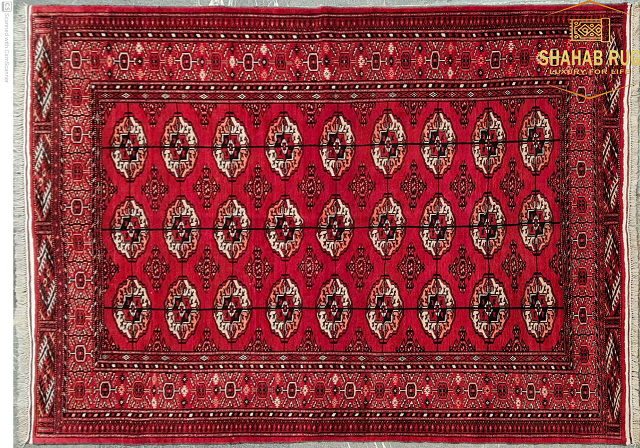
The process of creating a Mehraban carpet is a testament to this patience and skill. It begins with the selection of sturdy, locally sourced wool, known for its resilience. The wool is then spun by hand and dyed using traditional methods that produce rich, lasting colors. The weaving is done on a horizontal loom using the Turkish (Ghiordes) knot, which is exceptionally durable. This technique, combined with a medium to dense knot count, results in a carpet built to last for decades, growing more beautiful with age. This commitment to quality is central to the identity of a true Mehraban.
The design of a classic Mehraban carpet typically features a large, geometric central medallion on a rich, reddish-terracotta field. This primary motif is often surrounded by complementary elements and guarded by a detailed, geometric border. The color scheme is warm and earthy, dominated by deep reds, rusty oranges, ivories, navy blues, and browns. These colors are not just aesthetically pleasing; they tell a story of the land, derived from the very soil and flora of the Azerbaijan region. This distinct palette makes the Mehraban instantly recognizable.
Considering a specific size, such as a 2.1 x 3 meter carpet, highlights its perfect functionality. This dimension is ideal for anchoring a living room seating area, fitting comfortably beneath a coffee table and sofas. It is also a versatile size for dining rooms, hallways, or large bedrooms. The substantial surface of a Mehraban in this size allows its powerful geometric design and beautiful coloration to become a true focal point in any interior design scheme, be it modern or traditional.
Integrating a Mehraban into your home is to invite a piece of living history into your space. Its robust nature makes it suitable for high-traffic areas, while its artistic value elevates the aesthetic of any room. More than just a decorative object, it is a conversation piece, a testament to human ingenuity and artistic expression. Each Mehraban carpet carries the soul of its weaver and the centuries-old culture of the Azari people, making it a timeless investment.
In conclusion, the Mehraban carpet is far more than a simple floor covering. It is a vibrant embodiment of Iranian art, a symbol of Azari cultural identity, and a masterpiece of craftsmanship from the historic city of Heriz. Its durability, coupled with its bold and beautiful design, ensures that it remains a cherished item across the globe. To choose a Mehraban is to appreciate a legacy woven in wool and dyed with tradition, a lasting heirloom that celebrates the enduring spirit of Persian artistic heritage.
The Qashqai carpet is one of Iran’s most treasured artistic legacies. Woven by the nomadic tribes of Fars Province, these carpets are celebrated for their bold designs and exceptional craftsmanship. The Qashqai people have preserved this tradition for centuries, creating rugs that are both functional and deeply symbolic. Measuring 2.3 x 3.2 meters, a Qashqai carpet is a statement piece, blending tribal heritage with Persian elegance.

Every carpet tells a story. The geometric patterns, floral motifs, and vibrant colors reflect the tribe’s nomadic lifestyle. The Qashqai women, the primary weavers, use hand-spun wool and natural dyes to create these masterpieces. The process is meticulous, often taking months to complete a single rug.
Shiraz, the heart of Fars Province, is a city of poets, gardens, and art. Known for its historic bazaars, Shiraz has long been a trading center for Persian rugs, including carpets. The city’s influence can be seen in the intricate designs and rich color palettes of these rugs.
Fars Province is where ancient Persia flourished. Home to Persepolis and Pasargadae, this region is a living museum of Iran’s imperial past. The Qashqai tribes, with their deep connection to the land, contribute to this cultural tapestry. Their carpets often feature motifs inspired by Fars’ landscapes—mountains, rivers, and wildlife.
The Qashqai are a resilient nomadic tribe, migrating seasonally across southern Iran. Their lifestyle is reflected in their carpets, which are designed for both beauty and practicality. The Qashqai use their rugs as tents, blankets, and even saddlebags, showcasing their versatility.
Among Persian rugs, the Qashqai carpet stands out for its tribal authenticity. Unlike urban workshop rugs, weavings are spontaneous and freeform, with asymmetrical designs that make each piece unique. The 2.3 x 3.2-meter size is particularly popular, fitting perfectly in modern living spaces.
Iran has long been a center of art and craftsmanship. From calligraphy to tilework, Iranian artisans excel in intricate detail. The carpet is a prime example, demonstrating the country’s mastery of textile arts. These rugs are not just decorative—they are cultural artifacts.
Creating a rug is a labor of love. The wool is sheared, washed, and hand-spun before dyeing with natural ingredients like pomegranate skins and indigo. The weaving is done on portable looms, allowing the Qashqai to continue their craft even while traveling.
Every motif in a carpet has meaning. Stars represent celestial guidance, while diamond shapes symbolize protection. Animals, such as goats and birds, reflect the tribe’s pastoral life. These symbols make each rug a visual narrative of Qashqai culture.
A rug is more than a floor covering—it’s an heirloom. The 2.3 x 3.2-meter size is versatile, fitting both large and compact spaces. The high-quality wool ensures durability, while the natural dyes retain their brilliance for decades.
Collectors worldwide seek carpets for their authenticity and artistry. Unlike mass-produced rugs, each piece is one-of-a-kind. The tribal aesthetic complements both traditional and contemporary interiors.
Modernization threatens many traditional crafts, but the mentioned rug continue to weave with pride. By supporting their work, we help sustain an ancient art form. Each purchase ensures that weaving remains alive for future generations.
While some mentioned rugs have settled in villages, many still follow the nomadic lifestyle. Their carpets adapt to changing tastes while retaining traditional techniques. The 2.3 x 3.2-meter rug remains a favorite for its balance of size and artistry.
The carpet is a testament to Iran’s rich cultural heritage. From the nomadic tribes of Fars to the markets of Shiraz, these rugs embody Persian artistry. Owning a carpet means owning a piece of history—woven with skill, passion, and centuries of tradition.
The Timeless Beauty of the Antique Runner
Bijar rugs are among the most treasured Persian rugs, known for their durability and intricate designs. The Bijar runner, measuring 1.2 by 1.8 meters, is a stunning example of Iran’s rich weaving heritage. Often called the “Iron Rug of Persia,” these rugs are celebrated for their dense knots and vibrant colors.

The City of Bijar and Its Craftsmanship
A small city in Iran’s Kurdistan Province, has been a center of rug weaving for centuries. The city’s harsh climate influenced the tight weaving technique, making Bijar rugs exceptionally sturdy. Kurdish weavers in Bijar use high-quality wool and natural dyes, ensuring each piece lasts generations.
Kurdistan Province: A Cultural Hub
Kurdistan Province, where Bijar is located, is home to a vibrant Kurdish culture. The region’s history, traditions, and artistry are deeply woven into its textiles. Kurdish weavers often incorporate tribal motifs, reflecting their nomadic heritage. The Bijar runner, with its geometric patterns, is a testament to this cultural legacy.
Persian Rugs: A Symbol of Iranian Artistry
Persian rugs are globally admired for their craftsmanship. Iran’s rug-weaving tradition dates back over 2,500 years, blending artistry and functionality. The Bijar runner exemplifies this tradition, showcasing intricate floral and medallion designs. Each knot tells a story of patience and skill.
Kurdish Culture and Its Influence on Weaving
Kurdish culture is rich in music, dance, and textile art. Weaving is a communal activity, often passed down through generations. This runner reflects Kurdish identity, with bold colors and symbolic patterns. These rugs are not just decor but cultural artifacts.
Iran’s Artistic Heritage
Iranian art spans calligraphy, miniature painting, and carpet weaving. The runner is a prime example of this artistic excellence. Persian rugs often feature garden-inspired designs, symbolizing paradise. The precision in each rug highlights Iran’s dedication to craftsmanship.
Why Choose an Antique Runner?
The antique runner, sized 1.2 x 1.8 meters, is perfect for hallways and entryways. Its durability ensures it withstands heavy foot traffic while maintaining its beauty. The rich reds, blues, and ivories add warmth to any space. Owning a rug means owning a piece of Persian history.
Final Thoughts
Bijar rugs are more than floor coverings; they are cultural masterpieces. From the city of Bijar in Kurdistan to global markets, these rugs carry Iran’s artistic legacy. The Bijar runner, with its perfect dimensions and timeless design, is a worthy investment for any art lover.
Why This Runner Stands Out
To own a runner is to own Iran’s artistic soul. From Kurdistan Province’s loom to your home, this rug bridges past and present. Its 1.2 x 1.8-meter frame is a canvas of Kurdish resilience and Persian elegance.
The Timeless Beauty of Kashmar Rugs: A Masterpiece of Persian Craftsmanship
Kashmar is a name that resonates with elegance, tradition, and artistry. The Kashmar rug is a stunning representation of Persian rug-making heritage, known for its intricate designs and exceptional quality. These rugs are more than just floor coverings; they are woven stories of culture, history, and skilled craftsmanship.
A City of Art and History
Kashmar is a historic city located in the Khorasan Province of Iran. Known for its lush gardens, vineyards, and rich cultural heritage, Kashmar has long been a center of Persian art and craftsmanship. The city’s rug-weaving tradition dates back centuries, with each Kashmar rug reflecting the region’s unique aesthetic and dedication to perfection.

The Khorasan Province: A Land of Culture and Tradition
Khorasan, one of Iran’s most significant provinces, is a treasure trove of history and culture. It has been a crossroads of civilizations, influencing its art, architecture, and traditions. The people of Khorasan take immense pride in their heritage, and this is vividly reflected in their handicrafts, especially Persian rugs.
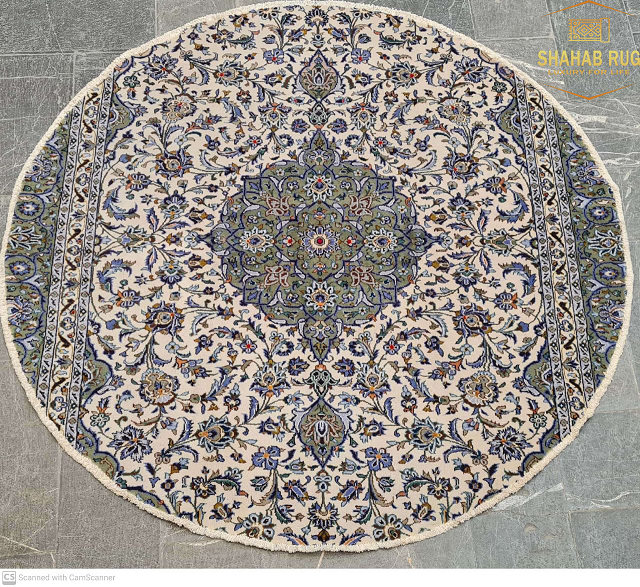
Khorasan’s Cultural Richness
Khorasan’s culture is a blend of Persian traditions, Islamic influences, and local customs. Poetry, music, and handwoven textiles play a vital role in daily life. The Kashmar rug, with its detailed patterns and vibrant colors, is a testament to this cultural richness. Each knot and weave tells a story of patience, skill, and artistic vision.
Iran: A Nation of Art and Craftsmanship
Iran, formerly known as Persia, is celebrated worldwide for its contributions to art and craftsmanship. From miniature paintings to calligraphy and metalwork, Iranian artisans have mastered various disciplines. Among these, Persian rugs stand out as one of the most iconic symbols of Iran’s artistic legacy.
The Art of Persian Rug Weaving
Persian rugs are renowned for their beauty, durability, and intricate designs. The Kashmar rug, with its 1.5 * 1.5 dimensions, is a perfect example of this artistry. Made from high-quality wool or silk, these rugs feature elaborate floral motifs, geometric patterns, and rich color palettes. Each piece is handwoven, often taking months or even years to complete.
Kashmar Rugs: A Symbol of Elegance
The Kashmar rug is not just a decorative item; it is a work of art. Its symmetrical designs and fine craftsmanship make it a prized possession for collectors and homeowners alike. Whether placed in a living room or a study, a Kashmar rug adds warmth, sophistication, and a touch of Persian heritage to any space.
Iranian Culture and Its Influence on Rug Design
Iranian culture deeply influences the designs of Kashmar rugs. From ancient Zoroastrian symbols to Islamic geometric patterns, these rugs are a visual representation of Iran’s diverse history. The use of natural dyes, passed down through generations, ensures that each rug maintains its vibrant hues for decades.
Why Choose a Kashmar Rug?
This rug is an investment in beauty and tradition. Its 1.5 * 1.5 size makes it versatile, fitting perfectly in various settings. Beyond its aesthetic appeal, owning a Kashmar rug means preserving a piece of Persian heritage. Each rug is a testament to the weaver’s dedication and the timeless allure of Iranian craftsmanship.
Conclusion: The Legacy of Kashmar Rugs
The rugs are more than just textiles; they are cultural artifacts that embody the spirit of Iran. From the historic city to the broader Khorasan Province, these rugs carry the legacy of Persian artistry. Whether you are an art enthusiast or a lover of fine decor, this rug is a masterpiece worth cherishing.
By choosing a this rug, you bring home a piece of Iran’s rich artistic tradition—a timeless treasure that will be admired for generations.
Nain is a name synonymous with elegance, precision, and artistry in the world of Persian rugs. Located in the heart of Iran’s Isfahan Province, Nain is a small but historically significant city renowned for its exquisite rug-making traditions. The Nain rug, often considered one of the finest Persian rugs, reflects the rich cultural heritage of Iran and the unmatched skill of its artisans.

A Nain rug, particularly in the dimension of 2 × 3 meters, is a perfect blend of sophistication and functionality. These rugs are celebrated for their high knot density, intricate designs, and luxurious materials. Made from soft wool and silk, Nain rugs often feature delicate floral patterns, medallions, and arabesques, all woven with remarkable precision. The craftsmanship behind each Nain rug is a testament to Iran’s centuries-old tradition of textile artistry.
The city of Nain, though modest in size, holds a prestigious place in Iran’s rug-weaving history. Situated in Isfahan Province, Nain benefits from the region’s artistic influences, particularly those of nearby Isfahan, a hub of Persian culture. The artisans have perfected their techniques over generations, ensuring that each rug meets the highest standards of quality. The city’s dry climate and access to high-quality wool contribute to the durability and beauty of the rugs.
Isfahan Province, where Nain is located, is often referred to as “Half of the World” due to its breathtaking architecture and cultural significance. The province is home to iconic landmarks such as Naqsh-e Jahan Square, the Imam Mosque, and the stunning bridges over the Zayandeh River. Isfahan’s rich history as a center of art, science, and trade has deeply influenced the craftsmanship of rugs, infusing them with timeless elegance.
Isfahan’s culture is a vibrant blend of Persian traditions, poetry, music, and visual arts. The city has long been a melting pot of creativity, attracting artists, calligraphers, and craftsmen from across Iran. This cultural richness is reflected in the intricate designs of the rugs, which often incorporate motifs inspired by Isfahan’s architecture and nature. The harmony of colors and patterns in these rugs mirrors the artistic spirit of Isfahan.
Iran, with its millennia-old civilization, is a land of profound cultural heritage. From poetry to pottery, Iranian artistry is celebrated worldwide. Persian rugs, including those from Nain, are among the country’s most treasured exports. Iranian culture places great value on beauty, precision, and symbolism, all of which are evident in the craftsmanship of Nain rugs. Each rug tells a story, weaving together history, tradition, and artistic expression.
Iranian artisans are masters of their craft, excelling in calligraphy, miniature painting, metalwork, and, of course, rug weaving. The rug is a prime example of this expertise, showcasing meticulous attention to detail and an unwavering commitment to quality. The weaving process is labor-intensive, often taking months or even years to complete a single rug. This dedication ensures that every rug is not just a floor covering but a work of art.
A Nain rug measuring 2 × 3 meters is an ideal choice for both small and medium-sized spaces. Its compact yet elegant design allows it to enhance any room, whether placed in a living area, bedroom, or office. The fine weaving and luxurious texture of a rug add warmth and sophistication to interiors, making it a favorite among collectors and decorators alike.
The Nain rug is more than just a Persian rug—it is a masterpiece of Iranian artistry. From the historic city of Nain to the cultural heart of Isfahan Province, every thread in these rugs carries the legacy of Iran’s rich heritage. Whether admired for its craftsmanship, design, or cultural significance, a Isfahan rug is a timeless treasure that embodies the beauty of Persian tradition.
By choosing a this rug, you bring a piece of Iran’s artistic soul into your home, celebrating a tradition that has been perfected over centuries.
In today’s interconnected global economy, both B2B (Business-to-Business) and B2C (Business-to-Consumer) trade play crucial roles in driving commerce. While B2B transactions form the backbone of supply chains and bulk trade, B2C platforms cater directly to end consumers, ensuring accessibility and convenience. Together, they create a seamless trade ecosystem that benefits businesses and individuals alike.
Two standout platforms facilitating this dynamic exchange are IR2World.com and Iran2Africa.com. These websites serve as vital bridges in international trade, connecting suppliers, manufacturers, and buyers across continents—particularly between Iran and Africa. Let’s explore how these platforms enhance global trade and why they are essential for modern businesses.

B2B trade is the foundation of large-scale transactions, enabling manufacturers, wholesalers, and distributors to operate efficiently. It supports bulk purchasing, long-term contracts, and streamlined logistics—key components for industries ranging from agriculture to electronics. Without robust B2B networks, supply chains would falter, disrupting global markets.
On the other hand, B2C business empowers individual buyers, offering convenience and competitive pricing. E-commerce platforms have revolutionized B2C by allowing consumers to shop from anywhere, anytime. This direct-to-customer approach enhances satisfaction and fosters brand loyalty.
Combining B2B and B2C models ensures that business remains fluid, scalable, and adaptable to market demands.
IR2World.com is a comprehensive platform catering to both B2B and B2C business, specializing in high-demand products such as:
✅ Global Reach: Businesses and consumers from any country can place orders.
✅ Secure Transactions: Reliable payment gateways ensure safe business.
✅ Competitive Pricing: Bulk discounts for B2B buyers and retail options for B2C shoppers.
✅ Efficient Logistics: Fast shipping to Africa, the Middle East, and beyond.
By entering IR2World.com, customers can effortlessly engage in business, whether they are sourcing raw materials for factories or purchasing gadgets for personal use.
Iran2Africa.com is a specialized B2B platform designed to enhance business between Iranian suppliers and African businesses. Key offerings include:
🌍 Targeted Market Access: Direct connections between Iranian manufacturers and African importers.
📦 Customized Solutions: Tailored product sourcing for African market demands.
🚢 Streamlined Export Process: Hassle-free documentation and shipping.
This platform is a game-changer for African businesses looking to source high-quality Iranian products at competitive business rates.

One of the biggest advantages of IR2World.com and Iran2Africa.com is their accessibility. Customers worldwide—particularly in Africa—can:
Browse extensive product catalogs
Compare prices and specifications
Place orders 24/7 with a few clicks*
With secure payment methods and multilingual support, these platforms make cross-border business smoother than ever.
The word “trade” is central to global prosperity. Whether through B2B bulk deals or B2C retail sales, business fuels economies, creates jobs, and fosters innovation. Platforms like IR2World and Iran2Africa exemplify how digital business can break geographical barriers, enabling businesses and consumers to thrive.
By leveraging these websites, you position yourself at the forefront of international business, accessing high-demand products with unparalleled ease.
In a world where business defines success, having reliable B2B and B2C platforms is non-negotiable. IR2World.com and Iran2Africa.com stand out as leaders in facilitating seamless transactions, particularly for African markets. Whether you’re a business looking for bulk suppliers or a consumer seeking quality goods, these websites ensure that global business is just a click away.
Start exploring today and experience the future of business!
The vibrant cultural heart of Kurdistan Province, is renowned for its exquisite kilims. Among these, the Kilim (A kilim is a flat tapestry–woven carpet or rug traditionally produced in countries of the former Persian Empire, including Iran and Turkey, but also in the Balkans and the Turkic countries. Kilims can be purely decorative or can function as prayer rugs. Modern kilims are popular floor coverings in Western households ) .stands out as a symbol of heritage and artistry. With dimensions of 2.28 * 1.48 meters, this kilim is not just a floor covering but a woven narrative of Kurdish tradition.
The capital of Kurdistan Province, is a city where history and culture intertwine. Known for its rich musical heritage, poetic traditions, and skilled artisans, Sanandaj has long been a center of Persian craftsmanship. The city’s kilims, especially the Sanandaj Kilim, reflect its deep artistic roots.
Kurdistan Province, located in western Iran, is a region of breathtaking landscapes and cultural richness. The Kurdish people, with their distinct language and traditions, have preserved their identity through art. The Persian kilim, particularly those from Sanandaj, showcases their exceptional weaving skills.
Kilims are more than decorative items in Kurdish culture—they are storytellers. Each pattern and color in a mentioned Kilim carries meaning, often symbolizing nature, tribal history, or spiritual beliefs. The intricate designs reflect the weaver’s creativity and the region’s natural beauty.
Iran has a millennia-old tradition of arts and crafts, from pottery to calligraphy. Persian kilims, including those from Sanandaj, are celebrated worldwide for their quality and beauty. Iranian craftsmanship blends functionality with artistry, making each piece unique.
Creating a Kilim requires precision and patience. Artisans use high-quality wool or cotton, dyed with natural pigments. The weaving process, done on traditional looms, can take months. The result is a durable, vibrant kilim that lasts generations.
The 2.28 * 1.48-meter size of this Kilim makes it versatile. It can adorn living rooms, hallways, or even serve as a wall hanging. Its sturdy construction ensures it withstands daily use while maintaining its beauty.
Kurdish culture is rich in music, dance, and oral traditions. The Sanandaj Kilim embodies this heritage, with motifs inspired by Kurdish folklore. Whether used in homes or ceremonies, these kilims are a proud cultural emblem.
Iranian kilims, especially from Sanandaj, are highly sought after worldwide. Collectors appreciate their authenticity, while interior designers love their timeless appeal. The Sanandaj Kilim represents Iran’s enduring artistic legacy.
A Sanandaj Kilim is more than a purchase—it’s an investment in art. Its unique patterns, cultural significance, and craftsmanship make it a treasure. Whether for decoration or collection, it brings a piece of Kurdish heritage into any space.
The Sanandaj Kilim is a testament to the skill and creativity of Kurdish weavers. From the historic city of Sanandaj to global markets, it carries the spirit of Iran’s artistic traditions. With its 2.28 * 1.48-meter dimensions and rich symbolism, it is a masterpiece of Persian craftsmanship.
Quchan, a historic city in northeastern Iran, is celebrated for its breathtaking Persian kilims. Nestled in the heart of Khorasan Province, Quchan has been a cultural and artistic hub for centuries. The Quchan Kilim, with its vibrant colors and intricate geometric patterns, is a testament to the skill of its weavers. These textiles are more than just floor coverings—they are woven narratives of Persian heritage.
Quchan is one of the most important centers of Persian kilim production. The city’s artisans employ traditional techniques passed down through generations. Unlike mass-produced textiles, each Quchan Kilim is handmade, often taking months to complete. The wool used is locally sourced, dyed with natural pigments, and woven on wooden looms. The result is a durable, visually stunning piece of art.
Khorasan, meaning “where the sun rises,” has been a melting pot of civilizations. It was once part of the Silk Road, absorbing influences from Central Asia, Persia, and beyond. Today, Khorasan Province remains a guardian of Iranian traditions, from poetry to handicrafts. The Quchan Kilim is one of its most iconic exports, embodying the region’s artistic soul.
The people of Khorasan take immense pride in their cultural heritage. Music, dance, and textile arts play a vital role in daily life. Persian kilims, especially those from Quchan, often feature symbolic motifs—birds representing freedom, flowers symbolizing life, and zigzag patterns depicting mountains. These designs are not random; they tell stories of nature, spirituality, and history.
Iran has long been a beacon of art and craftsmanship. From Persian carpets to miniature paintings, Iranian artisans have mastered various mediums over millennia. The Quchan Kilim is a prime example of this legacy. Unlike urban mass production, these kilims are typically woven by rural women, preserving a deeply personal touch.
Iranian craftsmanship is admired worldwide for its precision and beauty. Metalwork, ceramics, and textiles—particularly Persian kilims—have been traded across continents for centuries. The Quchan Kilim stands out for its bold colors and tribal influences, making it a favorite among collectors. Unlike factory-made imitations, an authentic Kilim carries the soul of its maker.
What makes the these Kilim so special? It’s the perfect blend of functionality and art. These kilims are sturdy enough for daily use yet exquisite enough to be displayed as art. The weaving techniques resist wear, while the natural dyes retain their brilliance for decades. Owning a Kilim means owning a piece of living history.
Sadly, modernization threatens traditional crafts like the Kilims. However, efforts are underway to support local artisans. Fair-trade cooperatives and cultural festivals help sustain this ancient craft. By valuing authentic Persian kilims, we ensure that Quchan’s legacy continues for future generations.
This Kilim is not merely a decorative item—it’s a cultural artifact. From the pastures of Khorasan to the looms of Quchan, every step in its creation reflects Iran’s rich heritage. Whether used in a modern home or a traditional setting, a Kilim brings warmth, history, and artistry into any space.
The Iranian Kilim so special. perfect blend of functionality and art.
These kilims are sturdy enough for daily use yet exquisite enough to be displayed as art. The weaving techniques resist wear, while the natural dyes retain their brilliance for decades. Owning a Kilim means owning a piece of living history.
Located within the sun-baked landscapes of southeastern Iran lies the city of Sirjan. This historic center, part of the vast Kerman Province, holds a revered place in the world of traditional Persian carpets. The name Sirjan resonates deeply with connoisseurs, signifying a unique and cherished strand within Iran’s magnificent carpet weaving tapestry. Understanding a Sirjan rug means journeying through the city, the province, and the rich cultural heart of Iran itself.
Sirjan city acts as the vibrant nucleus for this distinct craft. Located strategically along ancient trade routes, Sirjan has long been a crossroads of culture and commerce. Its semi-arid climate and surrounding plains, framed by distant mountains, provide the raw materials and inspire the motifs found in its famous weavings. The city’s identity is intrinsically linked to the rhythmic clack of looms and the skilled hands that bring wool and dye to life.
This craft flourishes within the context of Kerman Province, one of Iran’s most significant carpet-producing regions. Kerman boasts a long, illustrious history, evident in its ancient citadels, lush date palm groves (especially around Bam and Mahan), and bustling bazaars. The province’s diverse geography, from high mountains to vast deserts, has shaped a resilient and resourceful people. Kerman’s fame in carpet weaving is centuries old, producing some of the most intricate and sought-after Persian carpets globally.
Kerman culture is a fascinating blend of Persian traditions infused with distinct local flavors. Hospitality is paramount, deeply ingrained in the social fabric. Traditional music, often featuring the soulful strains of the “Tar” and “Setar,” accompanies celebrations and daily life. Poetry, particularly the works of Hafez and Rumi, holds a sacred place. Local crafts extend beyond carpets to include intricate copperwork, delicate “Pateh” embroidery (a specialty of Sirjan and surrounding villages), and exquisite wood inlay. These artistic expressions are pillars of Kerman’s cultural identity.
Zooming out, Iran presents a civilization stretching back millennia, a cradle of art, science, and profound philosophy. Iranian culture is characterized by deep poetic sensibility, elaborate courtesy rituals, and a powerful connection to family and history. Religion, primarily Shia Islam, profoundly influences social norms, calendar events, and artistic expression. This rich heritage provides the fertile ground from which all Iranian arts, including carpet weaving, spring forth.
Iranian art and craftsmanship represent a breathtaking continuum of skill passed down through generations. From miniature painting and calligraphy to tilework, metalwork, and architecture, Iranians have long excelled in transforming raw materials into objects of profound beauty and meaning. The Persian carpet stands as perhaps the most globally recognized symbol of this artistic mastery. It is far more than a floor covering; it is a woven narrative, a repository of history, belief, and aesthetic vision.
It is within this extraordinary context that the Sirjan rug finds its voice. While sharing the foundational techniques and symbolic language of Persian carpets, Sirjan weavings possess distinct characteristics. They are often known for their bold geometric patterns – diamonds, hexagons, and stylized animal or tree motifs – rendered with remarkable clarity. The color palette frequently features strong, vibrant contrasts: deep blues and reds interplay with ivory, touches of green, and warm yellows, often derived from natural dyes historically sourced locally. The weave is typically robust and durable, reflecting the practical needs of a nomadic and semi-nomadic past.
The motifs adorning a Sirjan rug are not merely decorative; they are a visual lexicon. Repeating geometric shapes might symbolize protection or eternity. Stylized trees represent life and connection to nature. Animal figures, often abstracted, could denote tribal affiliations or desired traits like strength. Every knot tied, every color chosen, carries centuries of accumulated meaning and tradition, making each Sirjan rug a unique cultural artifact.
In conclusion, the Sirjan rug is a vibrant thread woven into the magnificent fabric of Persian carpet artistry. It emerges from the specific environment and heritage of Sirjan city, resonates with the broader cultural spirit of Kerman Province, and ultimately embodies the timeless artistic genius of Iran. Owning or admiring a Sirjan rug is to connect with a profound legacy of craftsmanship, where the soul of a city, a province, and a nation is expressed through wool, dye, and the patient, skillful hands of its weavers. It is a testament to Iran’s enduring cultural wealth.
Antique rugs embody history, artistry, and cultural legacy. Each thread whispers tales of bygone eras. Collectors cherish these antique treasures for their unmatched craftsmanship. Among them, Persian carpets reign supreme. Their intricate designs transcend mere decor. They are heirlooms of human creativity. This antique tradition thrives in Iran’s heart.
Persian carpets symbolize Iran’s artistic soul. For centuries, weavers transformed wool and silk into masterpieces. Cities like Tabriz and Isfahan gained fame. Yet Arak, formerly called Sarouk, holds a unique legacy. Its rugs are antique icons of resilience.
Arak city, in Markazi Province, was once Sarouk. This name still echoes in rug galleries worldwide. Sarouk carpets are famed for dense floral patterns and rich reds. They epitomize antique elegance. Arak’s weavers blend geometry with nature. Their work reflects a deep, historical patience.
Arak Province is Iran’s geographical pivot. Mountains guard fertile plains where artistry blooms. Beyond carpets, it’s known for metalwork and ceramics. The climate fuels vibrant agriculture. Yet craftsmanship remains its heartbeat. Villages like Sarouk (now Arak) turned weaving into poetry. Each knot honors ancestral wisdom.
Arak’s culture is a fusion. Turkic, Persian, and Lor traditions intertwine. Local music, poetry, and rituals inspire rug motifs. Weavers embed symbols of love, faith, and nature. Antique Sarouk carpets often feature medallions or vines. These patterns mirror Arak’s communal spirit. Craft isn’t just labor—it’s storytelling.
Iran’s culture spans millennia. Poetry, architecture, and calligraphy reveal its soul. Persian carpets are mobile art galleries. They carry motifs from Shahnameh epics or Sufi verses. Iranian craftsmanship thrives on precision. Miniature paintings, tilework, and textiles share this DNA. Every rug is a testament to this heritage.
Iranian rug-making is sacred geometry. Natural dyes from pomegranate or indigo create timeless hues. Hand-knotting techniques vary by region. In Arak, the Turkish knot dominates, yielding durable, plush piles. pieces showcase fading techniques—a softness machines can’t replicate. This artistry demands years of mastery.
An Sarouk isn’t just decor. It’s a fragment of history. As investments, they appreciate. As art, they inspire. In Iranian homes, they signify sabr (patience) and ehteram (respect). Global collectors seek their soulful imperfections. Each antique piece bridges past and present.
In Arak’s workshops and beyond, this legacy lives. Persian carpets remain Iran’s gift to the world—a woven dream.
An antique Persian carpet, particularly a sought-after piece like a classic Sarouk from Arak, represents an investment in history and artistry. These rugs appreciate in value as they become rarer. More importantly, they carry the soul of the weaver and the cultural heartbeat of Iran within their fibers. They add warmth, sophistication, and a unique narrative layer to any space. Owning an antique is to become a steward of a living tradition, preserving a fragment of human creativity that transcends time and trends. The legacy of Sarouk, woven into the vibrant culture of modern Arak and Iran, continues to captivate the world.
Persian carpets are synonymous with Iran’s cultural soul. For over 2,500 years, skilled weavers have transformed wool, silk, and cotton into breathtaking masterpieces. Cities like Isfahan, Tabriz, and Kashan are legendary. Yet, the city of Arak, nestled in the heart of Iran, holds a distinct and vital place in this rich tapestry, particularly through its carpets woven under its former name.
The creation of a true Persian carpet is an act of devotion and immense skill. It demands extraordinary patience, precision, and an intimate knowledge passed from master to apprentice. Techniques vary regionally – the Turkish (Ghiordes) knot is common in Arak/Sarouk production, known for its durability
Located in Iran‘s vast Khorasan Province, the holy city of Mashhad holds profound spiritual significance. It is the site of the magnificent Imam Reza shrine, attracting millions of pilgrims annually. Beyond its religious importance, Mashhad is a cornerstone of Persian culture and a renowned center for exquisite craftsmanship. Among its most celebrated contributions to the world of art is the Mashhad rug. This specific type of Persian carpet carries the soul of the region in every knot.
Khorasan Province itself is immense and ancient, a land etched with history. It has been a crucial crossroads for trade and culture for millennia, fostering a unique and resilient spirit. Khorasani culture is deeply intertwined with Persian traditions yet possesses distinct local flavors – evident in its dialect, music, poetry, and, most tangibly, its world-famous carpets. Generations of skilled artisans here have perfected the art of weaving, passing down intricate techniques and patterns.
Iranian culture, stretching back thousands of years, places immense value on beauty, intricate detail, and profound symbolism. Art and craftsmanship are not mere professions; they are expressions of identity, spirituality, and history. Persian carpets, universally admired, stand as perhaps the most iconic manifestation of this rich artistic heritage. They transform functional objects into breathtaking canvases of wool and silk, telling stories through color and form.
The Mashhad rug exemplifies this national artistic genius. Woven primarily in and around the city of Mashhad, these carpets are distinguished by several key characteristics. They traditionally feature a deep, rich red madder dye, often as the dominant field color, symbolizing life and vibrancy. The designs are frequently grand and symmetrical, showcasing large central medallions surrounded by intricate floral motifs, intricate Shah Abbasi patterns (palmettes and lotus blossoms), and graceful vine scrolls. Borders are typically elaborate and well-defined.
Craftsmanship is paramount. Authentic Mashhad rug pieces boast a high knot density, usually employing the asymmetrical (Persian or Senneh) knot tied with exceptional precision. This results in a dense, durable pile and allows for incredibly detailed curvilinear designs. The wool used is often of high quality, locally sourced, and renowned for its lustrous sheen and resilience. Silk highlights are sometimes incorporated for added luxury and detail.
Owning a Mashhad rug is to possess a piece of Khorasan’s soul. The designs often reflect the grandeur of Persian gardens, the sacred geometry of Islamic art, and motifs passed down through generations of weavers, primarily women, working on large vertical looms. The process is slow and demanding, requiring immense skill, patience, and an innate understanding of color harmony and pattern balance. Each rug is a unique testament to the weaver’s artistry and the enduring cultural traditions of Mashhad.
The significance of the Mashhad rug extends beyond aesthetics. For centuries, these carpets have been vital economic assets for families and the region. They represent a tangible link to Iran’s glorious past and its ongoing cultural vitality. They are treasured heirlooms, prestigious gifts, and coveted investments worldwide, embodying the pinnacle of Persian carpet weaving from this specific, revered city.
In essence, the Mashhad rug is more than floor covering. It is a woven narrative of a holy city, a resilient province, and a nation with an unparalleled artistic legacy. It speaks of Khorasan’s spiritual heart, the meticulous skill of Iranian hands, and the timeless beauty that emerges when culture, tradition, and artistry intertwine on the loom. Each genuine Mashhad rug is a masterpiece, carrying the spirit of Persia from the heart of Khorasan into homes across the globe. Its deep reds, intricate patterns, and superb craftsmanship remain a powerful symbol of Iran’s enduring contribution to the world of decorative arts.
The Timeless Art of Tabriz Rugs: A Tapestry of Persian Heritage
Nestled in the heart of northwestern Iran, the city of Tabriz has long been celebrated as a cradle of craftsmanship, particularly for its exquisite Tabriz rug. These masterpieces, renowned for their intricate designs and unparalleled quality, are a cornerstone of Persian carpet weaving. As one of the oldest rug-producing regions in the world, Tabriz has gifted the world with textiles that transcend mere decoration, embodying centuries of artistic tradition and cultural pride.
Tabriz, the capital of East Azerbaijan Province of Iran, is a city where history whispers through its ancient bazaars and architectural wonders. Once a pivotal hub along the Silk Road, it thrived as a crossroads of trade and culture. Today, Tabriz remains a vibrant center for art, with its UNESCO-listed Historic Bazaar Complex serving as a bustling marketplace for Persian carpets. The city’s artisans have honed their skills over generations, blending motifs from nature, geometry, and classical Persian poetry into every thread of a Tabriz rug.
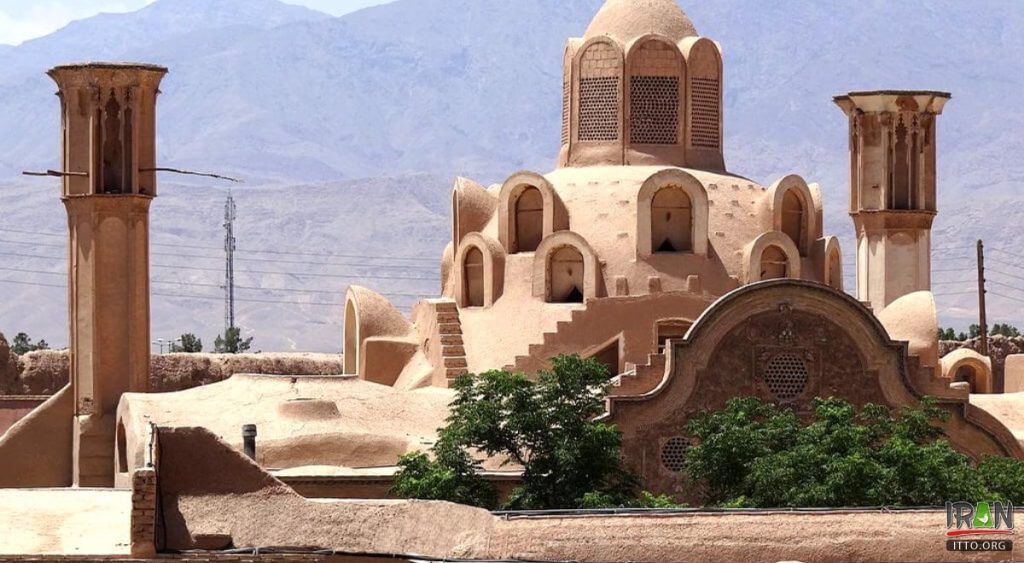
The cultural tapestry of Azerbaijan, the region encompassing Tabriz, is a rich blend of Turkic, Persian, and Caucasian traditions. This diversity is mirrored in Tabriz rugs, where floral patterns coexist with medallions and arabesques, reflecting the area’s historical interactions. Azerbaijani music, dance, and cuisine—marked by hearty dishes like ash-e doogh (yogurt soup) and kufteh Tabrizi (spiced meatballs)—echo the same harmony of influences seen in its textiles. The rug-weaving process itself is a communal endeavor, often involving families working together, preserving bonds as enduring as the rugs they create.
Persian carpets are more than floor coverings; they are emblems of Iranian identity. Among them, the Tabriz rug stands out for its precision and elegance. Typically woven with silk or high-quality wool, these rugs feature a high knot density, allowing for elaborate depictions of gardens, hunting scenes, or sacred symbols. Each piece tells a story, whether through the Herati pattern (a recurring floral motif) or the Shah Abbasi design, inspired by the Safavid dynasty’s golden age. For Iranians, these carpets symbolize beauty, patience, and a connection to their ancestral legacy.
Iranian art is a testament to the nation’s reverence for detail and symbolism. From miniature paintings to turquoise-inlaid pottery, creativity permeates daily life. rugs exemplify this ethos, demanding months—or even years—of meticulous labor. The dyeing process alone is an art form, using natural pigments from pomegranate skins, indigo, and walnut shells to achieve vibrant, lasting hues. Such dedication reflects a broader Iranian worldview: that art is not merely made but lived, intertwining spirituality and craftsmanship.
Iranian culture is a mosaic shaped by Zoroastrian philosophy, Islamic spirituality, and the country’s diverse ethnic tapestry. Nowruz (Persian New Year), celebrated with haft-sin tables and spring festivities, underscores themes of renewal deeply woven into rug designs. Similarly, Persian poetry, from Rumi to Hafez, inspires the lyrical flow of patterns in these textiles. The rug’s central medallion, often seen in Tabriz pieces, mirrors the Iranian love for symmetry and balance—principles that guide everything from architecture to social etiquette.
While globalization poses challenges to traditional crafts, Tabriz rug weavers continue adapting without compromising authenticity. Artisans now incorporate contemporary color palettes or smaller formats to suit modern interiors, yet the essence remains unchanged. Organizations in Iran and abroad actively promote Persian carpets as cultural ambassadors, ensuring techniques survive for future generations. In Tabriz, workshops still echo with the rhythmic clatter of looms, a sound as timeless as the city itself.
The Tabriz rug is more than a decorative object; it is a portal into Iran’s soul. From the bustling bazaars of Tabriz to the quiet homes where families gather around these heirlooms, each rug carries the heartbeat of Azerbaijani culture and Persian artistry. As symbols of endurance and creativity, they remind us that beauty is often born from patience—a thread connecting past, present, and future. In a world of fleeting trends, the Tabriz rug stands firm, a testament to Iran’s unwavering dedication to art, heritage, and the stories woven into every knot.
SultanAbad Rugs: A Timeless Thread in Iran’s Cultural Tapestry
In the heart of Iran’s Markazi Province lies the city of Arak, once known as SultanAbad—a name forever etched into the legacy of Persian carpets. Renowned for their intricate designs and masterful craftsmanship, SultanAbad rugs are more than decorative pieces; they are cultural artifacts that embody Iran’s artistic soul. For centuries, these carpets have woven together history, tradition, and identity, earning SultanAbad a place among the most revered hubs of Persian carpet production. Today, the city’s dual identity—as SultanAbad of the past and Arak of the present—reflects Iran’s ability to honor its heritage while embracing modernity.
The name SultanAbad dates to the early 19th century, when the city flourished as a commercial and artistic center under the Qajar dynasty. Renamed Arak in the 1930s, the city retained its reputation for producing exceptional Persian carpets. SultanAbad rugs, characterized by bold geometric patterns and rich earthy tones, became synonymous with quality, often exported to European markets. The transition from Sultan Abad to Arak marked a shift toward industrialization, yet the city’s carpet-weaving traditions endured, preserving techniques passed down through generations.
Arak’s culture is deeply intertwined with craftsmanship. Beyond carpets, the city is celebrated for metalwork, pottery, and poetry, but it is rug weaving that remains its crowning achievement. Families in Sultan Abad historically treated carpet production as a communal effort, with women and men collaborating on dyeing wool, sketching designs, and tying knots. This collective spirit is still evident in Arak’s workshops, where artisans use natural dyes from pomegranate, indigo, and walnut husks—a practice unchanged for centuries. The city’s annual carpet festivals, showcasing Sultan Abad rugs alongside modern creations, highlight its pride in this timeless craft.
Persian carpets are more than floor coverings; they are narratives of Iranian culture. Each Sultan Abad rug tells a story through symbols like the boteh (paisley), representing eternity, or the gol-e henna (floral motifs), symbolizing growth. These designs reflect Iran’s Zoroastrian roots and Islamic influences, blending spirituality with artistry. In Iranian homes, carpets are central to daily life—used in ceremonies, prayers, and as family heirlooms. Sultan Abad’s contributions to this tradition underscore its role in safeguarding Iran’s intangible cultural heritage.
Iran’s artistic legacy is a testament to patience and precision. From miniature paintings to turquoise mosaics, Iranian artisans excel in meticulous detail. Sultan Abad rugs exemplify this ethos: a single carpet can take months to complete, with weavers tying over 200 knots per square inch. The asymmetrical Persian knot, a technique perfected in Sultan Abad workshops, ensures durability and intricate patterning. This dedication to quality has made Persian carpets globally coveted, with Sultan Abad rugs standing as symbols of Iran’s unrivaled craftsmanship.
The legacy of Sultan Abad extends beyond carpets. The city’s artisans pioneered methods that influenced Iran’s broader artisanal landscape, from textile printing to ceramic glazing. Even after becoming Arak, the city remained a training ground for weavers, who blended Sultan Abad’s traditional motifs with contemporary tastes. For instance, 20th-century adaptations saw softer color palettes and larger medallions to suit Western markets, yet these rugs retained their Persian essence. This adaptability highlights Iran’s ability to evolve without erasing its past—a theme central to Iranian culture.
Iranian culture is a mosaic of ancient traditions and modern aspirations. Nowhere is this duality clearer than in Arak, where carpet weavers balance heritage with innovation. Young artisans experiment with abstract patterns, while elders preserve techniques like the herati (fish) motif, a Sultan Abad staple. Similarly, Iran’s architecture, literature, and music echo this harmony of old and new. Through Sultan Abad rugs, Iran shares its artistic philosophy: beauty lies in the marriage of discipline and creativity.
In modern Arak, Sultan Abad rugs remain cultural ambassadors. Museums worldwide display antique pieces, while contemporary weavers reinterpret classic designs for minimalist interiors. Collectors prize Sultan Abad carpets for their abrash—subtle color variations from natural dyes—which add authenticity and charm. As Iran navigates globalization, these rugs symbolize resilience, proving that tradition can thrive in a changing world.
The story of Sultan Abad rugs is the story of Iran itself—a tapestry of history, culture, and artistry. From their origins in Sultan Abad to their evolution in Arak, these carpets embody the patience, skill, and pride of Iranian craftsmen. More than artifacts, they are threads connecting past and present, ensuring that the legacy of Sultan Abad endures as a testament to Iran’s timeless creativity.
The Timeless Artistry of Sarouk Rugs: A Tapestry of Persian Heritage
Nestled in the fertile plains of west-central Iran, the village of Sarouk lies near the city of Arak in Markazi Province, a region celebrated for its centuries-old rug-weaving traditions. Sarouk’s name has become synonymous with some of the most exquisite Persian carpets, revered for their intricate designs, vibrant colors, and enduring quality. Though modest in size, this village has left an indelible mark on global textile art, blending rural craftsmanship with cultural influences from Kurdish, Turkish, and Armenian communities.
Arak: The Heart of Persian Rug Production
Arak, formerly known as Sultanabad, serves as the capital of Markazi Province and a cornerstone of Iran’s carpet industry. Founded in 1808 by Yusef Khan-e Gorji, a Georgian-born military leader under the Qajar dynasty, the city evolved from a strategic fortress into a hub of commerce and culture. By the late 19th century, Arak emerged as Iran’s primary center for carpet exports, fueled by its proximity to weaving villages like Sarouk and the establishment of European firms such as Ziegler & Co., which commercialized Persian rugs for Western markets. Today, Arak’s Amir Kabir Street hosts bustling rug markets where Sarouk pieces are traded alongside other regional styles, reflecting the city’s enduring artisan legacy.
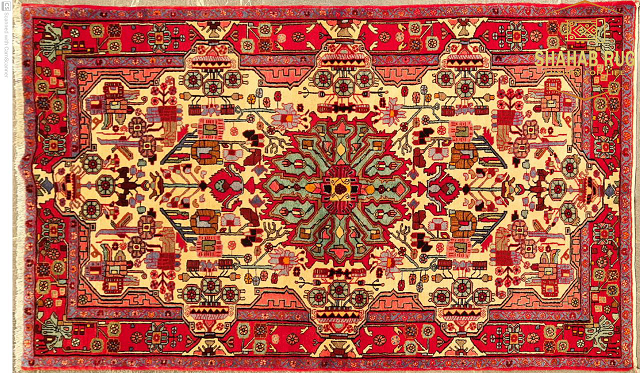
Cultural Synthesis in Sarouk Rugs
Sarouk rugs exemplify the fusion of Persian and Armenian weaving traditions. Armenian immigrants, settling in regions like Arak during the Safavid era, merged their geometric motifs and dyeing techniques with local Iranian styles, creating a distinctive “Iranian Armenian” aesthetic. These rugs often feature medallions, floral patterns, and symbolic motifs such as dragons, fish, and crosses, woven with asymmetrical knots on vertical looms. The use of plant-based dyes—extracted from madder roots, pomegranate peels, and walnut shells—imparts rich, enduring hues like blush red and indigo, hallmarks of Sarouk’s visual appeal.
Amir Kabir: Arak’s Illustrious Son
Arak’s cultural landscape is further enriched by its association with Mirza Taghi Khan Farahani, better known as Amir Kabir, the 19th-century reformist chief minister to Naser al-Din Shah Qajar. Born in the nearby village of Hazaveh, Amir Kabir’s legacy of modernization and administrative reforms echoes in Arak’s transformation from a military outpost to an industrial and artistic nexus. His vision indirectly supported the preservation of traditional crafts like rug weaving, ensuring their continuity amid Iran’s rapid modernization.
Craftsmanship and Global Resonance
Sarouk rugs are distinguished by their dense weave (40–50 knots per 6.5 cm) and plush wool pile, often layered over cotton foundations. While earlier designs leaned toward tribal simplicity, Western demand in the 20th century spurred larger formats and elaborate medallion patterns. This adaptability underscores the artisans’ skill, balancing tradition with innovation. Today, Sarouk rugs adorn homes worldwide, prized for their durability and timeless elegance—a testament to Iran’s enduring cultural influence.
Iran: A Legacy Woven in Thread
Iran’s identity is deeply interwoven with its carpet heritage, and Sarouk rugs epitomize this artistry. From the bazaars of Arak to global markets, these textiles embody a millennium of craftsmanship, reflecting Iran’s diverse ethnic tapestry and historical resilience. As symbols of beauty and cultural dialogue, Sarouk rugs continue to captivate collectors, ensuring that the village’s name—and Persia’s artistic soul—endures for generations.
Tradition in Transition
Modern weavers balance heritage with innovation. While some workshops still produce heirloom-quality rugs, others experiment with abstract designs or synthetic dyes for budget markets. Yet purists argue that true Sarouk rugs must adhere to traditional methods—a debate echoing Iran’s broader struggle to safeguard its crafts. Organizations like Iran’s National Carpet Center now certify authentic pieces, ensuring buyers receive genuine Sarouk artistry. For collectors, owning one is not just an investment but a connection to a living history.
Sanandaj: The Heartbeat of Persian Kurdish Rug Artistry
Nestled in the rugged mountains of northwestern Iran, Sanandaj—formerly known as Senneh—stands as a cultural beacon of Kurdish heritage and Persian craftsmanship. This city, the capital of Kurdistan Province, is celebrated not only for its breathtaking landscapes but also as the birthplace of Sanandaj rugs, a pinnacle of Persian carpet artistry. For centuries, Sanandaj has woven its history, culture, and identity into these textiles, creating masterpieces that transcend borders and time .
Founded in the 17th century, Sanandaj’s name derives from Senna (a historical settlement) and Daj (Persian for “fortress”), reflecting its strategic military past . Today, it is Iran’s second-largest Kurdish city, where Kurdish traditions thrive alongside Persian influences. The city’s Mediterranean climate—hot summers and snowy winters—shapes its rhythms, but its true pulse lies in its weaving workshops. Sanandaj’s artisans, predominantly Kurdish women, have preserved ancient techniques passed down through generations, transforming wool and silk into narratives of identity and resilience .
Kurdish culture permeates Sanandaj’s streets, from the Shafi’i Sunni Muslim practices to the melodic Kurdish dialects spoken by 86% of its population . This cultural tapestry is mirrored in its rugs, where geometric precision meets organic motifs, embodying the harmony between Kurdish tribal life and Persian artistic sophistication.
Sanandaj rugs are a testament to Persian carpet-making excellence. These rugs, often labeled Senneh in antique markets, emerged as trade staples in the 19th century and are revered for their semi-geometric designs and meticulous craftsmanship . Unlike other Persian rugs, Sanandaj pieces employ the Turkish symmetric knot despite the city lending its name to the Persian asymmetric knot—a paradox underscoring the region’s cultural intersections .
The Kurds, one of Iran’s largest ethnic groups, inhabit regions from Sanandaj to Khorasan, their diversity reflected in rug designs. Kurdish tribes, whether nomadic or sedentary, use rugs not just as decor but as functional art—for tents, saddlebags, and ceremonial items . Sanandaj’s weavers, often women, draw inspiration from their environment: mountain flora, tribal symbols, and ancient myths. The Mahi (Herati) pattern, for instance, symbolizes life and abundance, with fish motifs evoking the rivers of Kurdistan .
Iran’s Kurdish communities, though politically marginalized, have safeguarded their identity through textiles. Sanandaj rugs, with their Kurdish geometric rigor and Persian refinement, epitomize this cultural synthesis. They are not merely floor coverings but chronicles of resistance, adaptability, and pride.
From royal Safavid patronage to modern-day collector’s items, Sanandaj rugs have evolved while retaining their soul. Antique pieces from the mid-1800s, often dubbed the “golden age” of Senneh weaving, showcase unparalleled dye quality and intricate Gol-i-Bolbol (nightingale flower) patterns .
Today, these rugs bridge past and present, adorning global homes and museums alike.
In Sanandaj, weaving remains a communal act—a defiance against homogenization. As the city navigates modernity, its rugs stand as vibrant testaments to Kurdish ingenuity and Persia’s enduring artistic legacy. To own a Sanandaj rug is to hold a fragment of history, woven with the patience of centuries and the spirit of a people.
What stuff comes to your mind when you think of Persian Carpet ?
Big size carpet which can be lied down on the ground in Living room , dining room , bedroom , etc . ?? !
But have you ever thought that luxury long narrow Persian carpets can be applied in other locations like stairs ?
In hotels , Double X mansions , etc.
Just take a look at Hossein Abad rug which had been applied in one of customer’s house .
It conveys luxury and beauty of its nature.
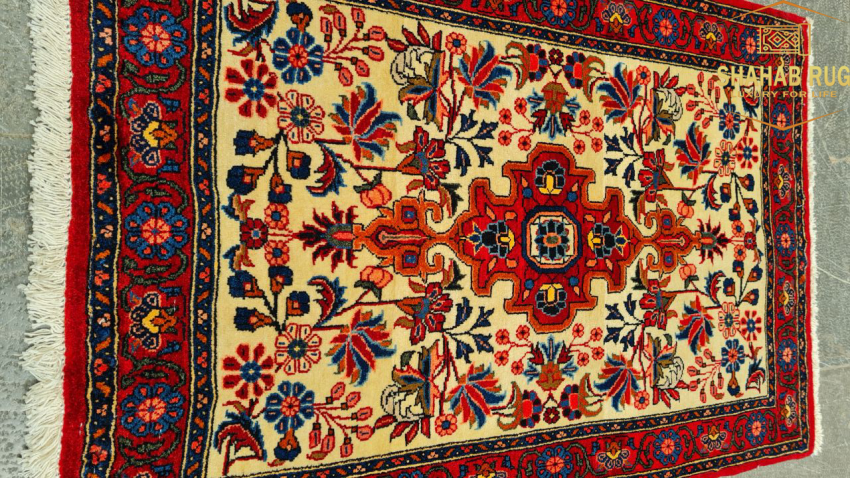
The Rich History and Legacy of Persian Carpets
Persian carpets have been woven by hand for over 2,500 years, making them one of the oldest and most respected forms of textile art in the world. The earliest Persian carpets were made by nomadic tribes, using wool from their own sheep and goats. Over time, carpet weaving became a specialized art form, with master weavers creating intricate designs for royalty and the wealthy.
During the Safavid Dynasty (1501-1736), Persian carpet weaving reached its pinnacle, with weavers using the finest silk, wool, and cotton to create some of the most beautiful and intricate carpets ever made. The dynasty’s rulers even established royal carpet workshops and schools to train the finest weavers.
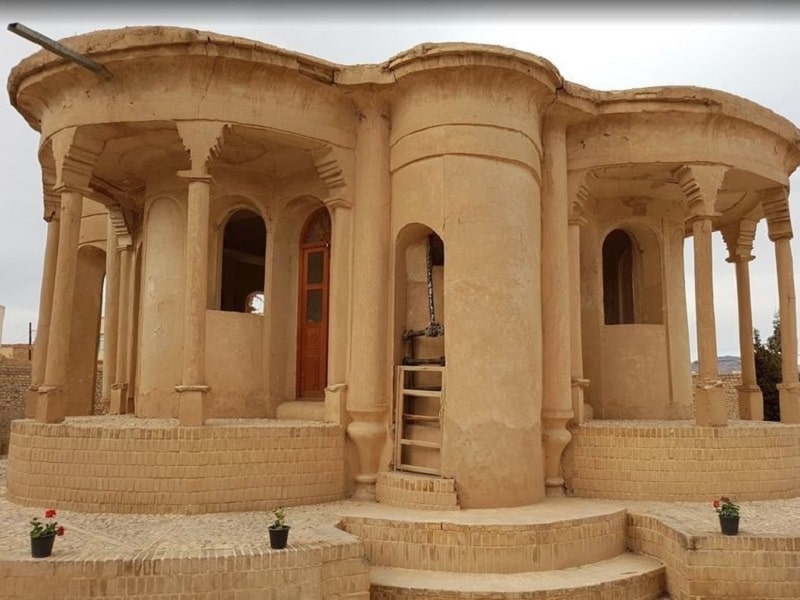
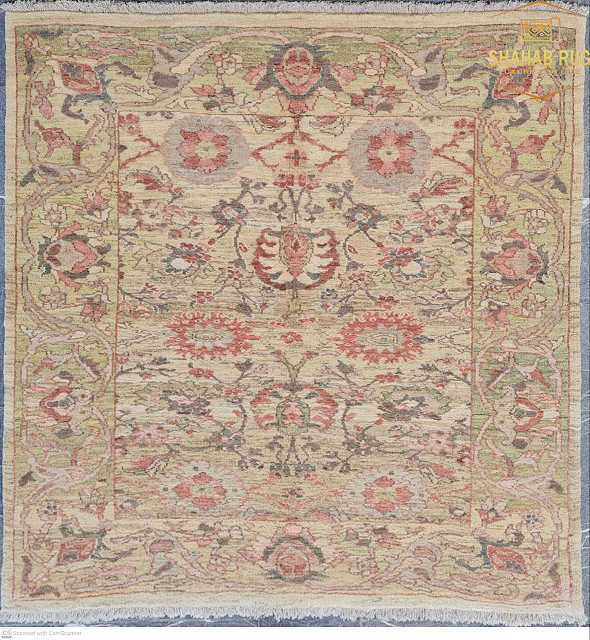
In the 19th and 20th centuries, Persian carpet weaving faced a period of decline. Western influence and the introduction of synthetic dyes led to a shift away from traditional natural materials and designs. However, in the mid-20th century, there was a resurgence of interest in traditional Persian carpets, especially among collectors and interior designers.
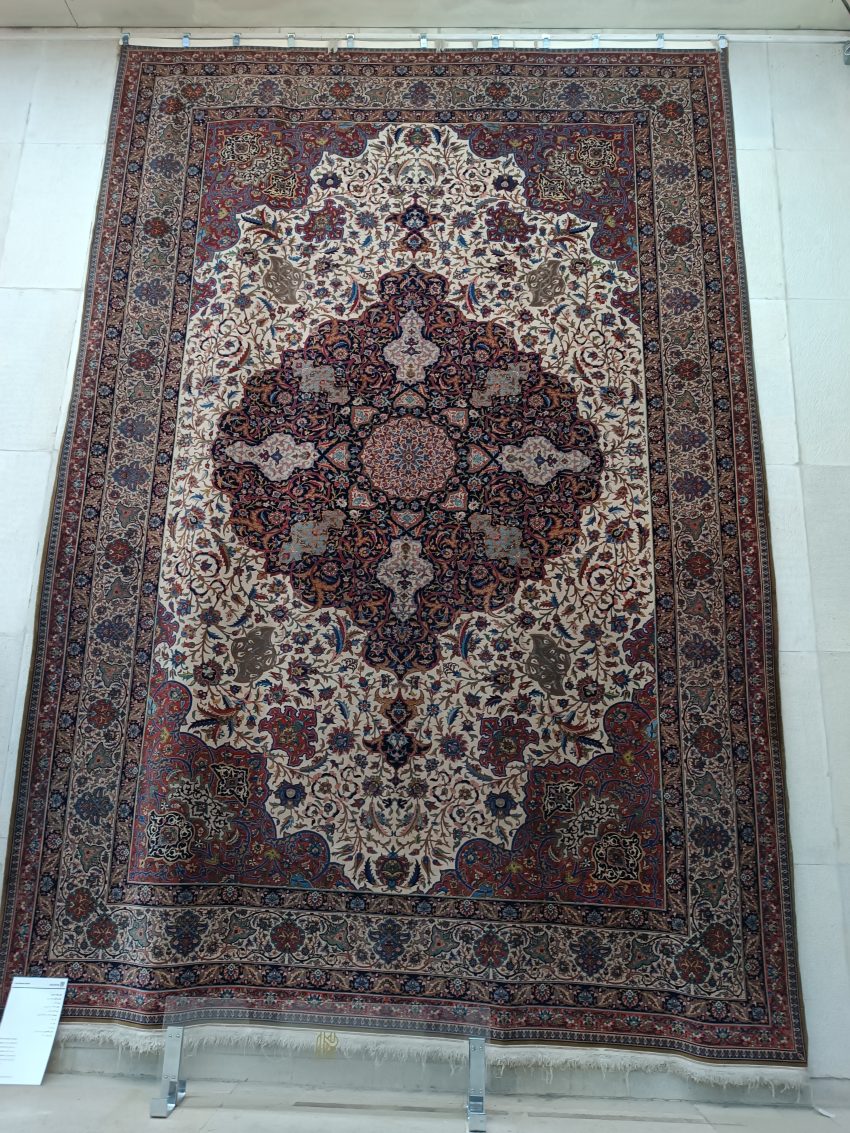
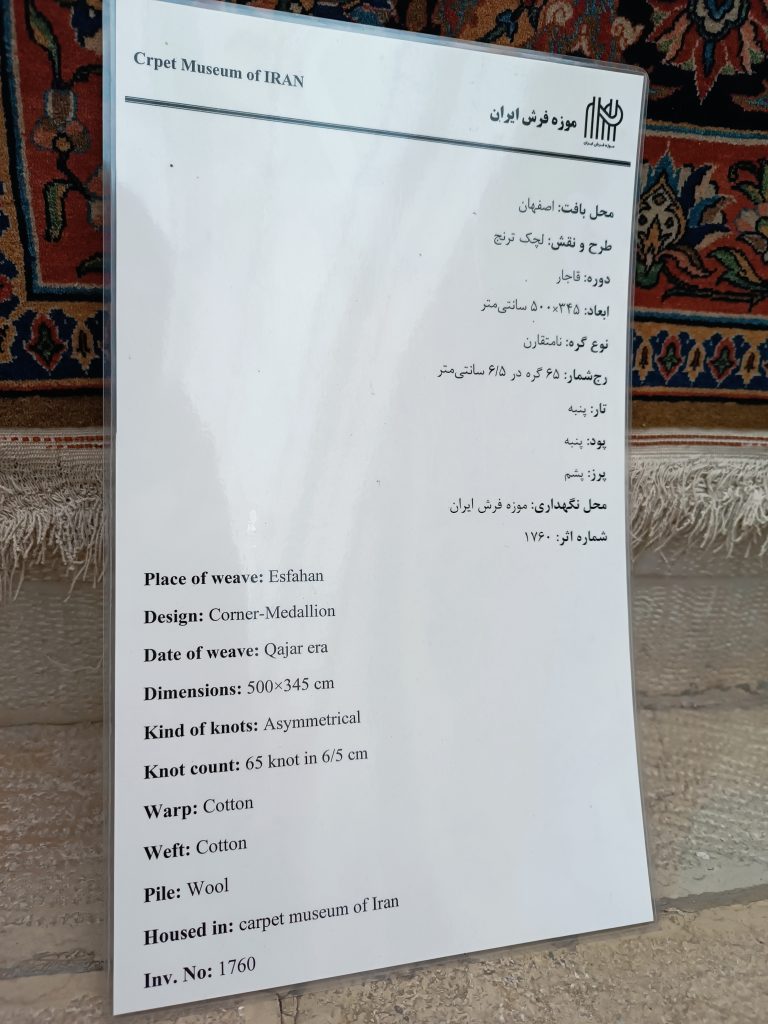
One of the main characteristics of Persian carpets is their use of natural materials, including wool, silk, and cotton. Weavers use a variety of techniques to create different patterns and designs, including knotting, pile weaving, and flat weaving. Each region in Iran has its own distinct style and techniques, from the floral motifs of Isfahan to the geometric designs of Qashqai.
Today, Persian carpets continue to be highly prized and sought after by collectors and interior designers alike. In recent years, there has been an increase in the popularity of antique and vintage Persian carpets, with collectors seeking out one-of-a-kind pieces that embody the rich history and artistry of these beautiful textiles.
In addition to antique carpets, many contemporary designers are creating new, hand-woven Persian carpets using traditional techniques and natural materials. These modern designs often incorporate bold colors and abstract patterns, while still keeping the artisanal quality and time-honored techniques of traditional Persian carpets.
Today, Persian carpets continue to inspire and delight people all over the world, bringing a touch of art and history to the homes and businesses of those lucky enough to own them.